Subscribe
Share
Share
Embed
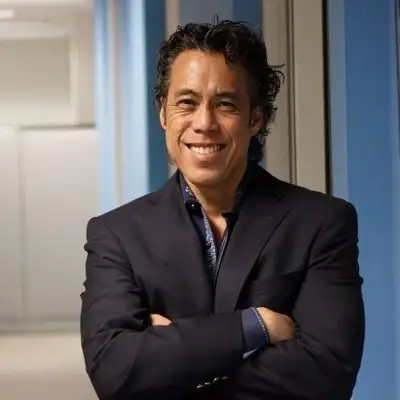
Your host, Sebastian Hassinger, interviews brilliant research scientists, software developers, engineers and others actively exploring the possibilities of our new quantum era. We will cover topics in quantum computing, networking and sensing, focusing on hardware, algorithms and general theory. The show aims for accessibility - Sebastian is not a physicist - and we'll try to provide context for the terminology and glimpses at the fascinating history of this new field as it evolves in real time.
Welcome back to the New Quantum Era, the podcast where I speak with the pioneers who are propelling the field of quantum information science and technology forward. I'm your host, Sebastian Hassinger. And I've got a really interesting conversation again for you in this episode. I had a great time talking to my guests. I spoke with Mark Lowe, cofounder and CEO of Quantum Brilliance, and Brian Wong, who's just joined as their independent board chair.
Sebastian Hassinger:And so Quantum Brilliance is another hardware vendor, one of the the many who've been popping up over the number of years. But, the interesting thing about them is they're actually the first hardware vendor I've spoken to who are pursuing the modality of, diamond nitrogen vacancy cubits. So quite a different modality than the superconducting and neutral atom and trapped ion modalities we've spoken to and even different from, spin cubits, like c 12 or Dirac, we've had conversations with or the photonic, cubits as well. So you'll learn a bit about how these types of cubits work, what these devices are, their applications in computing and in sensing. And also Brian, like myself, is not from the physics world.
Sebastian Hassinger:He's much more of a veteran emerging technology sort of entrepreneur, more on the technical side, but he has a lot of business experience. He's raised a ton of capital for a number of different startups over his career. And so it was really interesting. Think one of the key key challenges for quantum computing in general is bridging the gap between the curiosity driven science research from which all of these incredible findings are have emerged and and still remains a critical, component of the overall development of the space. But bridging that science world with the engineering and technology and business acumen it takes to bring products to market, and find the market opportunity that matches with the capabilities of the technology you've developed.
Sebastian Hassinger:So that's incredibly challenging. It's still obviously in the early days, the technologies we have today are still experimental. But the sooner we start wrapping our heads around what those business challenges are going to be, those go to market challenges, those product market fit challenges, the ease of use, the scalability, the supply chain, the lower the risks are going to be as the technology matures. I think Brian spoke to that point, very, very interestingly and effectively. So let's get right to the conversation.
Sebastian Hassinger:I hope you enjoy the episode and, you learn as much as I did about this modality of diamond based qubits. Excellent. Thank you very much for joining, Brian and Mark. I really appreciate your time. I'm really excited about the conversation today because I've covered a lot of different modalities of qubits, but nothing to do with nitrogen vacancy qubits.
Sebastian Hassinger:Quantum Brilliance, of course, a pioneer in that space. Mark, you're a cofounder of the company. Can you start by sort of walking us through what is a nitrogen vacancy, and how does it how does it create the conditions for being a qubit?
Mark Luo:Absolutely. So nitrogen vacancy used as a quantum defect for quantum technology, has been around for twenty plus years. Essentially, how it operates is the spin uses a nitrogen atom in the vacant space next to it, which in itself creates a spin. And the benefit of using synthetic diamond for these NV centers as your quantum bits is that you it can operate under not only under room temperature, but a lot of the complex control electronics or cryogenics, complex lasers, and vacuum chambers are not necessary because it inherently is a very stable qubit. And the reason for its stability is diamond is a very rigid material, So the thermal energy to cause decoherence has to be quite high.
Mark Luo:So consequently, that's why a lot of that complexity can be removed. And in addition to that, the other benefit is you can really achieve miniaturization where you can actually bring a quantum system down to various four size. So for example, Bosch developed a diamond quantum sensor that is the size of a credit card. Our quantum computer that we deployed to Oak Ridge National Lab is a 19" track that is, you know, 6U tall operating at 300 watts. So you end up with a quantum device that is room temperature, in size, weight, and power, and easy to integrate in all types of complex environments.
Sebastian Hassinger:That's amazing. And so diamond is it's a as you said, it's a very rigid grid of carbon atoms. Right? So is one of those carbon atoms is literally missing out of the out of the the matrix and is replaced with a a nitrogen atom. Is that right?
Mark Luo:Yeah. So the way it works is, basically, you've got carbon atoms, and right next to it is replaced with a nitrogen. Then there's an empty space next to it, and that gives you your MV spin.
Sebastian Hassinger:I see. I see. The nitrogen atom creates the geometry that creates an empty space. And so that empty space is actually where the two level system is that that supports the computation.
Mark Luo:That that's
Sebastian Hassinger:a That's really interesting.
Brian Wong:And it's And then you're in.
Mark Luo:Sorry. You go ahead.
Sebastian Hassinger:Go ahead.
Mark Luo:It's not only using computation, but it can also be used for sensing as well as the system. And that's really because it really has this ability to get to very high sensitivity using the same quantum spin as well.
Sebastian Hassinger:And sensitivity, what types of of energies? What's it's able to sense?
Mark Luo:Yeah. So you've got assembled nitrogen vacancy centers in single MV. So the main difference is assembled MV has hundreds and thousands of these MVs that's laid across
Sebastian Hassinger:Right.
Mark Luo:You know, not evenly distributed, but at a level of density. That gets you to picotestla to even hundreds of pentotestla sensitivity that's been proven. Then you got the single nitrogen vacancy center. It's used for quantum microscopes, and that can that can get to a nanotesla, picotesla level sensitivity. And then you can use it for nanoscale MRI to magnetometer for GPS free navigation to even things like growing brain chips.
Mark Luo:Sorry. Growing brain cells on diamond chips in order to detect electric currents for different drug profiling candidates. So that's what's it's been useful sensing.
Sebastian Hassinger:That's incredible. And and so the interaction with those qubits, with those two level systems, that's all photonic? Is this lasers, as you said?
Mark Luo:So for these quantum systems, the way it operates is that the way you initialize it is you have a green light that is used. You shine a green light, and the NV observes that energy. It then emits a red light that depends on its quantum spin state. You can read the you can read the light using two technique. One is using photonics.
Mark Luo:The second one is using detecting electrons. So one is called ODMR. The second one is called PDMR. And the main difference between these two different technique really comes down to how you want to think about packaging as well as increasing for different environments. You want ODMR versus PDMR.
Mark Luo:So what our company has really pioneered is using PDMR because we can see how you can miniaturize that quantum package down to very small form factors.
Sebastian Hassinger:That's really cool. And and I assume it's still the the one of those two systems or control means are are used to entangle two qubit operations?
Mark Luo:Yeah. That that that that's correct. So your entanglement that you use is effectively for quantum computing, it's a dipole dipole coupling where try and get the magnetic interaction. And so yeah. But you can achieve entanglement with this quantum system as well.
Sebastian Hassinger:That's really cool. In terms of I've heard that one of the challenges in the in the the sort of the early days of the exploration of this modality was fabrication. It was sort of, I think at some point, maybe four or five years ago, somebody described to me the fabrication method as sort of a shotgun blast and and not very precise placement of the of the vacancies. But that's something that Quantum Brilliance has really had some incredible advancements around the the placement of the actual vacancies. Right?
Mark Luo:Yeah. So that's one of the things that we really focused on six years ago when we built the company, which was we looked at what was the critical bottleneck behind being able to achieve either higher sensitivity in quantum sensing or creating scalable qubits using this material. And you are exactly right. I think one of the main challenges is the way these quantum diamonds are being produced today, it looks nothing like what happens in semiconductor sector. So you basically have a whole bunch of diamonds you get, and then you you know, your your yield in terms of usability is actually quite low.
Mark Luo:So a lot of times, a lot of researchers and scientists and engineers, they spend a lot of time just trying to find the right diamond in order to progress it forward. What you see in semiconductor sector is that that that was where semiconductor was in ninety forties and ninety fifties, but now the supply chain is so efficient. You have these you have these silicon before it goes to TSMC, you know, out of Shinetsu, they produce these very, very high purity silicon wafers, and then it gets sliced before it then gets tested, characterized before you basically start doing the fabrication process. That's where diamond needs to be as well. So a lot of our intellectual property and process that we've developed has really been about that start to all the way to the end, which is you've gotta make sure you have a high purity diamond before we can start various proprietary processing steps to get you to something that is a higher performing quantum sensor diamond or quantum computing diamond, which the quantum computing diamonds requires lithography techniques that we have invented.
Mark Luo:But a lot of lithography techniques that we develop can actually be used to improve the sensitivity of quantum diamond as well.
Sebastian Hassinger:That's really cool. And and, Brian, I wanna bring you in here. Like me, you are not a physicist. Is that right?
Brian Wong:That's right. I'm a double E
Sebastian Hassinger:Okay. So you do Okay. So you do have some hard engineering background. That's good. I'm sure that prepared you for some of the challenges in quantum computing.
Sebastian Hassinger:But what was sort of the origin point for you and your fascination with quantum computing? Yeah.
Brian Wong:So my undergrad is electrical engineering and my grad is also electrical engineering. But kinda early on, I was really fascinated with with lab to fab in in the business of technology. So many great technologies are are kinda stuck in the lab, whether it's batteries. And I've been fortunate enough to be CEO of Silicon Anode Battery Companies where we try to get more energy density, innovate, try alumina where we we try to do, like, a 100 times lower cost lidar for autonomous driving. And all the way from primary in my first startup, which try to do really low cost optical fiber to the processor.
Brian Wong:So I I I think one of the things that really interest me is there's so many great technologies that use lab techniques to build a prototype that can never be replicated. And when I saw Quantum Brilliance, they're already thinking about how can we start leveraging the huge ecosystem that's already there. Right? And so instead of building, you know, a custom whole set of factories and machines to work on diamonds one by one, How can we actually take that those diamonds and put it in a form factor like a wafer that can start going in this this infrastructure? And so it's all about leveraging, which which is what I saw.
Brian Wong:And, you know, this started for me all the way back at a company called TRW, which is now Northrop Grumman, which is an aerospace and defense company. And we, you know, we built a fab and we basically got to the point where we're building these these super, unique circuits for spy satellites and missiles and whatever. And we would change the process to make the chip work well. Right? And I did that for seventeen years.
Brian Wong:And then all of a sudden when I left, it struck me, you don't get to do that. You can't go to TSMC as Mark brought up. Say, hey. You need to change. So so that started getting me thinking, how do we how do we not just have this breakthrough in in technology, but how we do the great engineering work to be able to get it fabricated in super high volumes.
Brian Wong:What I call democratizing the technology. So my philosophy is some tech breakthroughs that solve a problem in an emerging market. And to boot, how do we democratize that where a lot of people can can use it? And if you look at my my background, it's with optical datacom trying to get a really low cost with batteries to leverage existing infrastructure even though it's a new material. With quantum brilliance, it's very similar.
Brian Wong:It's it's how do we get it. It's where it's room temperature, it doesn't need a cryocooler. That really attracted me. Where now all of a sudden, instead of being in a giant room or even a football field sized facility, we can get it where it could be on your desk, it could be on the edge application. And so we're really
Sebastian Hassinger:looking Well, 19 track six u is pretty that's that is a far cry from any other client. Right. Exactly.
Brian Wong:So it democratizes the technology where more people can access it. Because I've been I've been in tech for forty years. Right? I've gone through the PC revolution where good enough and all that. So anyway, so that's what attracted me.
Brian Wong:And and since I've been on nine boards and and been an executive, it's really how can I take even though I'm not an expert, I'm not a physicist in quantum diamonds, we're starting to say how can we build a a chip? And the other thing is we're in a value chain should we is the best place for us. You can go all the way from licensing the technology at one end of the spectrum to we're going to build the whole thing, the machine, the IO, the software, the compiler. There's a pretty broad spectrum. And if you look at going back to the PC again, was the best place to be an IBM clone or is it really where the IP is the highest, like a a Wintel, you know, place in the value chain.
Brian Wong:So that's the other thing is is the company, you know, was exploring this, where is the best place in the value chain when I when I started getting really interested about five or six months ago because it's really hard to double back if you decide to go lower in the value chain and then all of your partner ecosystem now thinks you're a competitor and they really don't wanna deal with you. So you you gotta move pretty carefully and communicate very carefully what your intentions are. If you wanna do it with a partner ecosystem, which which is the the last thing that really struck me of the company is they were aligned with with my views of instead of going in alone, build a partner ecosystem where we're all building and delivering something together where different partners are great at what they do, but they need something that's impossible to get anywhere else except for from quantum brilliance.
Sebastian Hassinger:Right. Right. That makes sense. And, you know, it struck me coming into the quantum computing community. My background is similar to yours.
Sebastian Hassinger:I'm old as well and have been around since the PC revolution and and the Internet and all of the, you know, the dawn of time kind of phases of technology. The the importance of collaboration in sort of transitioning from you know, or coming out of the lab, as you said, would have open science and curiosity driven research into something more applied. And, you know, it it also one of the reasons I've been tracking Quantum Brilliance is because of the the really high quality partners you've got. I mean, you've got Oak Ridge. You've got Fraunhofer.
Sebastian Hassinger:You've got Pawsey in Australia. These are all really leading research institutions on a global scale. Mark, is is that, you know, something that you see as on the critical path to continuing to develop technology is is those types of of working partnerships?
Mark Luo:Yeah. I think over the over the the next one or two years, you'll see more partnership where we'll be working with different beneficiaries of our sensing technology in a combination of industrial sensing and defense
Brian Wong:Commercial partners.
Mark Luo:Commercial partner.
Brian Wong:Yeah. That we can't really name at this point, but Mark says yeah.
Mark Luo:And I think the the thing from us is if you want to develop a technology that can be produced at scale, then it is quite important to work with your commercial partners to define these requirements now rather than later because that really allows you to have a more effective route towards understanding exactly what are the fabrication as well as engineering pathways and specifications so you can actually solve problems with more precision. Whereas when you're trying to build something that solves problems for everyone, then it it it really changes the calculus about how you go about solving problem. So that level of focus and those partners with Pauzy or Oak Ridge National Labs and Fraunhofer, these are extraordinarily rare because these folks have so much industry experience and so much understanding about what the technology needs to do to solve what problems, and that really helps us actually refine the technology so it becomes truly useful. So that that's how we go about approaching our route to market.
Brian Wong:Yeah. Not only useful, but easy to use, I think, is is really important. I've I've, you know, come in as a first the first CEO of a company early on, the second, and then the third. And the reason why there was a second and third is the technology was great but really hard to use. You know, like, when when digital power came along or, you know, something that's brand new from analog, the engineers that were used to working with power that when I was in a company didn't know z transforms, and they wanted a graphical user interface with knobs.
Brian Wong:Right? And that unlocked thousands and thousands of users. And so I think what Quantum Brilliance is is is gonna be focused on in addition to great technologies, how do we get it easy enough to use, as Mark said, in a form and with all the tools necessary so that they can actually go into the next level of assembly and go to market. You know? If they don't sell and and find it easy to incorporate our technology, it's just it's not gonna ramp the volume.
Brian Wong:And so the When you're
Sebastian Hassinger:talking about incorporating your technology, are you thinking more, at least in the near term, in terms of sensing applications where where you may provide a sensing technology that's part of a a larger system or product?
Mark Luo:Yeah. That's that's correct. So on the sensing side of things, it's about having our chip technology be integrated into a bigger system. And sometimes that means that you need to interact with, for example, different type of sensors, different type of workflow, for example, navigation system and platforms. But even on the computing side, it's actually quite critical.
Mark Luo:So our quantum computer that we deployed at National Labs, our quantum chip is located right next to NVIDIA GPU, which is closely integrated. And part of that thinking is we believe one of the critical evolutions for the future of supercomputing is to have a hybrid node. And that hybrid node is to have a QPU, a CPU, and a GPU deeply integrated, which is quite common in how compute architecture works today. You don't really have a GPU sitting somewhere far away in a separate facility that is connected to a data center. It really needs to be deep deeply integrated, and we're pioneering that in order to achieve that integration.
Brian Wong:Yeah. How do you use complementary
Sebastian Hassinger:sorry. Oh, go ahead, Brian.
Brian Wong:I'll just say, how do you, you know, use complementary technologies to deliver a solution instead of being, you know, maybe dogmatic about every every aspect has to be solved with with quantum. I think that's the right attitude.
Sebastian Hassinger:Yeah. And you used the word complementary. I was curious, do you see sensing as a complementary application to computing for the technology you're developing? Or is it sort of a hedge? Like, in case computing doesn't work out, you've got a sensing a solid sensing technology that you can fall back on.
Mark Luo:That's a really good question. The way we look at it is slightly different, which is computing will definitely come. However, when you actually think about how we think about the market of the future, semiconductor history has been littered with examples where because the switching cost is quite quite quite low, so whoever comes up with a better performing chip that is more cost effective and more engine effective, people flip over. Now the way we think about this is that by building the sensing chip, that actually creates the conditions of the value chain to result in a high volume, low cost production outcome. And so when you think about that quantum device in sensing, that drives the pressure to get you to a more cost effective quantum computing chip anyway.
Mark Luo:So from our perspective, we look at it from a value chain perspective, which is sensing is about volume and price, and that naturally leads to a cost effective quantum computing chip solution within the next decade. In the meantime, we're still part of the computing evolution and revolution, and all the dollars that 50 or 100 companies are spending in quantum computing, ecosystem development, algorithm, application integration, that will benefit us as we come up with a chip that is cost effective and low energy and small and can be deployed anywhere.
Sebastian Hassinger:That's really cool. And, Brian, I mean, I'm guessing you've never as as much as you've been in an emerging technology areas, you've never seen something as bleeding edge as quantum computing before. It's in in I like to joke it's sort of like we've reset the clock to, like, nineteen forty eight or something. Right? It's it's kind of extraordinary.
Sebastian Hassinger:But does that I mean, on the one hand, there are you've already talked about a lot of the lessons you've learned that are applicable here in terms of bringing, you know, the the business discipline about how to how to take something out of the lab and turn it into a marketable technology. Are there things about this super early stage that are are worrisome? I mean, obviously, the lack of of need for a big dilution refrigerator is great, but then there's also I mean, all of these modalities have, you know, their own pros and cons. Are there things that you that sort of keep you up at night in terms of of the risks of this modality or or of quantum computing as a whole since it's so early stage?
Brian Wong:Yeah. That that's right. This is probably one of the more bleeding edge. I mean, I've been on the board of AI companies, but that's pretty well well known and the market is there. And, you know, I've actually interviewed for a a fusion energy company, and one of the things that struck me was their first demo was, like, ten years away, and I'm thinking, wow.
Brian Wong:I'm used to VCs and investors, you know, wanting to see some some core milestones. So, I think one of the risks of, hey. Give us money, in in whatever technology space is bleeding edge, and we're gonna, you know, go in a room with a bunch of PhDs and emerge ten years later with with a fantastic solution, is the the practicalities of hitting milestones that keep that keep the company, you know, well funded enough to do and execute what you need to do. So, obviously, you know, operationally, one of the things is how can you be as effective as possible with the money you raise and punch above your weight. But there's not too many people that are doing what we're doing to your your point.
Brian Wong:Right? So there's always technology risks. And so when we bring up the sensing, I think, I look at it less of a hedge, but as a proof point that we're probably gonna be one of the first quantum device companies to be able to really not just do a demo, but get a product out in quantum sensing. And I think it does everything that Mark just mentioned, but it but it it also derisks our path to get there. Right?
Brian Wong:And
Sebastian Hassinger:That revenue stream would be awfully nice.
Brian Wong:Yes. Yes. The revenue stream, not only to offset, you know, the expenses that we're plowing into computing, but but to show the community that
Sebastian Hassinger:That's right.
Brian Wong:Quantum devices are real. Right? It's it's not the fusion.
Sebastian Hassinger:I imagine you you always get more patience from investors when they can see the the proof in the that you can bring part of the technology is already in the market and it's already starting to make money. That's that's bound to buy some goodwill.
Brian Wong:Yeah. If for sure. I mean, I've raised, like, over 200,000,000 in in equity for all my companies. And the way to do that is to be able to to show them where we're gonna go and where it's gonna be, but to to offer, you know, some pretty meaty, tangible proof points along the way. And if you can monetize that like we are gonna do, that's even better.
Sebastian Hassinger:That's amazing. And, Mark, so you mentioned the device you're gonna be deploying at Oak Ridge. I think you already have a device at Pawsey, and I can't is there a device at Fraunhofer or is that still planned?
Mark Luo:So both in Fraunhofer and Oak Ridge National Lab, all these devices have been deployed already.
Sebastian Hassinger:Oh, they have. Okay. And and how many qubits are in each device?
Mark Luo:So all the devices so Oak Ridge National Labs combined has six physical qubits. Fraunhofer has two, and Oak Ridge has two as well. Oh, sorry. Right. Pauzy has two.
Sebastian Hassinger:Pauzy has two. Yeah. So the the the small number of cubits is is because you're at that sort of sort of prototyping or or, you know, testing the the modality phase. What does the sort of scaling road map look like for you? When do you get to sort of the the either the the Nisk sort of era of 50 to a 100 cubits or or even, I think Preskill's trying to call it the the mega quap era.
Sebastian Hassinger:It's sort of early fault tolerance with, like, you know, tens of logical cubits, that kind of scale.
Mark Luo:Yeah. So when we look at it, our our current road map is looking at 2028, 2029 is where we will be able to have enough useful qubits to what to to do what we call application specific quantum computing. ASIC is a new term that we're trying to establish. Interesting.
Sebastian Hassinger:It's I've complained to to John about mega quop. ASIC sounds way better than that.
Mark Luo:And then our route to full tunnel and quantum computing, we're currently looking at twenty thirty four, twenty thirty five. And the way we're looking at it is we think at that lunchbox size form factor with about 50 to 60 logical qubits, you will you will be able to do useful tasks that is just simply not possible unless you get to that very small form factor.
Sebastian Hassinger:Right. Right. And I guess that the the you know, as I said, I alluded to sort of all of the modalities have their pros and cons. You already addressed sort of the, the precision of placing the vacancies, which I think was one of the hurdles for for NV centers. What about operational speed?
Sebastian Hassinger:I mean, you know, you compare superconducting or spin qubits with atom based neutral atom or or trapped ion, and speed is quite an issue. I believe that's that's similar in in another, you know, diamond qubits because they're another physical system. Is that is that true?
Mark Luo:Yeah. So when you look at, say, diamond qubits, I think the interesting part about this technology is that it sort of sits right in the middle across all modalities when it comes to both coherence time as well as speed as well. And so as as you will know, from a speed perspective, the fastest will be superconducting, and then you'd have, you know, traffic light on the other side, which is extraordinarily is one of the slowest in in the system in modalities, whereas Diamond MB sits right in the middle between these. When you look at, say, coherence time, superconducting has much slower coherence time and trap ions much faster. Again, Diamond MB actually sits right in the middle as well.
Mark Luo:And so from a trade off perspective, what you're looking at is you have about average coherence time. You have about average speed, But your main differentiator is that deployment mode because what you're really looking at is having what we call more compute density per volume, and that means that you can achieve extreme miniaturization with our system. And naturally with that comes low energy consumption costs. So because nitrogen baking systems are they sit there as salts say cubits. You don't need active lasers or active cooling to do that.
Mark Luo:So we're really looking at about 300 watts, if not lower, as opposed to, you know, tens of kilowatts over 15 megawatts. So this this becomes the other core advantage as well.
Brian Wong:Scalability, I think, is is is the key here. I mean, what even before my time, that we had vacuum tubes and they were substantially ahead of any kind of semiconductor. I mean, they could do maybe one transistor or two. But at the time, you know, you could you could do a whole computer with with vacuum tubes and stack it got got to market faster. Right?
Brian Wong:And you would say, wow, you know, I don't know these transistors are gonna, you know, ever be enough, you know, transistors to match a vacuum tube system. But but the acceleration once you get to a scalability technology is immense. And I think that's one thing that we have at that attracted me to to join as chairman here is that it's it's just so scalable. Once we get this technology down, we can get into larger scale wafers. We can we can get more and more logical qubits.
Brian Wong:And and at the place and the value chain that we have, we can actually go to market in a in a in a in a really efficient manner. And that's exciting, right, to to be able to scale this very rapidly. As Mark says, we don't need lasers and free space or other or cryocoolers. And our manufacturing process should be very scalable if if we do it Yeah. That we are planning.
Sebastian Hassinger:That's fantastic. Well, this has been super interesting. I really appreciate your time. I'm glad I know more about what Quantum Brilliance is doing now. It really does.
Sebastian Hassinger:I mean, it's a very credible story around scalability and usability. So I'm very much looking looking forward to seeing what comes next. So thank you.
Mark Luo:Thank
Brian Wong:you. Thanks. That's it. Alright.
Sebastian Hassinger:Thank you for listening to another episode of the podcast, a production of the New Quantum Era hosted by me, Sebastian Hassinger, with theme music by OCH. You can find past episodes on www.newquantumera.com or on blue sky at newquantumera.com. If you enjoy the podcast, please subscribe and tell your quantum curious friends to give it a listen.