Subscribe
Share
Share
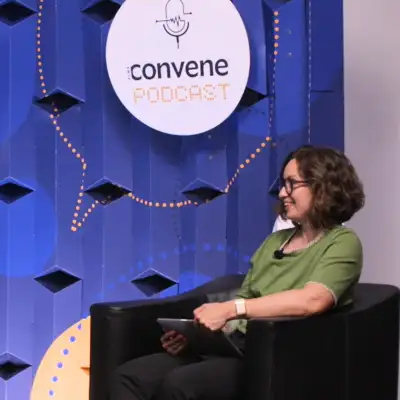
Embed
Since 1986, Convene has been delivering award-winning content that helps event professionals plan and execute innovative and successful events. Join the Convene editors as we dive into the latest topics of interest to — and some flying under the radar of — the business events community.
Convene Podcast Transcript
Convene Interview, ep. 13
*Note: the transcript is AI generated, excuse typos and inaccuracies
Magdalina Atanassova: This episode we are going to talk about how to lead through disruption with Jay Kiew.
This is the Convene podcast.
Jay is a keynote speaker and innovation strategist who helps leaders thrive amid rapid change and build resilience in uncertain times.
I'm excited to explore more about change fluency and what it really means and how event professionals can lead with courage, clarity and confidence when disruption hits, which can be pretty much every minute of the day.
Jay, thank you so much for being here.
Jay Kiew: Thanks so much for having me, Maggie. Really, really grateful to be here.
Magdalina Atanassova: Yeah, I want to dive directly into change fluency. Can you tell us more about it and why is it important,
especially nowadays in this digital disruption age? Let's put it this way.
Jay Kiew: Yeah. The. The predominant, you know,
known function in, you know, across all like transformations and orgs is, is traditionally change management.
How do we manage change? How. How do we see as something to overcome, something to tackle?
And the truth is, is that as you mentioned, change is just so complex.
It's constantly evolving,
it's accelerating.
And so change fluency, to answer your question, is really how do we have the mindset to see change as both an opportunity,
but also being adaptive and proactive with it?
Magdalina Atanassova: And that was one of my personal takeaways from your keynote.
When you said leaders don't manage change, they manage mindsets,
I really took that to heart because it kind of highlighted the fluency of change and you can't really manage it.
Jay Kiew: Right.
Yeah, it's like, is it a project,
Is it a specific project that you're trying to manage? Which is often what leaders try to do. And they say, you know, we're going to do XYZ initiative. Here's the change that we're implementing this quarter or over the next six months.
And then the truth is, is that we get pings constantly on our phone.
Right. Hey, by the way, this is shifting. And we said that we were going to do this in the strategic plan, but actually it's not the case anymore. So. So how do we see changes in language?
Yeah,
something that's complex, something that's something that we can get better at by practicing. Kind of like learning any language.
Magdalina Atanassova: Yeah. And I think for me, the biggest kind of aha moment was there's no end.
Right. Because if it's a project, you wrap it up, but change, you can't really wrap it up.
Jay Kiew: Right.
And, you know,
I was just talking to a few event professionals and leaders outside and we were talking about how everyone was so tired right there as, as event strategists we're often burning the midnight oil and we run straight through, through every conference to try to make the most out of everything.
And so there's this question of how do we battle the change fatigue that we see.
And if we think that there's an end, then we think that maybe there's something we can get to.
But to your point,
it's ongoing.
Magdalina Atanassova: Yeah.
Jay Kiew: And so instead of trying to control how do we just become immersed in all of the change and be totally fluid or adaptive within it.
Magdalina Atanassova: So what are the mindset shifts that you have seen from leaders that have been successful with this, leading their teams through all that?
Jay Kiew: Anytime some announcement is made, something that disrupts your whole day, maybe, you know, a kid gets sick at home, or your Internet cuts out,
that's a disruption.
Right.
As human beings, we have like the knack of reacting in that moment.
And that's where the mindset comes in.
Right. In that moment, am I trying to defend what I, what I had planned?
And I am, am I a bit more calm and analytical and observing what's going on around me to say, hey, maybe this is okay?
Or am I self sabotaging by saying, oh man, like, you know,
because I, I'll use my own daughter as an example. She got sick over the holidays because Maddie got sick.
Our whole plans are ruined for all two weeks. Right. I'm self sabotaging. What could be. Because I'm almost relegating to the fact that because Maddie's sick,
our whole holiday season is a wash. And is that the case?
No. Right. So how do we maintain, out of all those mindsets, a change, fluent mindset to say, okay, out of all of this disruption, what's actually present here, what's possible here?
Magdalina Atanassova: That reminds me of,
I think it was in a book which said. Exactly, exactly that. I'll take your example as a parent.
If your child comes into the room while you're working, they say,
mom, dad, can you come play? And the parent would usually respond, no, I'm busy. I have those, you know, calls. I have all these things. But if the child comes and says, mom, I cut my hand.
Then all of a sudden you have all the time in the world to attend to the kid.
Jay Kiew: Right?
Yeah. And you know, the meme, or it's one of those viral video clips back from when the pandemic first started of the news reporter and the child walks in.
Magdalina Atanassova: Yeah, yeah, yeah. I remember that.
Jay Kiew: There'S almost this, this moment of like creating differentiation in the disruption.
And that actually that moment probably happens to all of us, where maybe a kid runs in and is like, hey, can I play right now?
There's this beautiful opportunity for us to sit and say, oh,
would. Would y' all like to meet Madison? Real brief. She's just gonna wave hi. And you're almost including her in that moment and then saying, hey, you know, dad, Dad's on a work call.
Come back. Go ahead. Go. Go find Mommy. You know, but, like, integrating it so seamlessly where now Maddie is almost like a part of the team, where they're like, oh, Maddie was on a work call.
You know, how do we find moments like that?
Magdalina Atanassova: But also, how do you. How do you build that? Because it's a skill, right, to be present, to stay calm and not rush, like you said, not react.
Jay Kiew: Yeah. Yeah.
Magdalina Atanassova: How do you view that?
Jay Kiew: Well, if you look at the four change mindsets, it's like the immediate one is, do I see change,
change or disruption as a threat or as an opportunity?
Is it a threat to my brand recognition if someone, my kid is running in and saying, hey,
come play with me? There's a lot of things I can do in that moment of, oh, do I feel like I'm unprofessional because my kid is showing up?
Or it's like, oh, yeah, this is normal. This is part of our life. And over the pandemic, we've kind of become very accustomed to that.
Where's the opportunity here?
Magdalina Atanassova: I like that.
Jay Kiew: Yeah.
Magdalina Atanassova: Can you tell me what are some blind spots or disruption traps that maybe event professionals get caught in when it comes to disruption?
Jay Kiew: Gosh. I want to say I mentioned this in yesterday's keynote, but I'll bring it back.
It's the notion of yesterday's data defining today's decisions,
and so how do we refine our programs for resonance?
So I shared that yesterday, and then as I'm having lunch and coffee, chats and connections with. With different event strategists today,
someone called me out and they said, hey, you know it.
Even though AI and productivity is the number one topic that everyone is asking for,
I'm skipping all of those sessions today.
And I thought to myself, huh, interesting. Why? Why is that?
But she's like, well, you know, I'm. I'm. I'm AI saturated out.
I thought, well, okay. Well, out of that,
I could see that as, you know, almost this, like, oh, you don't want to hear what I have to say.
That's a threat or as an opportunity, it's actually like, well, what would you like to hear about?
What are you Digging into what's the disruption that you're curious about? And we got into this great conversation about creativity,
how to solve problems that are complex.
We talked through critical thinking,
and it just led to this natural, organic thing that has her reconsidering how she's planning her event this year.
Magdalina Atanassova: That's so cool.
Jay Kiew: I know. We need to make a decision so far in advance as event planners. Right.
How do we also create a lot of buffer within our schedules for interactions like that where we're in tune with our attendees?
Magdalina Atanassova: And we had this discussion before we started recording that you had. You have to budget time here because we're recording live at Convening leaders.
Just walk and be stopped by people and have chats because that's why we are here. It's not to rush from the one session to the next, but to connect with people.
Jay Kiew: Yeah. The magic is in the in between.
Magdalina Atanassova: Exactly.
Jay Kiew: Right. Yes. There's a lot that we can learn in the sessions,
I hope.
Right, that's our hope. Ssp. Right. And so.
And yet some of the most memorable moments are sporadic.
Magdalina Atanassova: Yeah, yeah.
Jay Kiew: What. What's a magical moment for you? Like, I would love to hear from you as you think back to either this conference. Right. With convening leaders. May. Maybe it was a different one.
What's been a magical moment at. At a conference for you?
Magdalina Atanassova: I think exactly those moments, the. The unplanned, serendipitous moments. Conversations that you randomly meet someone that changes your whole worldview on a topic.
Jay Kiew: Yeah, yeah, yeah.
Magdalina Atanassova: It's never what's planned. You take away a lot from the sessions from what you hear. But the in between.
Jay Kiew: Yeah, I love that. Yeah, I love that. Thanks for sharing that.
Magdalina Atanassova: Tell me about behavioral science, because you use it quite a bit in your work.
So what is the science telling us about how people and teams respond to uncertainty?
Jay Kiew: Selling us a lot. It's telling us that we don't deal with change very well.
It's telling us that change is accelerating.
And so the challenge is actually in these micro moments,
behavioral nudges.
So I might see a big change as something that's very intimidating.
Right. Let's say you're deploying a new software within your organization, or maybe the event that you're planning is a new format.
How do we move towards these micro moments, these behavioral nudges that have us asking, okay, well, out of all the big, hairy, audacious goals that we have for this event this year,
what are the micro moments that I might nudge myself to remind myself of why we're doing this in the first place to be participant centric. Right. To care about what the big problems are that they're dealing with.
Right.
And are we serving?
Are we trying to get our agenda across?
Right. So. So I think the mindset of being service oriented comes across as pretty important.
Magdalina Atanassova: Yeah. Like Simon Sinek says, show up to give, not to get.
Jay Kiew: I love that. Show up to give, not to get. Yeah, yeah, yeah. I often found, like, early on in my speaking career that I felt like I had something to prove.
And when I did, I was. I was almost like, oversharing or providing too much information.
But by focusing on the person in front of me, you in this moment. Right.
What's the best way that I can serve in this moment to provide the most value?
And that's actually taken a lot of pressure off in the. In the. Very much the same way I would hope for a lot of event strategists.
How do we serve and how do we just support people to create meaningful connection?
Magdalina Atanassova: What do you think, speaking about giving,
what do you think event strategists and event professionals can do to help one another out when it comes to,
you know, when you're on site at an event and trying to do your best?
Jay Kiew: Yeah.
Coming back to these micro moments and the nudges, right. We do way better at understanding that if we can nudge just every time we think about it, we actually get rid of that thought.
So for humans, we have so many repetitive thoughts over the course of a day,
but the minute we act on a thought, we actually let it go.
So, for instance, I might think about you later on today, and I'm like, oh, wow, that was such a great podcast episode. I wonder how. How Maggie's doing.
And I might realize that you've been in here all day recording, and I might think to myself, oh, my gosh, Maggie's probably so, like, tired right now. Or maybe she's like, you know, she needs water.
I might shoot you a message, like an email or a text to be like, hey, Maggie, just hope the rest of your day went well. Like, is there anything I can help you with?
Can I bring you drink? Can I drop by with some snacks?
That shows that I care.
Magdalina Atanassova: Yeah.
Jay Kiew: By the way, now I feel like I'm responsible for that. I need to shoot you a text later on to say, no, don't worry,
you can have the water. Yeah, I'll have a file for you right now.
Magdalina Atanassova: So no pressure.
Jay Kiew: Yeah,
but how do we, you know,
how do we show moments of care?
Right.
For each Other,
especially as we're running and burning hot through a long 12, 14 hour conference day.
Magdalina Atanassova: Yeah, yeah. Is there a way that AI can help us in such situations?
Jay Kiew: You think, oh my gosh, there's like the authentic answer and then the. There's the AI answer.
Magdalina Atanassova: Well, go for both.
Jay Kiew: Yeah, yeah. The AI answer is we can automate a lot of this and I might, you know, plug in that. Your favorite. What's your favorite copy, by the way?
Magdalina Atanassova: I like pour over. If you were looking for a brand or.
Jay Kiew: Yeah. Or type or.
But you and I might have this conversation and you might say, like, I really appreciate pour over coffee.
I would do my best to. To lock that note in and say, oh, Maggie really likes pour over coffee. So maybe a year from now you might have forgotten about me and I might just ship you a pour over coffee brand of beans and be like, hey, this is from Vancouver.
Just thinking of you.
Magdalina Atanassova: Yeah.
Jay Kiew: Right off the bat, like that amount of detail and care is something that we can almost refer to AI to automate and say, hey, you know, if you ever see anything that's unique in terms of pour over coffee beans,
ping me and then I'll ping Maggie.
Right. So that's the automation side and maybe that blends both the human and AI piece.
Magdalina Atanassova: I like that. Have you tried that? Have you built an agent like that to help you with certain.
Jay Kiew: A reminder.
Magdalina Atanassova: Yeah, reminders. It's like, for me, it sounds like a reminder to be more empathetic to others.
Jay Kiew: Yeah,
yeah. I, I can get a lot. I'll be honest, I can get a lot better at this. I do it for people when it comes to their birthdays.
And so I have an AI agent that reminds me,
and then I'll shoot that person either a text or a note to say, hey, just thinking of you, Happy birthday.
I. I don't want to almost like release that to have AI message you because then it feels disingenuous,
right? To be like, happy birthday, Maggie from Jay. And it's not me, it's my agent.
So I haven't done that. But it's almost like, can I get me up to the point where I can then physically just take action even though I know AI can do it.
We've been debating about this actually, from the point of view of writing handwritten notes,
especially with the book launch. I'm like, oh,
it's way faster for me to just ship you something via Amazon and plug your address in and ship you a copy of my book.
And it was a conscious decision for us to Say, wait,
no,
we're not going to do that. AI can do that better or it's automation, we can do that better through Microsoft forms, et cetera.
But I'm going to take the time to physically write something and get carpal tunnel because I think, and I believe that that'll resonate better with you.
Magdalina Atanassova: Yeah.
Jay Kiew: And I might be wrong, but you know, stake in the ground.
Magdalina Atanassova: No, you are right that all these moments right now are really much more appreciated when you, when you see something physical or it will be. I was just thinking when you were saying if an AI would message me for my birthday and you, it wouldn't alert you and then we would have a conversation and I would be like,
you know, you would just talk to me like it's a normal day not knowing I have a birthday. Right,
right. That would be so awkward. And at the end I would be like, did you really send me that message? Like, did you really know I had birthday?
Jay Kiew: Yeah. And then that, that decreases trust.
Magdalina Atanassova: Yeah, right.
Jay Kiew: The, like the implication of that. And so I, I see the superpower, especially with people who connect really well within our industry.
I always, I'm in awe of how they remember favorite sports teams or,
you know, where their kids are going to call other people's kids are going to college or whatever it is.
And I ask myself, how can I get better at that when I'm not intuitively good at that?
AI can probably help me a little bit in just nudging.
Magdalina Atanassova: Yeah,
I think we all need a little bit of help because we are so,
our minds are so busy and I want to shift the topic a little bit towards resilience. I think event professionals are one of the most resilient people out there.
Jay Kiew: Preach. Yeah.
Magdalina Atanassova: Because of everything that's happening and it will continue to happen.
But I want our audience to hear your message and your life story. For those that haven't seen the keynote or don't know you.
So can you share how resilience intertwines your personal story with your work currently?
Jay Kiew: Oh, gosh.
Just an easy question, an easy log there, right? Yeah. So I'm from Singapore originally and I was an 80s baby. So back in the 80s, they had these like old school film cameras.
And my aunt, I was a baby about 10 months old, she starts taking pictures of me with one of those old school film cameras and the flash goes off as, as they got the photos developed, my aunt and my mom, they noticed something strange.
In every single photo where flash was used, there's a little red dot right on top of my. My left eye,
it's cancer.
Seven tumors.
My ophthalmologist rushes in to operate, and before I turn one year old, I had been left half blind with prosthetic glass eye and a cancer survivor.
And it's so fascinating because as I think about all of the disruption in our lives,
that's just one moment.
And it's something that I've been born with. And people will say, hey, like, you're really resilient as a result of that. But I actually don't know any other reality.
Magdalina Atanassova: Yeah.
Jay Kiew: Or truth. And I think what that's led to in terms of bringing bridging my work is I don't know what limits there are that are like, almost like, placed on me.
And so I'm just going to act in a way that continues to drive my hopes and my aspirations forward.
And as I think about what the tie in is for event strategists,
we almost don't know how resilient we are.
To your point, we've been hit with two tariffs and Covid shut down and shifted us all virtual. And then the economic uncertainty of the world right now and buying and supplying and costs are going up, and there's so much that event strategists have gone through over the past, like,
five, six years alone. Yeah,
kudos. Right? And at the same time,
do we realize that and you're like, yeah, that's just a normal Monday, Jay. Like, that's fine. Like, we're you. We're totally used to that.
And I actually remark at how resilient event strategists are as a result of that.
I would argue that probably most people in the room don't see themselves as highly resilient. They probably see themselves as like, just, yeah, we're adaptive. The minute I drop change fluent on the screen, they're like, yeah, we see ourselves in that,
you know? And so all kudos to the events industry.
Magdalina Atanassova: What can make event professionals even more resilient, do you think?
Jay Kiew: I think a bit of levity is needed in this world today.
A bit of lightness.
Everything feels heavy every time I open my social media. If it's not a meme, it's a war announcement or someone, you know, some sort of president's experiencing something.
As I think about what helps us be more resilient, I think it's introducing a lot of play into our work. I just got out of the Disney session, and they're talking about how they were just playing around with whatever they had in front of them to create moments of this really powerful experience for attendees.
But it wasn't because it was, like,
really serious. And we have this conference that we need to do. And how do we make this event the best thing we ever possibly can,
where there's a lot of pressure?
Magdalina Atanassova: Yeah.
Jay Kiew: It's actually this notion of, like, what can we create today? How do we design something that's fun? How do we have fun with this? You know? And so.
Magdalina Atanassova: So what do you think as an international speaker? You go to a lot of events and you see a lot of different ways of creating an event.
What can we improve to make it more playful and lighter?
Jay Kiew: I have a short story, if I may. It was the most memorable event I ever had at a conference. And it had nothing to do with the programming. It was the Project Management Institute 2023.
It was in LA or Atlanta, one of those two.
Don't quote me on that.
And I'm at a coffee line just waiting to get coffee, and this woman comes up to me. Her name's Mai.
She says, hi, I'm from Australia. I'm from Melbourne. Like, cool. That's a very cool accent.
And she's like, what would you like from my bag?
She has this bag that she's carrying with her with all these goodies from Australia that she just starts pulling out.
One of those things that she pulls out is a packet of Tim Tams.
Do you know what Tim Tams are?
Magdalina Atanassova: I know. I've heard of them. I've never tried.
Jay Kiew: They're chocolate wafers. They're like, yay big.
And I light up. Because one of my favorite moments with one of my former roommates was, who was Australian, was a Tim Tam slam.
It's this habit that they do. It's this fun routine where, like, you bite off two corners of the Tim Tam and you stick it into coffee or tea, you chug it through the straw and then you,
you know, slam back the Tim Tam and the drink.
It's the most amazing experience in your mouth. Like, anyway,
don't quote me on that one either.
But pretty soon, Mai and myself started rallying, like, 20 people around the coffee table to do Tim Tam slams.
And it was one of the most amazing things. And so oftentimes, I think, like, our participants actually bring so much of the fun.
Let's give them space and time to do that, just to be themselves.
So there's a lot of nuance in the unknown.
We can plan and we can organize and we can strategize. And at the same time, some of the most beautiful moments just happen. When we are just being ourselves, like Mai was being herself.
Magdalina Atanassova: How would you react if somebody books you for an event and just tells you,
just do whatever you want to do,
figure it out on the spot. Would that be weird?
Jay Kiew: I would love that.
Magdalina Atanassova: Yeah.
Jay Kiew: Yeah. We do a lot of, like, pretty pre discovery interviews, and I actually prefer that they're at either end. So right when we book the event,
right. Maybe it's six months out, nine months out,
and then a few interviews that are like maybe 30 days out.
The reason why is I want to hear about their change challenges that they're going through now, today, when we make the booking.
And then I know that things are going to change.
So how can I, you know, triangulate? By getting a sense of today.
Let's say it was like 30 days out from the event. What's going through your minds today?
And the more I can interview attendees, participants,
leaders to hear their point of view,
the more I can fully customize a keynote that doesn't isn't about my message.
I'll provide a framework that's loose and there's tactical takeaways and all that fun stuff. And here's use cases for AI.
But it also places me right into their shoes of what are the problems that they're facing right now.
That would be my biggest hope.
Magdalina Atanassova: I love it.
So tell me now that we are just beginning 2026,
what would you recommend to event planners who want to start a bit looser but ready for the challenge ahead? What's that one? Mindset shift or a habit that they can start building on for the rest of the year?
Jay Kiew: Yeah. Mindset shift would be the notion that change doesn't happen to us,
change happens through us.
Right. So when we are hit with disruption.
Yes. We're gonna have that immediate reaction of like, oh, this is happening to me.
What do you mean, my AV costs or my. My venue food catering is 30% more. What, what, what?
We're gonna have that reaction, and that's gonna be very much a. A mindset acknowledgement of, okay, this is happening to me.
And then there's the okay, now what?
How do we shift from what's present to what's possible?
Right. And so having the mindset shift from that change happens through us is all about asking, okay, what's present, the disruption to now what's possible? How do I differentiate this event based on what I have in front of me?
Magdalina Atanassova: I love it. I'm taking that for myself as well.
Jay Kiew: Yay. Amazing.
Magdalina Atanassova: Was there anything we didn't mention? But we definitely should before we wrap up.
Jay Kiew: Oh, my gosh. I think we covered a lot. We covered a lot of ground. I'm trying to think of if I have anything wise to say, and I'm.
Magdalina Atanassova: Like, nope, I don't.
Jay Kiew: I don't know right now. So, yeah, well, we could. That was an amazing conversation. What were some of the takeaways for you?
Magdalina Atanassova: I think your.
Your last recommendation. I'm definitely taking this to heart,
for sure. I mean, the realization that things happen not to you, but through you. I mean, I think that's. That's very powerful.
Jay Kiew: Yeah.
Magdalina Atanassova: And by the way, I'll definitely put a link in the show notes to your book so people can get it and read more.
Jay Kiew: I appreciate that. Thank you.
Magdalina Atanassova: Well, thank you for making the time and being on the podcast.
Jay Kiew: Thanks again for having me, Maggie.
Magdalina Atanassova: Remember to subscribe to the Convene Podcast on your favorite listening platform to stay updated with our latest episodes. For further industry insights from the Convene team, head over to PCMA.org/convene. My name is Maggie. Stay inspired. Keep inspiring. And until next time.