Subscribe
Share
Share
Embed
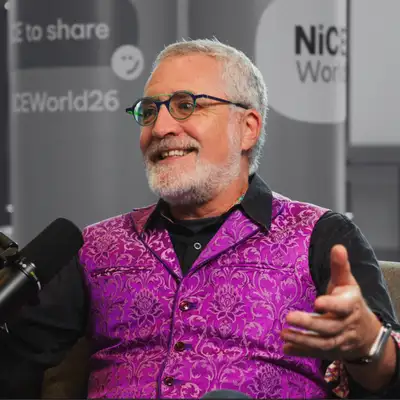
Speak to an Agent explores what it really takes to bring AI into large organizations, why AI can't fix a problem you haven't already solved, why real understanding matters more than a polished voice, and why the domain expert who knows how to use AI is becoming the most valuable person in the business. Featuring the people and ideas shaping the future of CX AI, the innovators, the thought leaders, and those making the decisions. They get candid about what's working, what isn't, and what changes now that machines can reason, plan, and act at a human level, and sometimes beyond it. If you're responsible for putting AI to work inside your organization, this is a conversation you won't want to miss.
The data is like 6.8 billion people have never touched AI at all.
It is a challenge given the fact that the world's knowledge can be picked up
at any time by any LLM. Who's going to take over after them? Like somebody
has to like learn, fail, learn, fail. We need
to still be able to build up the human knowledge if in fact the
human role is to know the business. Welcome to Speak to an
Agent. Those words used to mean one thing:
get me a human. Now, the agent people actually want is
AI. It's faster, sharper, and never puts you on hold.
If that surprises you, you're exactly who this show is for.
Featuring the people and ideas shaping the future of CX AI. The
innovators, the thought leaders, and those making the decisions. Comparing
notes while the next generation of technology gets built. You're
not just listening, you're in the room. I'm your host, Neeraj
Varma. Joining me today are Ian Jacobs and Derek Topp from
Opus Research. Ian is VP and Lead Analyst And Derek
is Principal Analyst and Director of Research. Let's get into it. AI
is, it's clear, it's everywhere. And it's
also clear that we all have to have our own defensible
moats on the value that we deliver versus
AI, right? I mean, you guys as analysts, you guys deliver
reports and amazing research. But one of the, one
of the cool things that AI can do is pretty amazing research.
How do you guys compete and sort of differentiate yourselves from that?
Derek? It is a challenge. I mean, given
the fact that the world's knowledge can be picked up at any time by any
LLM and then packaged in a way that looks and
passes the smell test of an analyst report.
But I do think it's still lacking the human perspective, the understanding
of what— where we come from is identifying trends,
what's next, why that's important. And AI is
collectively bringing all of that information together in a
regurgitated, repackaged way, which can be helpful, can be useful, can have that
type of snapshot. But really, I
think the human element is just like most of our jobs,
is underappreciated and underestimated part of
how we view the world. And so
I do think also AI is a tool. It's something that we
also use as well. So it's not something that I think of as something that's
going to be one or the other. There has to be some kind of combination,
just as any kind of technology evolves, and really leveraging it and
maximizing it and understanding what it can do can help you in your job and
make it better. One of the things that
I hear a lot is, yeah, you wrote a
report, if you fed all of that data into
Claude, GPT, Gemini, it could create that report.
But there's the feeding in that data piece. Mm-hmm. And one of the
things that's always been important in the analyst world, but is
now critical, is not looking at the past
only. We've gotta actually be thinking of things that wouldn't be in the
corpus that an LLM would be analyzing, 'cause it
doesn't exist yet. So we're starting to think about,
ways to combine what we're hearing, all the signals that
we're receiving into completely new ways of looking
at things. And you can try and get an
LLM to do that, but often it's repackaging to use your
words sort of the old way with some new words rather than creating
something completely new. But also to Derek's point, our job
has changed a lot. And that's where you started as well.
I'm wearing a device now on my wrist that is an
AI note-taking device. So when I go into
sessions, it's not just my notes. I now have a full
transcript to go back to start to pull out the nuggets
that are going to start to feed this thought. I've been an analyst for
decades. In the past, my notes were always good enough, right? Right. Like, I would
just— my job was to sort the wheat from the
chaff and figure out what was ignorable and didn't need to make it into
my notes. But now I kind of need to have it all and then
start from having a giant corpus of my own data in a weird
way. I guess I've trained myself to become an LLM,
right? Like, I need my own large corpus of data to start to
derive meaningful analysis. But I don't
think that we're in danger on the
thinking part. We're in danger on like the writing and presentation.
AI is much better at data visualization than I ever was and
ever am going to be. And so we just use it. We
were joking before we started recording about AI
creating photographs. Both of our headshots are
AI-generated. We can tell. That did a lot of that. We can tell. Yeah.
So like we're using it, but it
hasn't replaced us yet. Right. I think it's also
interesting, right? Because we were just talking to Michael Partridge from
Deloitte around sort of how the T&M space, right? The
time and sort of time and material space is essentially dead.
Why? Because if you're using AI to make your job easier,
why am I paying for the same amount of time it would've taken without AI?
Yeah. And I'm sure you guys are running into that today. The outputs
are coming out so fast. How are you thinking about changing your output
model? Because I mean, someone asks you for a research, Siobhan, or
I ask you for a research report and it's done in 3 days. How do
you justify those 3 days for whatever cost, right? How are you guys
thinking about that? Yeah, I mean, the same kind of model
could be even used for seat-based licensing versus outcome-based
value. So yeah, in terms of the kind
of services model that we as analyst firms would have or others, and is
based upon that kind of 6 reports a year, 5
advisories, some level of time put into those and the
expectations from that. But another part of our value too is, of course,
face-to-face conversations, which cannot be, you know, changed.
AI can't replace that in terms of obviously having the opportunity
to talk to us, ask questions, and have, you know, the personal
value of that. Right. So it's true, like the
glut of information that's out there, there is some
desire to just put out more and more and more from an analyst point
of view, is just kind of create more research, create more content. But I do
think that has some level of tailing off. It's not
necessarily going to bring more information, more value. It's going to bring just more data,
more noise to what could be— what you want is something very
specific and really having that human judgment, that
evaluation of the creativity of where things are going, not necessarily
regurgitating what's actually already out there. Right. And the more output there is, we're talking
about decision fatigue. Someone has to use your
output for some values at some point. And the more output there is, the more
decision fatigue is on the decision makers. And it's a challenge that I
face all the time. That's a good way of thinking about it. I hadn't really
thought about it that way. I was thinking about it more from our point of
view where I think of the old adage, right? If I had
more time, I would've written you a shorter letter, right? Like more words
doesn't necessarily mean more information or more value. The
value comes from the curation and that, means that
from an Opus Research point of view, I can't speak for all analyst firms,
but from our point of view, we've amped up our
output, but not meaningfully.
Maybe 10% or 15% more research reports a year
at best. We're not trying to flood the market. We're trying
to figure out what really moves the needle on our clients'
business. and focus on those things, which goes back to what I was saying
about how our job is changing. A lot more of
sort of predicting the future, figuring out the future.
Right. Rather than describing how to
operationalize something that's already out there. Mm-hmm. Right? We do that
too, but like where we're moving, there's more of the
stuff that the LLMs can't do. And so I
think it's a fool's errand, frankly, to just flood the zone with
More from an analyst point of view anyway, more research.
The same is true, you say decision fatigue, but like more
reports, more dashboards inside a business isn't
necessarily what you need. What you need is here are the 3
things that you need to care about and you need to do.
Right. And here's what you need to do. So it's sort of the same
thinking in our business. And if in fact
other analyst firms are gonna flood the market. I guess
that becomes our moat, right? We're the curatorial firm
that's only gonna give you the things that really matter, not just more of
everything. Have you guys seen sort of the— since the agentic era, this is kind
of unrelated, but agentic era and the number of applications on the App
Store, right? And it's essentially a straight lineup.
And ratings on average are down, users per application. Usage is
down. And usage, well, usage per application. So average usage is the same.
No, usage— Usage per application is down because there's a finite number
of users on any platform, right? And that kind of goes to show
that the more you have, the less users you'll have
per thing, right? You're still fighting over the same sort of domain.
And I think curation in itself becomes more
important. I don't want to use a bunch of AI slop-generated
applications. Maybe I do, I don't know. It depends on what that slop happens to
be. I want the best slop, the
best curated slop, right? I mean, you think about it, I do. And I, you
know, I vibe code all the time and I feel like I create great things.
Not everything I create is great, but some stuff is, right? So I think
curation becomes a really, really interesting point. No, sure. There should
be a premium on that. And there is in terms of having the right thing
at the right time and the right use. And it's funny, just thinking about
this too, like time itself is a variable for for us
as analyst firms and others, like, and businesses, is you learn as you
go. We serve an educational element here. So we can't tell the world
everything that they need to know about AI today because it's gonna change tomorrow. So
like, as people start, and we also have a near future
type of point of view, we're always looking kind of see what's next, but not
too far out. Right. And so as these things play out, we then are
able to provide some of those learnings, what's, you know,
best practices, how to think to operationalize agentic
AI, looking at conversational AI and conversation intelligence and how they can be used
within organizations is something that we constantly look at. And
time itself, and as evolution occurs in those business
use cases, we then are able to provide more value because of that.
Interesting. Yeah. One of the things that has always been true about the
analyst job is that a part of it, and sometimes a
big part of it, is providing validation for customers. Like
they want to do something and they just need the analyst, the third party outside
to say, no, look, this is the real thing.
This is the right answer. This is the right direction. This is what you should
be doing. And I think that's actually pretty parallel to what brands are
facing now too, right? They're looking at all of this
stuff coming from LLMs and they need the, the
person internally to say, yep, that's the right
direction. Whether that's like literally the human in the loop in a
process, right? The AI says, build another AI agent that does
this thing, and you need a human to say, yep, that's correct, go build it.
Or whether it's somebody who's more like an analyst, not
industry analyst, but an analyst within a firm to actually
look at all of this output. And that's sort of a curatorial role,
but it's also like the validation of the giant dataset.
Oh yeah, okay, that's what it's telling us. Interesting. That sort of jibes
with our experience as human beings. What I'm a
little bit concerned about, and it's not a unique concern to
me, and it's a problem in the analyst world as I'm
sure it is in lots of the other worlds, as a lot of the
simple kind of tasks of being an analyst get consumed
by AI, You kind of lose the junior pipeline who
then builds up the experience. Like, what is the role for
humans going forward? Know your business. Well, how do you know
your business if you didn't start out as a junior person and work your way
up and like learn all of the pain points? If all we're going to
have is like the salespeople who are really great at using
AI, who's going to take over after them? Like somebody has to
like learn, fail, learn, fail, learn,
fail. Interesting. Right. AI. But, and that's
true for like a claims adjuster or whatever the role
is. Like, we need to still be able to build up the
human knowledge if in fact the human role is to know the business,
to be able to say, yes, that AI is right, or that
plan that the AI created is the right thing for us to do. I do
worry about that getting cut off at the knees right now. Yeah. Because we're
so focused on taking out the work of junior people. But I
do wonder if the world, as I said,
belongs more to generalists. I don't say that lightly.
I say that in a— when I say a generalist, I don't mean a person
that can draw a picture and ride a bike. I mean more like
a general analyst that understands
data, that understands, has analytical thinking,
but isn't necessarily segmented into a role,
right? They're not a salesperson, they're not a business analyst, they're not a
contact center leader. They're a generalist
analyst, right? That essentially looks at output from an AI system and
makes the decisions, right? Because, you know, I
don't see a world where people hire tens of
thousands of specialists like they have today. No. Right? No.
And that resonates with me. I have a previous career as a journalist. And what
are journalists other than generalists who go in, learn a domain, build up
expertise, then you get assigned a new domain, you go and you learn it. Like,
that's how it worked. But I think there's a big
challenge to what you're saying. And that is,
I don't mean this to sound derogatory in any way, but most of
our enterprise clients and most of my enterprise clients for the last 20-some-odd
years have thought themselves special snowflakes. Right. And it always
requires like the experience, not just
in the auto business, but in the auto dealer networks that have
these particular constraints on them. And so how do you overcome
that thinking to say, actually, we don't need— Yeah, but that's domain expertise. We just
need somebody who knows how to learn and make good decisions. But that's domain expertise.
I think there's a difference between domain
expertise and task specialization.
You can be a domain expert, like for me, as an example,
To be honest, I've spent what, 18 years, 17 years in this industry. I'm a
domain expert in CX. Yes. I know CX really well,
but I'm not a specialist in sort of any one category of
job, meaning I'm not a product person, I'm not an engineer, I'm
not a media person, I'm not a podcast person. I'm just a
generalist that I can do each of those things decently
well, right? Which is why I think people like
that aren't sort of relegated to a single role but still have domain
expertise are the ultimate winners, right? So those
special snowflakes of the auto industries of South
America with cars from North America, they exist, but they don't
have individual roles inside the organization. They're
just generalists that do it all. I think that, that in my
opinion is the key. What do you think? Well, I mean, you're basically saying like,
how good can you write a prompt, you know, and like have like And that's—
And analyze the output. I think the key is how do you analyze the output?
Sure, and then that's part of the domain expertise that may have some value
in that kind of long-term, or at least building up the information
and the knowledge and the kind of human understanding of whatever that task is,
and then leveraging AI to understand it better. That's asking the right
questions, you know, it's looking at the task itself,
and that's, you know, certainly can be
also done by AI as well. And I mean, and you look at such things
as like the AI agent to a sub-agent. We talked about in the past some
kind of generalized type of chatbot, then have more domain-specific
language models, domain-specific bots, which would have
been focused on whatever business unit or task use
case that was necessary. That all can be delegated now. I mean, and
that in itself is, to your point, having the ability to kind of go
down whatever rabbit hole you want to go down to with based on
the, the, the having a, that first
agent, AI agent prompt. And then from there, the AI agent can, can even go
digger, dig deeper into different angles that you weren't expecting.
That, that's going to be done. Your question though around, because like what
Derek's saying is still domain specific,
right? So let me— how— who are those people?
What training do they have? I mean, I always think,
great, go to J-school and, you know, you're a journalist, you can learn things.
And like, that's what it teaches you. But maybe that's the key, right? Maybe that's
the key. It's like, you know, and we're— I think every organization in the world's
figuring it out, right? I mean, and it's clear even when I look at my
organization, the people that are doing whatever job they have the best
are the ones that are generalists that are not, you know, you've got engineers,
Yeah. That are hyper-focused on just writing code, and all they see is AI
taking my job, right? So they're very hesitant to use it. And
then you've got product people that are looking at AI and they're saying, well, I
could have it write a description of my— of the thing that I'm gonna build.
But the most successful people almost take like a
higher-level approach of like, it's not gonna
replace my current job, or it might replace my current job, but
what's the larger value that I can deliver to the organization?
So you have product people building entire applications.
You have engineers that rewrite the entire software development
lifecycle, right? And when I say the
people that are not so— that are generalists, they understand
the problem at a higher level
than a specific person in an organization, right? As an example, a salesperson,
usually understands the product at like a
300,000-foot view, and all they're focused on is relationship
building and, you know, taking people out to dinner. Then they bring in specialized people
that sell them this, whatever, you know, pre-sales people. But what if
that specialized person didn't exist? Well, I think, I mean, I think what you're saying
there, understanding the problem at a higher level, that's always been true in
terms of a business. And then people kind of fall into their roles, whatever that
may be in sales or in terms of, you know, middle management and having that.
I think that basically you're saying if
you're able to articulate the
problem and solving it through AI or using
AI to build that generalist type of role is— I think
that's already been there. But again, this is where I see AI as the tool.
And that's what I mean in terms of the sub-agent as a way to use
AI to identify whatever task and whatever bigger
problem you want to solve. I mean, this is where I've got 2
kids in college right now, and, you know, they're humanities majors, liberal arts majors,
like psychology, and one's in education science and political science. And it's like
having that type of understanding of humans and
sociology, whatever, how we work, is going to be as important
as going to computer science school was, you know, 10 years ago, or having that
engineering degree, or having— the ability to construct
a solution to the problem is the goal there. And I think, and
that's also, again, I think it is specific to the business and understanding your
business and really kind of, you know, again, leveraging, right? I'm using the filter of
AI as like I'm leveraging AI to help my business do things better. Yeah, I
think it's recognizing the problem. And I think the specialists, in my opinion, don't
exist in the future, right? So if you've got 3 levels of people
in an organization, you've got really specialized people, then you've got
managers, and then you've got people that understand the problem at a high level.
I think that gets collapsed into maybe 2 or maybe
1 level. And I don't say that lightly, right? But I
find myself doing work that
other people in the organization would've done in the past because
AI can do that work for me. And it's,
I don't know, I think it's really interesting. I actually don't
necessarily agree with you, Derek, because,
so I, this isn't a thought I had 30
minutes ago. This is, Niraj put this thought in my head, so now I'm working
it through. But like, what was the path to becoming an engineering
manager? It was being a really good specialized engineer.
It wasn't necessarily thinking more broadly.
Right? So I do take your point there. Like that used to be the
progression. Right. Right? And it led to— I'm a C# engineer that
understands backends really well. Yeah. And that's
what I'll be maybe. Well, and so the engineering manager
also knew back in the day Java and 5 other things too.
But great, they were broader in their depth, if
that makes any sense. They had multiple areas of
depth. Yes. That was the way to advance your
career and maybe, Maybe that's not true anymore. Like, that's
not what it takes. I think it's like— To manage those people,
or at least not 5 years from now. Right. And I almost feel like, you
know, we talk about this sort of a mile wide and an inch deep. I
almost feel like a mile wide and an inch deep are the
people that succeed in today's world. And I'm not saying that lightly.
I feel like you can get the depth
much easier than you can get the breadth. And I don't know how to describe
it. And I would like to, you know, like I describe myself, by the way,
as a person that doesn't go deep in anything, but I have a lot of
breadth of experience that I can use to formulate something as an
example for an AI system that can help me get deep in any topic.
Well, to close the loop back to analysts, we're seeing a lot of analysts.
You know, we have somebody in our firm who's complaining about all the analysts who
seem— industry analysts who seem to think they're financial analysts these days
because they can feed in, you know, the transcript from an earnings call
and say, to Claude, what does this mean? And then all of a sudden, that's
now part of their analysis. Right. Right. So they're, they're also
trying to become much broader. So, you know, when I
start to publish analysis of like
point-of-sale systems for car dealerships, you know,
I've bought into that idea of breadth. CX, who
cares? Let's start doing everything. Yeah. So,
you know, I guess, you know, we're going to be out of time here pretty
soon. I'm going to, I'm going to try to kick off a bigger question.
Since you guys are industry analysts, it's obvious that you guys know the industry very
well, and you guys say you're predicting the future. What does the
future of the CX industry hold, and sort of what
organizations— and you can be open— what organizations
succeed in this world and don't?
Well, that's a $64,000 question, right? In terms of
like how Um, well,
the funny thing is that we can predict the future, but we also
can enable it, you know. And like, I think that's how, um, as
organizations start using more AI, understanding what value they can create that they
didn't know about before, um, that's going to be part of
the fun part. And I think, um, I do think technologies,
you know, around— we talk about agent-to-agent communications and MCP and kind of,
you know, there's a pure CX quality to Or I'm sorry, there's a pure
integration and kind of AI agent, AI access
quality that's being built right now, that architecture is available.
And I think in terms of CX and customer service is gonna create
all kinds of unique qualities around that agent communication
and doing tasks on my behalf. And so
the ones that succeed will be the ones that are able to
manage and control and govern all of these
communications and making sure that they're built
in trustworthy ways and do the right things for customers.
I think customer adoption is also a huge part of this, but I do think
customers will move to agents, to personal agents,
and kind of that AI agent as your best friend
world if it works. It has to work. Right. That's the main part of this,
and that's part of the enabling of it. I mean, 66% of all, you know,
the recent statistics, what, 2/3 of all consumers have already sort of
adopted and daily use of some sort of
AI system. So I think it is, it's an interesting point.
It's funny, I'm seeing almost the exact opposite. I mean, it depends on
whether we're talking about globally, right? Like the data is like
6.8 billion people have never touched AI at all. At
all. So, I mean, it's a narrow set, but I think in a weird
way, Derek's even underselling it because the biggest
problem that we've had with this personal agent stuff has not been
that it didn't work. That's true. It's that nobody
figured out how to make money off of it. Like, there needed to be a
business model for a brand that would then— Right. Build
something that people would actually adopt. And if Apple,
who would be one of the most obvious, vendors
to cater to broad consumer base, you know,
billions of people, if they can figure out how to
embed that in your life and make money off of doing it,
then just in the same way that like the billionaires who are kind of pushing
AI on all of us, whether we like it or not,
consumers are gonna find it because it's gonna be in every tool they use. And
again, to your point, if it suddenly works, and there's a brand making money
on the back end, then that becomes the future for every brand
because then you've got a mix of generations. You
know, you've got some generations that are using AI agents as
their proxy in the world. But for now will be, you know,
human interaction with your AI, your
brand's AI, and you've got to have the human backup of that. So we end
up with an end-to-end problem. And that becomes a big
mess for a while. But you then as a brand
have to start to figure out, right? Like, do I have agent to
my agent to my agent talking to your agent, which then
goes back to you as a consumer for some validation, which
then goes and escalates to my human, right? Like that kind of
crazy chain. Sort of like this proxy thing that you've got. Yeah. Right.
But that, I think, is the future. It's gonna
happen because there's enough
impetus. Right. Both in terms of like, just there's money to
be made, but there's also lifestyle
improvements for us as consumers if we can get this to
work and figure out, like, one of the problems that we've always had with this
idea is how much information as a consumer
do you give the AI agent? How much control does it
have over decision makings, right? It's fine if you
make some boneheaded purchase that's $25, but I'm not going
to allow you to do anything that's $2,000 without my
approval, which then means you've kind of broken the
time savings that you would've had having the AI agent do everything
completely autonomously. Like that sort of
utility problem, paired with, is somebody gonna make
money off of this? It's gonna be solved. It's gonna be
solved. And when that happens, that's a massive change. And I think we're
close. It feels like we're close. You know, I use Claude.
I use Claude's deep research to essentially buy, not
physically buy, but essentially pick anything that I need to
buy, right? If I wanna buy a TV that's this size, of this quality,
Go look up RTINGS. It's gonna look up Amazon. It's gonna look up every place
that sells it. Tells me this is the best TV and here's where it's available.
Can I help you open this webpage so you can go buy it? Right? That's
the kind of output that I'm looking for in my life. Now. Right? But now.
But in, but you know, in very short order, it's going to be, here's your
budget, go buy it. Right, exactly. And it could be there tomorrow if we really
wanted it to be. Well, we have, we have the whole agentic commerce kind of
issues to work out. Right? Yeah, but yes, that's kind of
my point though. Like, what happens then for like
governance? Oh, well, my agent bought this thing, but I
want to return it 'cause it paid too much. Well, that's not in our return
policy. Uh, do we dispute it with the consumer? Do we dispute it with the
credit card, right? But I mean, it's the same problem that you have with self-driving
Teslas, right? In theory, if your car is self-driving,
is it Tesla's problem that it killed someone or your problem that it killed
someone, right? In theory, right now it's your problem that it killed someone. So
do you take the AI agent as your proxy? Right?
It's an interesting question, so. Well, anyway, that's where I really
think brands are gonna see massive change in
relatively short order. And I would've said longer term
even 3 weeks ago, but, you know, seeing where they're going with
Siri, that's like, it's on how many phones? I mean, it's like
ridiculous. It's billions of phones. Do I use it for anything other than setting a
timer right now or checking the weather? No. Those are the two— I use
it every day, but I use it for those two things. Now imagine how much
data Google is going to have from that. Well, there you go.
Yeah, that's— I mean, that's enabling the marketplace, whatever that
becomes. And I mean, it's scary though, right? How much data that they're going to
suddenly have access to anyway. Well, Google
and Apple. And Apple's going to, you know, they're going to try to do this
thing where it's a lot of it's on device. It's not going to be very
good. So I don't know. Yeah, we'll see. Well,
even in the anonymized form that they will
get that data, you know, it's still going to be
incredibly valuable. Yeah. I mean, it's going to be amazing and sad
also. And that closes out this episode of Speak
to an Agent. A double thank you this week to Ian and to Derek.
If you found the conversation valuable, subscribe wherever you listen and leave us a
rating or review. It helps more listeners discover the show. We'll be back
soon with more of the people making the AI agent the one you actually want
to talk to. Thanks for listening.