Subscribe
Share
Share
Embed
One of the most essential ingredients to success in business and life is effective communication.
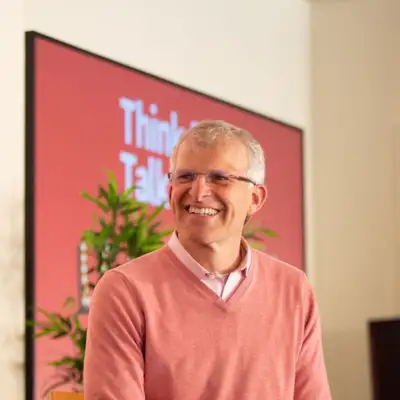
Join Matt Abrahams, best-selling author and Strategic Communication lecturer at Stanford Graduate School of Business, as he interviews experts to provide actionable insights that help you communicate with clarity, confidence, and impact. From handling impromptu questions to crafting compelling messages, Matt explores practical strategies for real-world communication challenges.
Whether you’re navigating a high-stakes presentation, perfecting your email tone, or speaking off the cuff, Think Fast, Talk Smart equips you with the tools, techniques, and best practices to express yourself effectively in any situation. Enhance your communication skills to elevate your career and build stronger professional relationships.
Tune in every Tuesday for new episodes. Subscribe now to unlock your potential as a thoughtful, impactful communicator. Learn more and sign up for our eNewsletter at fastersmarter.io.
Matt Abrahams: Answers
lead to destinations.
Questions lead to journeys.
My name's Matt Abrahams and I
teach strategic communication at
Stanford Graduate School of Business.
Welcome to Think Fast
Talk Smart, the podcast.
Today I look forward to speaking
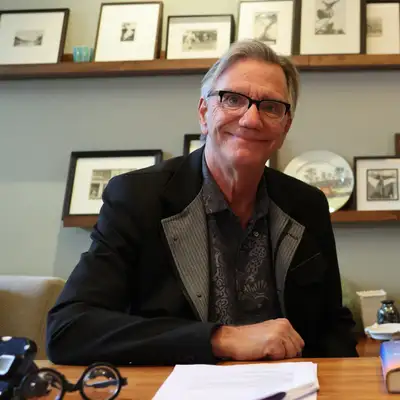
with Bill Burnett and Dave Evans.
Bill is the executive director of the
Life Design Lab at Stanford and an adjunct
professor in mechanical engineering.
Dave is a lecturer in the product
design program and co-founder
of the Stanford Life Design Lab.
Both have worked in various cool
and influential jobs from Apple
to Electronic Arts to Hasbro.
Together they wrote the New York
Times bestselling book, Designing
Your Life, and their latest book is
How to Live a Meaningful Life: Using
Design Thinking to Unlock Purpose,
Joy, and Flow in Everyday Life.
Welcome, Bill and Dave, I am
thrilled to have you here as
somebody who is trying to figure out
what I want to be when I grow up.
I'm very excited for our conversation.
Thanks.
Dave Evans: Great to be here.
Bill Burnett: Yeah.
Thank you for inviting us.
Matt Abrahams: Shall we get started?
Dave Evans: Let's go.
Matt Abrahams: Excellent.
So, Dave, your new book provides useful
tools for living a meaningful life.
How do you and Bill define
meaning and purpose, and why do
you write that we don't need to
know our true purpose after all?
Dave Evans: Well, you know,
we're user-centered designers.
We live to reframe things.
So the first thing the book does
is reframe meaning and purpose.
And so we're not after finding the
meaning of your life or your one true
purpose because we define the human
being as a becoming, we're all a dynamic,
flowing, constantly changing thing.
So how could a changing thing
have one static right answer?
We encourage people to live meaningfully
and direct their lives purposefully, and
we've got some tools for how to do that,
but we want you to be going the right
direction, not find the right destination.
Matt Abrahams: I love that idea and making
those words adverbs can really help.
Gimme an example of
living life purposefully.
Dave Evans: We talk about coherency a lot,
and the whole idea is who I am and what I
believe and what I'm doing in alignment.
One of our tools is
called a coherency side.
We have a compass tool that helps
you figure that out and write it
down in less than three pages, and
then you can catch yourself in the
act of acting just like yourself.
So this morning, I'm having a very
coherent moment talking to Matt
because he's interested in the same
things we are and communicating
to people, which is what we do.
So man, I'm right on target right now.
Matt Abrahams: So it's about
reflecting and knowing your
purpose, and from that you can then
assess if you're in line or not.
Dave Evans: Compasses
say North, not Seattle.
So am I going North?
I'm doing the right thing.
Matt Abrahams: Excellent.
Very good.
Bill, your work in both your
books focuses on design thinking.
We've talked about design thinking
on the show before, but for those who
aren't familiar with it can you define
what you mean by design thinking?
What are some of the core
concepts that you employ?
Bill Burnett: Yeah, and it was the
idea of taking engineering and adding
in psychology, anthropology, and art,
'cause we should make beautiful things.
But it was always rooted in the notion
that you talk to humans about what
they need and you try to understand
them using anthropological tools
like ethnography and other things.
So we boiled it down
to a five step process.
Don't start with the
problem, start with people.
Empathy.
It's the first step in design thinking.
Then define the right problem.
'Cause oftentimes the problem
you got is the wrong thing.
It doesn't respond to the human need.
Then have lots of ideas.
'Cause we know, as designers
says, if you have lots of
ideas, you have better choices.
And then prototype and test.
Relentlessly test your hypothesis about
the user with a prototype or prototypes,
not to prove you're right or wrong, it's
just to explore the idea, and then test
and then refine it and test and refine it.
So it's a very empirical
human-centered process.
I took a full-time position here at
Stanford in 2006, but I'd been teaching
design to design students for a long time.
When Dave came over in 2007 and proposed,
Hey, let's do a class for the students.
Are they struggling to launch?
Are they concerned about
meaning and purpose?
I said, absolutely, and it seemed
to me like it was a design problem.
We could prototype your future.
We could interrogate, what do I need?
Empathy for me, empathy for the world.
What does the world need?
So the whole idea of using design thinking
for life design just fell into place very
quickly and the students really responded.
Matt Abrahams: I think it's a
wonderful toolkit to look at purpose
and meaning, and I have benefited
from it from the work you've done
in my own life and my own searching.
In your book Designing for Life, Dave,
you leverage one of the tenets of
design thinking when you advocate for
prototyping conversations to gather data.
What are prototyping conversations
and what are some of the best
practices for having them?
Dave Evans: So again, as Bill just
described in design thinking, a
prototypes job is to ask an interesting
question and learn your way forward.
And I'm trying to design
this thing called the future.
I don't have any data,
so you can't analyze it.
So we have a very hands-on empirical
bottom-up process that talks about
gathering data through experiences.
And if I'm trying to design my life,
I'm thinking about ways people live.
Oh, I can go visit the future by sitting
down with a person who's doing the kind
of thing or living the kinda lifestyle or
believing the kind of thoughts that I'm
contemplating considering so I could visit
the future by entering into their story.
So that a life prototype is a
conversation or an experience, and
importantly, it's not a transactional one.
Like, well, how much money do you
make and do I need an MBA or not?
Those are interesting questions
about the transaction of do I
want to become Professor Matt?
But what I realized is so, wow, you
communicate about communicating.
How's that for you?
That's the narrative story of
the experience you're having, and
we know neuroscientifically now,
that if I actually get into your
story, I'm actually having an
experience walking along with you.
Surrogation, as opposed to simulation,
according to Dan Gilbert at Harvard.
If I live into your life a little
bit, I really can understand things
differently than just reading data.
Matt Abrahams: Thank you for sharing what
you mean by prototyping conversations.
Bill, I want to talk about another
concept that I really find interesting,
which is the idea of an odyssey plan.
What is an odyssey plan?
How should we develop them and how
do we best then communicate them?
Bill Burnett: Well, I mentioned that
one of the steps in the design process
is ideation, having lots of ideas.
And we know from lots of research from
the business world that if you have a
binary decision, an AB decision, you make
a bad decision more than 50% of the time.
So have more than two.
We do three odysseys, and there
are three explorations of the
next five years of your life.
What might that be like?
And typically odyssey one is whatever
you're doing now, and it just goes
great for the first five years.
Odyssey two, we suggest,
Hey, what's your plan B?
AI just took that job
and that life is gone.
You have to, you know, plan B. And then
the wild card plan, the third plan, is
what would you do if you had all the
money and the resources that you needed?
No one would say, well,
that's a stupid thing.
Why are you leaving a position at Stanford
to go be a clown at Cirque Soleil?
Matt, that's crazy.
So all your friends would say,
whatever you're doing is great.
Because a lot of times the social
pressure of staying in their lane
is so powerful that they can't even
ideate about something different.
So the idea is it's three completely
different lives played out in five
years and not just work stuff, but
life stuff and family stuff, and
your bucket list and everything else.
And we find when people do three,
not one or two, it really opens
up the possibilities of what could
happen in the next five years.
Now, we're not suggesting
that you pick one.
They're not truly plans.
They're really just a chance to imagine
yourself in three different futures.
And then one of the things we do
is we say, okay, pick two of those
futures and write me a story.
It's four or five years from now.
I say, Hey Matt, how you doing?
I ran into you to Starbucks.
How you doing?
You say, I'm great.
I go, Hey, what happened
with that odyssey?
And then you tell me.
So you actually write a letter
from the future back to yourself
about what that Odyssey was like.
Sometimes it's challenging for people to
think of three things, but once they've
actually got it and they get into it,
developing these lives really changes
their perspective on what's possible.
And that's all we're trying to
do is open up the solution space.
Matt Abrahams: Bill, I want to
go back to this idea of meaning.
You both articulate four key
components of meaning making.
I'd love to hear more detail about those.
Bill Burnett: We start with this idea
of coherence and we have a little
tool, as Dave said, we built a compass.
You know, who you are, what's your
story, what's your theory of work,
and what's your theory of everything
that's sort of transcendent?
So coherence is the first part.
Wonder is the second step.
Wonder we describe as
curiosity plus mystery.
And so walking around the
world with the sense of wonder.
And then the idea of flow.
We propose in the book, we live in
two worlds, the transactional world
of getting stuff done, which is great.
And then right underneath that, kinda
like an aquifer below the surface, is
the flow world where we, where actually
the flow world is where you will
experience meaning and transcendence.
And then the final element is community.
We have a mindset called, in creating
your world, you create the world and you
create the story of the world you live in.
And you surround yourself with
relationships that are meaningful.
It's all about community
and relationships.
So coherency, flow, wonder, and
community are for meaning making methods.
Dave Evans: Lemme double down on
the community thing for a minute
'cause there's social community
where we gather to have a good time.
Collaborative community where we gather
to get something done, which most of your
colleagues help us do over at the GSB.
And there's a formative community
where we are becoming together,
and that's a fundamental shift.
What we're finding is the overwhelming
majority of modern people have lots
of social and tons of collaborative
community, which is wonderful.
Getting something done together
is very life-giving, but it's not
the same as becoming together.
So it's not, did you get it done, Matt?
Or how are we gonna do this together?
Or wasn't it great when we won?
It's like, so are you moving
toward the better Bill, Bill?
And that conversation we call the
formative community, we have some tips for
how to do that and it's very life-giving.
Matt Abrahams: I wanna
come back to those tips.
I'm in the process of building one
of those formative communities, and
I really appreciate how you delineate
the different types of community.
The more I do the work I do in
communication, the more important I
see both context and community being.
I wanna come back and share with us
the wonder activity if you could.
Dave Evans: We have a number of tools
for each of these things, but the first
one is put on your wonder glasses.
And put on your wonder glasses
means you could sit anywhere, and
first of all, you look around the
room with your regular glasses on.
You just see the way the world is.
Like, I'm in the studio and there's
Gordon, he is working behind the
desk and, and what do I notice?
And then I see what's going on,
and then I go, oh, there's a,
the broom is next to the door.
I wonder if that was forgotten.
And so my eye naturally goes to
things that want to turn into tasks.
So suddenly my natural glasses
sees the transactional world
and what I need to go do next.
And I go, thank you very much.
Now take another look and just notice,
and then what else comes to mind?
And then I see this other really nice
chair two clicks over from the broom, and
I'm thinking, huh, that's an empty chair.
And then my wonder glasses look on, like
I wonder who might sit in that chair next.
I wonder what conversations happen
in this room, very thoughtful people.
Isn't it great there's an institution
dedicated to thoughtful conversation, and
then I can just appreciate that and so
in about a minute, I go from, oh, I gotta
call Patrick back, to, I get to be in deep
conversations as part of a long tradition.
That's a real joy and
I'm so grateful for it.
That's the wonder glasses,
and you can do it anytime.
Matt Abrahams: I love the idea of
wonder glasses, and it really, to
me, it sounds like it's all about
curiosity and allowing yourself
to more deeply think about things.
You did something there in your
example that I really wanna highlight.
When you transition from the
transactional view of the world
to the wondering, curiosity
view, you simply said, thank you.
I see that, but I wanna look differently.
Many of us beat ourselves up or
say, oh, I shouldn't be doing that.
That's the wrong way to approach things.
And you simply acknowledge and move on.
And that to me, I think is a
key element in this flow state.
Dave Evans: Well, again, we have
this framing that so many people
came to us where we redesigned
our lives, but it's still not as
fulfilling or meaningful as I thought.
What did I do wrong?
We go, oh, we got that problem.
So that's where this
recent book came from.
And as we listened to them, they
overwhelmingly described lives lived
entirely in the transactional world.
Now there is only one world.
But our brains can't handle
the whole thing all at once.
We have modalities.
So we're inviting people to spend more
time in the flow world, which is the
present moment through which the entire
coursing cosmos is under our feet and
in front of our eyes all the time.
That present moment, which is different
than the transaction in the future.
And so the reason we have a
friendly relationship between the
transactional world and the flow
world and transactional thinking, or
achieving brain and flow thinking,
or the awakened brain, is because
they're friends, we need them both.
Somebody's gotta take out the trash.
So there's nothing wrong
with the transactional world.
And we accept the fact that most of us
are overwhelmingly biased that way because
the systems of the world all run on that
all the time, so cut yourself some slack.
All we're trying to do is get
better, and I don't need more
reasons to critique myself.
Frankly, that's just the
transactional world catching me in
the act of doing something wrong.
I'm just trying to become a person.
Matt Abrahams: That's a fundamental
mindset shift, but when you do it,
it allows access to this flow state.
Bill Burnett: Yeah, and it's always there.
Matt Abrahams: Yeah.
It's just giving yourself
permission to see it.
Let's go back to formative communities.
How do you build these?
How do you find the people to support you?
What's involved in building that?
Dave Evans: It's all about the question.
So I start with the definition, you
know, Bill and I have been talking
about people for a long time.
We do human-centered design.
So our definition of
the human is a becoming.
So then if I'm becoming,
what am I becoming into?
So then it begets what's the
question I'm living into?
And one of the unfair ways to divide
the world in two is there are the
people who run around rehearsing
their answer and the people who
run around living their question.
So if you wanna live a becoming
growth oriented life, now
you're living into the question.
So the question is what am I living into?
So I'm seventy-two, I've got eleven
grandkids, and the question I'm asking is,
am I ready to shift out of a role-based
life into a more soul-based life?
And how can I have my primary
verb shift from got to to get to.
Now, that's not the same as, I gotta call
Patrick back, that I mentioned earlier.
That's my transactional task list.
I've still got a task list, but the
question I'm living into is I wanna
spend more time doing get to not got to.
How do I do that?
So you start coming up with
those questions and ask that of
yourself, and then find others
who wanna ask that question.
And you start by having a dinner and
let's ask more interesting questions.
And if people like it, do it again.
And then, you know, read a book together
and then say, I think we got a group here.
Matt Abrahams: I love this idea
of the question I am living into
instead of just being the answers.
Dave Evans: Yeah, we call
that the focus question.
Matt Abrahams: Bill, the book also talks
about the practice to production trap.
What is this and how do we avoid the trap?
Bill Burnett: So we always do this,
we turn what could be a beautiful
moment and it's like, it's one of the
things to say, what a beautiful sunset.
I long for beauty.
It's another thing to say,
well, that sunset was okay,
but I've seen better ones.
You know, where, where could
I go to find a better one?
And so every time we take a potentially
meaningful moment and turn it into
another item on our to-do list,
we try to make it more efficient.
Practice to production is making
everything a production, a transaction
in the transactional world.
It's a big trap and you just want to
be aware of it because the beauty of
the sunset is beauty in and of itself.
It's a completely whole moment.
Don't turn everything into a transaction.
That's the trap.
You know, people just all the time
to themselves, they rob themselves
of the chance of having a little
moment of meaning by judging and
making it performative or whatever.
Dave Evans: You gotta channel the Beatles.
So you're, you're doing your practice and
the voice pops up, like, you could do this
better and then let it be, just let it be.
Matt Abrahams: But first you have to
be aware that that's what's happening.
Dave Evans: Yeah.
And you have to like the Beatles.
Matt Abrahams: Thank you.
This has been a fantastic conversation.
Before we end, I like to ask
three questions of all my guests.
One I create just for you all and
then two, I've been asking forever.
You guys up for that?
Dave Evans: Yep.
Bill Burnett: Sure.
Matt Abrahams: Dave, I'm
gonna start with you.
You both have been communicating
about finding meaning,
purpose, life for a long time.
What are some best practices
you have found for helping
communicate your messages clearly?
We've seen it play out here.
You give lots of examples,
you bring lots of energy.
Talk to me about how you
strategically think about how
you communicate your messages.
Dave Evans: We're narrative animals.
We're human-centered designers.
It's about the listener,
the user, the reader.
It's about the reader.
It's about the reader.
It's about the reader.
It's not about you.
And the last thing is they
never know what you don't say.
It's about the user.
Keep it a story and don't worry
about the stuff you're not saying.
Matt Abrahams: Many of the listeners
have heard me say this before.
A piece of advice my mother,
unfortunately, has to constantly
remind me of is tell the time.
Don't build the clock.
I'd love to hear from both of you
and we'll start with you, Bill.
Who's a communicator
that you admire and why?
Bill Burnett: Sir Ken Robinson,
who I think still has one of
the most popular TED Talks ever.
And he was an educator and was
communicating about education and the
importance of creativity in education.
So I loved his message.
And he was funny and self-deprecating,
and he is just fantastic communicator.
And Richard Feynman, who was the,
he is probably the only guy who
could ever explain physics to
me in a way I could understand.
And he did all the math and all the
equations, but he made it a story.
It's great.
Matt Abrahams: Dave, how about you?
Who's a communicator you admire and why?
Dave Evans: Recently I decided
I, my current favorites are
Anderson Cooper and Ken Burns.
Anderson is a lovely journalist and gets
to the story, and Ken Burns manages, he
actually returns us into the history.
He doesn't talk about it.
And he's brilliant at it.
He's been doing it for 50 years
and I still find him riveting.
Matt Abrahams: Excellent.
Four amazing communicators.
Thank you.
Bill, we heard Dave's answer, which
essentially was three key ingredients
to successful communication.
I'm curious to get your first
three ingredients that go into a
successful communication recipe.
Bill Burnett: When I first heard
that question, I was thinking more
about one-on-one communication,
particularly communicating with my
wife or communicating with a friend.
And so it was empathy 'cause that's
where designers start, right?
And then assuming the
best of the other person.
'Cause we're always in these
conversations and people are not
giving people the benefit of the doubt.
And then yeah, prototyping tests
because, uh, one of my favorite, Scott
Galloway says, uh, you can't read
the label from inside the bottle.
And even though you think you're
being very clear, unless you try
it with somebody and then you
say, okay, what did I just say?
And then they say, I don't have no idea.
Prototyping tests, because you don't know
if it's gonna communicate what you want to
communicate until somebody else hears it.
Matt Abrahams: Amazing ingredients there.
I wanna just put an exclamation point
around the fact that you practice
and you prototype your talks.
So many people, either based
on being so busy or so nervous,
don't take the time to do it.
And somebody like you who has been doing
this for a long time still does that.
Just really shows how important that is.
Thank you both.
The idea that when we communicate,
we give people an entire experience.
You have given us a very
meaningful experience.
This idea of role to soul I really like.
We all have that opportunity to
go deeper, to be in that moment.
And the tools you provide to help us
figure out how to live purposefully
and meaningfully really hit home for me
and hopefully for all of our listeners.
Best of luck with your new book,
How to Live a Meaningful Life.
Thanks for being here.
Dave Evans: Matt, thanks so much.
Bill Burnett: Thank you.
Matt Abrahams: Thank you for
joining us for another episode of
Think Fast Talk Smart, the podcast.
To learn more about life and purpose,
please listen to episode 181 with Arthur
Brooks and episode 138 with Graham Weaver.
This episode was produced by Katherine
Reed, Ryan Campos, and me, Matt Abrahams.
Our music is from Floyd Wonder.
With thanks to the Podium Podcast Company.
Please find us on YouTube and
wherever you get your podcasts.
Be sure to subscribe and rate us.
Also follow us on LinkedIn,
Instagram, and TikTok.
And check out fastersmarter.io for
deep dive videos, English language
learning content, and our newsletter.
Please consider joining our Think
Fast Talk Smart Learning Community
at fastersmarter.io/learning.
You'll find video lessons,
learning quests, discussion boards,
our AI coaches, and book club.