Subscribe
Share
Share
Embed
Time and Tide is a New Hampshire Sea Grant podcast for anyone who is connected to the Granite State’s waterways and wants to learn more about the latest science impacting both yourself, and the animals that live here. Hosts Erik Chapman and Brian Yurasits break down complex topics from seafood to coastal resilience by bringing on guests from both the research world, and local industries to share their expertise and perspectives.
Lobster Trap Cleanup_MASTER
===
Brian Yurasits: [00:00:00] Most people who walk New England beaches, like you see lobster buoys, you see these traps that have washed in from storms. It's kind of this, like, normal sight in a way. It's something you almost expect to see on New England beaches. Something that people don't understand is that you're not allowed to touch that gear.
Renee Zobel: Our conservation officers need to be able to enforce the potential for someone to take, move, touch, cut off, steal somebody else's gear. But yeah, you can't pick up a buoy off the beach and take it home and add it to your coffee table. You can't grab a lobster trap and do something cool with it. You know, I know that's pretty common here in the Gulf of Maine.
Run up and down the coast and you're gonna see buoys out on people's houses or sheds as decoration. Those belong to the owner. It is pretty strict regulation. If you see a trap on the beach, you are not to touch it.[00:01:00]
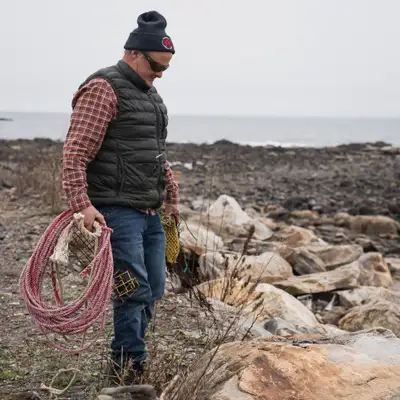
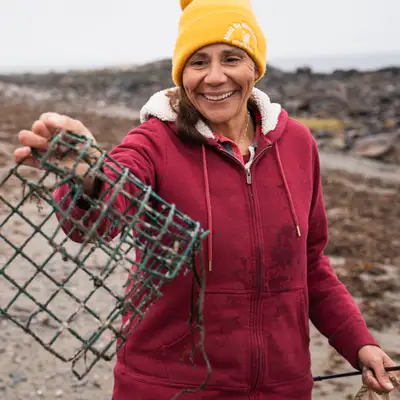
Brian Yurasits: It's a dreary spring morning along the seacoast, and like the clouds above, a large group is gathering. The group consists of local fishermen who have a shared mission: to clear the entire New Hampshire coastline of derelict fishing gear that's washed in over the winter. They divide up the coastline and head out in their trucks, finding creative ways to unearth even the most buried lobster traps.
Truck beds are filled to the brim with the day's findings and brought back to Rye Harbor, where they're documented and collected in a massive pile. What can still be used is salvaged by the fishermen, and what's left is disposed of properly. Remnants of lost and damaged lobster traps are a common sight here on New England beaches. Winter storms and mean seas regurgitate lost traps at sea into mangled bunches on our shoreline. But did you know that it's actually illegal under state law to touch or remove any of these forms of marine debris? That's why once each year, this [00:02:00] gathering of fishermen takes place at the New Hampshire Coastal Lobster Trap Cleanup to document and remove the traps that were lost to the ocean.
No fisher wants to lose their gear. It comes at a cost to their business and to the health of our ocean. So why do these traps wash ashore, and what can be done to prevent this form of marine debris from occurring?
I'm your host, Brian Yurasits, and welcome to Time and Tide, the podcast from New Hampshire Sea Grant, where we explore the science, stories, and people behind our changing coastlines.
On today's episode, I'll be joined by my co-host, Erik Chapman, as we break down the issue of marine debris on New Hampshire beaches.
In Act One, join us at the harbor with Damon Frampton, a local lobster fisherman and participant in this year's annual lobster trap cleanup, who describes why it's important to him as a fisher to be a steward of the ocean.
In Act Two, our very own Gabby Bradt helps us take a step back and understand the broader issue of marine debris on New Hampshire's coastline and how lost or abandoned fishing gear fits into this puzzle.[00:03:00]
In our final act, we speak with Renee Zobel from New Hampshire Fish and Game, who helps explain why it's illegal for any member of the public to touch a lobster trap and how fishermen are working to address some of the challenges we saw during this coastal cleanup.
Swim along with us.
When we arrived at the cleanup, local lobster fisherman Damon Frampton brought us to the first site along Route 1A near Odiorne Point State Park. We hopped out of Damon's truck and saw our first challenge, a lobster trap that was deeply buried under smaller rocks and wedged between two larger rocks.
I think it's just under that rock.
I think it's under this thing. Some leverage maybe. What do you say, tie a rope to it and then, into your truck and just... Yeah, I have a feeling that [00:04:00] thing's gonna need a solid tow.
It seemed like an impossible challenge, the literal definition of being stuck between a rock and a hard place. But rather than call it quits and move on, they were extremely determined to unwedge this trap.
Fishermen: Just do all the heavy lifting. There you go. That's one heck of a knot. Yeah. We can, instead of trying to muscle that out, we can just run the rope through whatever we can grab. I don't want him to hurt his nice GMC. I can grab my Chevy. I wouldn't worry about it. Do you want me to tie one more, like, on one of these corners or something?
Yeah, right, if you go right to here. There's another piece right there. Yeah. I'm gonna get the truck to bring around. You guys ready? It's coming slow. You ready? It coming? Yep, yep. All right, you're good. You're good. Keep going.[00:05:00]
Brian Yurasits: Once we successfully unstuck the lobster trap, I sat down with Damon to talk about why he helps to clean lobster gear off New Hampshire beaches each year.
Damon Frampton: I'm just a commercial fisherman for 40 years. I also am acting president now of the New Hampshire Commercial Fishermen's Association.
Brian Yurasits: How long have you been doing this coastal cleanup, and what's your role in the cleanup?
Damon Frampton: My role in the cleanup is just as a commercial fisherman. I'm, just a guy that goes out and likes to clean up the beach. And, um, long as I've been fishing, I've been doing it. We do it because, uh, the lobstermen are stewards of the ocean, and I believe that this program, everyone comes together one day a year to clean the beach up.
We all work together. We start at one end, work our way to Rye Harbor, and then the, then the Hampton guys work their way up this way. We all unite and work together. I think it's the responsible thing that New Hampshire commercial fishermen enjoy doing.
Brian Yurasits: I assume no one wants to lose traps, right? Like, if you could talk about, you know, the cost behind losing traps and how it happens.
Damon Frampton: Why, why the traps end up on the beach?
Brian Yurasits: Yeah, and how it impacts you.
Damon Frampton: I mean, there's many different styles of [00:06:00] fishing. A lot of guys fish offshore, a lot of guys fish in the middle. Uh, there's still a fair amount of fishermen who fish right up in the rocks.
They're called rock fishermen, like fishing shallow in the summer and in the fall, where the lobsters, you know, they tend to be in the summer and in the fall is real shallow. There's many different types of fishermen that fish differently. And, you know, you have storms throughout the year. And, uh, some guys that fish 10, 12 feet of water, 20 feet of water, you get a great big storm, that's the result.
They end up on the beach.
Brian Yurasits: Yeah.
Damon Frampton: And then after all summer long, since we do this every year, we're not picking up traps that have been there for years. We're picking up traps that didn't survive a season. So they end up being washed up through the wintertime, and that's why they pick this time of year to clean it up, and then next year we'll do the same thing.
Brian Yurasits: Is there anything that you'd want to tell to, say, like a beachgoer who doesn't understand the industry or-
Damon Frampton: The lobstermen, through and through, are stewards of the ocean and the beach and the water within, and I think we all believe in and take care of the way of making a living. We believe, uh, you know, believe in keeping everything clean.
[00:07:00] The responsible part is to pick up our trash behind us, and I think all of us here today and who participate in this program feel the same way.
Brian Yurasits: Along for the ride in Damon's truck was Gabby Bradt, the fisheries and aquaculture extension specialist here at New Hampshire Sea Grant, who helps New Hampshire's fishing community address issues like marine debris.
Gabby sits down with us as we comb through what marine debris actually means and where lost lobster gear fits in the bigger picture. Why do lost lobster traps pose a problem for boaters and ocean life? And how can fishermen save time and money by preventing gear from becoming lost in the first place?
Stay with us.
What's the most unusual marine debris item that you've ever come across during a beach cleanup? It can be the weirdest item, the biggest item.
Erik Chapman: Maybe not the grossest item.
Gabriela Bradt: I have three. I can't choose. All three of them are equally [00:08:00] incredible. One was a mattress on Hampton Beach.
Erik Chapman: That is incredible.
Brian Yurasits: Ew.
Gabriela Bradt: And then the other two are from our shoals cleanups on Appledore, and we found half of a Porta John.
Erik Chapman: Ew. Oh.
Gabriela Bradt: We had been looking out to Star Island and everything, and these big gray seals kept popping up. And I go over this rock ledge thing, and there's this big brown gloppy thing and fuzzy. But out of the corner of my eye I see it, and I'm like, "Oh, my gosh!" And I, like, jump away, start running as fast I can, and then I look around.
They're like, "Yeah, it's a fuzzy beanbag."
Erik Chapman: Oh, like a beanbag chair?
You know, like a beanbag.
Brian Yurasits: Yes. Whoa.
Gabriela Bradt: And it was fuzzy, like a, like mammalian looking.
Erik Chapman: Wow.
Brian Yurasits: I was there with Gabby. I heard the scream. It looked very much like a marine mammal. But the thing that I find the grossest... Sorry, I'm gonna go down the gross road.
I guess my pet peeve is, like, dog poop bags. Those I think are the [00:09:00] most gross form of marine debris.
That's gross and also, like, annoying, 'cause I don't understand bagging it and then leaving it, which is a kind of a little mysterious human behavior that I-
Gabriela Bradt: Well, that's it. It's the human behavior.
Brian Yurasits: The topic of marine debris, it really is this wide spanning threat to our oceans. It's a form of pollution in our oceans, and there's so many different items that are a part of this. Gabby, it would be awesome if you could share, like, a definition of marine debris. Like, what does marine debris mean?
Gabriela Bradt: So marine debris is any persistent solid material that has been manufactured or a.k.a man-made that is accidentally or on purpose either disposed of or it finds its way into marine environments and/or the Great Lakes, 'cause that's sort of the official NOAA Marine Debris Program definition.
But it's basically just any man-made garbage that ends up in the marine environment, and it has to be solid.
Brian Yurasits: Solid man-made items that end [00:10:00] up in our marine environment that shouldn't necessarily be there. I'm wondering if you could talk about some of the organizations that do beach cleanups in New Hampshire?
It's a really great way to get out there, meet some community members, and make our environments a cleaner place, but it's also where we get data on a lot of basically what's washing into our coast here. Who are the big players, uh, collecting this data out on New Hampshire beaches?
Gabriela Bradt: Really the top one is Blue Ocean Society for Marine Conservation, and they have a very systematic way of collecting beach cleanup data.
And it involves ID cards and tallying every piece of garbage that we collect, and then weighing it and identifying it as, you know, is it plastic, is it fishing gear, is it wrappers and stuff? Then you have Surfrider Foundation, the New Hampshire chapter, and I think Surfrider is national. And then the New Hampshire Department of Environmental Services has the Coastal Program.
And then we have New Hampshire Sea Grant, and I help Blue Ocean collect the data. But we also have the Great Bay [00:11:00] Waterkeeper has started doing cleanups. The keeper of the New Hampshire data is Blue Ocean.
Brian Yurasits: Fun thing, I pulled up Blue Ocean Society's data from 2025, which is from over 363 cleanups at 47 different sites, and this is a tally of the number of items that were collected.
So the number one most collected item is cigarette butts on this list.
Gabriela Bradt: Hasn't changed in the 12 years I've been doing it.
Erik Chapman: Looking at the numbers, it looks like it's much higher than the others, too.
Brian Yurasits: Yep. Number one by far, 25,658 individual cigarette butts collected. In second place, we have wrappers, like candy wrappers, food wrappers, with 9,800, so just what you mentioned there, Erik. It's a big jump between first and second.
Then I wanna get into a few of these other pieces that folks might see on the beaches and that we're gonna talk about today. So traps, like fishing traps, that were not removed from the beach, and we're gonna talk about why, 2,807. And then [00:12:00] you have these smaller pieces, like larger than one yard rope. There was 1,274 pieces of that.
So those are some of the fishing-related pieces of debris that we're gonna speak about, and anyone can access this data on Blue Ocean Society's website. I want to get into the focus of today's episode, which is speaking strictly about derelict fishing gear as a form of marine debris on our beaches.
I feel like if you walk around any New England beach, it's something you'll see. You'll see, like, little pieces of maybe lobster buoys. You'll see pieces of lobster traps around. How do these lobster traps end up on our beaches, and is there anything that can be done to help fishermen prevent some of this from happening?
Could you explain this one-day-long cleanup event that happens in April each year called the New Hampshire Lobster Trap Cleanup?
Gabriela Bradt: It's usually the second Saturday in April, and it's been going on for over 30 years. All of the fishing industry is invited to [00:13:00] participate, particularly the lobster fishermen, but anyone who has a license in New Hampshire.
It's been coordinated, really, Fish and Game and the Commercial Fishermen's Association. An average of 100 or more fishermen show up in the early hours of the morning, and it can go all day, depending on how much is on the beaches . And they start out in Portsmouth and go all the way to Hampton and stop everywhere to grab anything that has floated up onto the beaches over the year.
Brian Yurasits: What's one word that you would use to describe this cleanup?
Erik Chapman: The first word that comes to my mind is heartwarming. There are families, entire families that show up and get involved in this, and to me it's just incredibly heartwarming to see pure sort of caring for the environment that comes from the fishermen.
The second, I'm gonna add a second word, pride.
Gabriela Bradt: Camaraderie. The fishing industry and, you know, partners coming together.
Erik Chapman: I think the ingenuity that they are able to pull together to remove [00:14:00] these really difficult to access traps from, you know, our rocky coastline, it's impressive.
Gabriela Bradt: What's awesome about that, though, is that they have all the equipment with them.
Erik Chapman: Yeah, it's a pretty impressive display.
Brian Yurasits: How does derelict fishing gear end up on New Hampshire beaches? What are some of the challenges that fishermen face that leads these lobster traps to show up on our beaches?
Gabriela Bradt: Can we just define derelict? Personally, and this is not anybody else, but this is Gabby Bradt, don't like the term derelict fishing gear.
I mean, that's what it's called. To me, there's just a negative connotation to it. Some people are actually using abandoned and lost gear as opposed to derelict. But derelict, it just means that it is a non-fishing piece of equipment, lost or abandoned, regardless whether it was on purpose or not.
Sometimes it is preventable, but often it isn't. So the way the lobster industry works is that they set their traps in trawls, right? So they're attached [00:15:00] one after another, and they set them down, and it's on the bottom. So you have a lot of ropes and lines, but then you also have a very dynamic ocean, and you have, you know, nor'easters, and you have big storms and hurricanes.
They move. They're not cemented to the ocean floor. So that's one of the biggest contributors to lost gear. You know, a lot of it has to do with accidental running over end lines. Those are the primary contributors to it. Nobody wants it. A 2026 trap, to replace it, it's like $75. It's not cheap. And even if you're a fisherman, you make them yourself, that's still, you know, money that you've invested in your gear, and so nobody wants to lose that.
So imagine if you have even just one trawl of 20 traps times 75, like, that's a significant chunk of money that you lose. Other contributing factors are the actual parts of the trap and gear itself. So the buoys, buoys, you know, age and weather. So they're made out of styrofoam, which is a lot of it that washes up.[00:16:00]
But they break or they get cut off by accident, so you lose those. But everything erodes, right? And so if you have poor quality materials, use and elements, you know, will make it fall apart. And then the plastic coating that's on the wire traps, the manufacturing of it is poor quality. Not only are traps not as well made with good materials, planned obsolescence, right?
So you have to replace them more often so the people who sell you the traps, you know, make money. That's another contributing factor, is they're just not as good as they used to be.
Brian Yurasits: Other forms of marine debris, like you think of cigarette butts, you think of plastics, they break down and incorporate into our environment.
There's threats to people, to wildlife. What would you say are the real, like, worries around abandoned and lost fishing gear?
Gabriela Bradt: The ones that remain in the marine environment, so the ones on the bottom of the ocean, they continue fishing. They're not made out of biodegradable materials. So we didn't used to have a lot of this issue with the wooden lobster [00:17:00] traps, 'cause they would eventually degrade, and they wouldn't continue fishing.
But Because these things don't degrade quickly, especially at the bottom of the ocean, they trap things. Because they're not cemented on the bottom they're still moving around, and it's almost like they start to, you know, entangle amongst each other, and then they can become big gear balls, which in turn becomes a navigational hazard.
Brian Yurasits: So I'm hearing navigational hazard. They continue doing what they were designed to do, which is catch marine life down at the bottom. Are there any, like, solutions to this that can help out the fishermen, that can prevent it from happening?
Gabriela Bradt: New Hampshire Sea Grant has been working with the industry itself and with Blue Ocean coming up with affordable solutions.
So one of the biggest ways to prevent lost and abandoned gear, if you have sort of an end-of-life trap, for example, what are your options? You either can leave it in your backyard forever, or you have to go to the dump and pay money to get rid of it. What Fish and Game, Blue [00:18:00] Ocean, New Hampshire Sea Grant have done in the past is either gotten grants or some form of support to put dumpsters at the ports for gear so that if there's end-of-life lines or traps or nets or anything fishing gear related can go into those dumpsters free of charge. But then the other thing is to also work with fishermen who want to actually help. You know, I think a lot of them are very much, "I lost it. It's my responsibility to get it."
It's not always easy, so when there's opportunities for them to partner up with us, they donate boat time and grappling time and help us remove stuff as best as they can.
Brian Yurasits: You mentioned grappling. Can you explain that a little bit?
Gabriela Bradt: The idea is you put this line with a grapple and a hook, and you go and you hook up to a lost trap.
And then with your winch, you bring it back up. It's not easy. If you end up hooking, like, a big gear ball, it's also dangerous. So really, it literally is by [00:19:00] hand and a side-scan sonar sometimes to figure out where the traps are and hook them up and bring them back up. It's not easy, and it's not efficient either.
Erik Chapman: Do we have a sense of how big these gear balls are or can get?
Gabriela Bradt: It depends, but tons.
Brian Yurasits: Where are we going with this issue? Are there any, like, exciting new technologies being used rather than, like, a grapple, for example? Is there anything that might help us address this problem in a more efficient way that kind of benefits everyone?
Gabriela Bradt: What I think we need to spend a lot of time trying to figure out is what part of the problem that is really truly preventable can we start honing in on? We can't prevent hurricanes and nor'easters. Is there any way we can start focusing on building better materials? I like the idea of research and development efforts going into developing just-as-good materials that are biodegradable or more readily recycled.
Right now, almost nothing on a lobster trap [00:20:00] except maybe the wire and, you know, the cotton rope or something can be recycled. But if things last longer and there's a real streamlined way of disposing end-of-life gear. And so I think what's exciting is that there's organizations that are really looking at that and trying to figure that problem out.
You have to start looking a little bit more upstream in the raw product that will eventually become a lobster trap. How can we make that more sustainable, more eco-groovy, and last longer, and so on?
Brian Yurasits: That all sounds very eco-groovy, and I just love that word that you used. It sounds like everyone's kind of figuring this out in real time at the same time, in a way.
Anyone listening who's maybe undergrad or grad student or is interested in addressing this problem, it sounds like you can get creative with some of these solutions and that they don't exist yet.
Erik Chapman: Circling back to sort of the list of the top 10 and how many of those can trace back to not fishermen, the important take-home for all of us is we can all play a role in, you know, when we bring something onto the beach, take it off.
Gabriela Bradt: It [00:21:00] starts with plastic. At the end of the day, it's the plastic, and we are a society that is completely and totally dependent on plastic material. It's cheap. It's the same thing as, "Well, how do we get rid of all the plastic bags or the plastic straws?" It's like, "Don't use 'em." Well, what's my alternative?
Brian Yurasits: We've all participated in beach cleanups, and anyone listening who hasn't, I highly recommend that you do. It's just a great way to see the problems that our coasts face firsthand. What are the benefits of coordinating and participating in these beach cleanups?
Gabriela Bradt: When I first started working on marine debris and microplastics, I was a brand-new mom, too.
I would go out and do these beach cleanups. Then my kids couldn't walk, and they'd be on the sand, and they'd be grabbing, you know, cigarette butts instead of the goldfish that they dropped. And it really brought it to a very immediate impact personally because I don't want my kid to be eating cigarette butts.
Right? And so the minute you start seeing it, you can't unsee it. Part of what I [00:22:00] think beach cleanups do is exactly that. Once you are aware of it, you can't not be. My kids have all grown up with cleaning up the beach just passively their entire life. Step two is you can see sort of the excess of consumerism, right?
Like, do we really need all this stuff? Part of, you know, a lot of these other big ecological environmental problems, people feel stuck. What do I do? It's such a huge problem. It's an active solution 'cause you can go every Saturday, and you can fill up that bag, and you're like, "Yep, I just got 20 pounds off by myself, and I did a good thing today."
Brian Yurasits: And there's a before and after. You look at the beach beforehand, especially with a cleanup this big, and you see afterwards there's no more lobster gear on any of our beaches. It's like this very satisfying, like, this is what we did today. There's a sense of, like, true community there in a lot of ways.
Erik Chapman: You know, by and large in New Hampshire, we're very fortunate. The beaches are pretty clean. The water is pretty clean. [00:23:00] Seeing that sort of energy focused on keeping things clean is really important to me.
Gabriela Bradt: Our partnerships with the fishing industry is really important, too, right? Like, they really are very concerned about, you know, the waters they're making a living off of and how they are perceived.
And I think this lobster trap cleanup every year, I wish more people were seeing it.
Brian Yurasits: Gabby, thank you for taking the time and talking about marine debris with us, and lost and abandoned fishing gear.
Gabriela Bradt: Thanks for having me.
Brian Yurasits: Our final guest on today's show is Renee Zobel, Chief of Marine Fisheries at New Hampshire Fish and Game.
Renee helps explain why it's illegal for any member of the public to touch a lobster trap, and gives us a crash course on New Hampshire's commercial lobster fishing industry.
Stay with us.
Renee Zobel: I'm Renee Zobel. I'm the Chief of Marine Fisheries for New Hampshire Fish and Game. Relatively new role for me. I've been in the department for 20 years and served in a number of capacities. I [00:24:00] have been a staff participant in the trap cleanup for probably about the past 10 years. As somebody who's kind of monitoring things, helping out where I can, and helping to coordinate the event.
Brian Yurasits: And a personal question for you, what made you want to pursue a career in fisheries? Like, do you have a personal connection to fishing and the ocean? I know you mentioned you're from the Lakes Region.
Renee Zobel: How did I fall into saltwater? So like many folks, I went to school, and then I looked for a science job and had a little bit of experience with invasive species research through the work that I was doing prior.
Came back to the area, was in the seacoast, and found a job with New Hampshire Fish and Game in their marine division, and kind of the rest is history. And I feel blessed because I've had the opportunity to work on commercial fishing issues, recreational fishing issues, but have spent a good chunk of my career working with the commercial fisheries.
As much as I love field work, which I do, all of us kinda get into it for being in the field, I'm really interested in people, in populations, and in the intersection of the two. So some people think a job [00:25:00] like mine, where I go to 1,000 meetings a week, sounds terrible, but our job as fisheries managers is to bridge the gap between the science, the resource, and the communities that it impacts and that depend upon the resource.
So you're trying to strike that middle ground, and there's a lot of economics and data that go into that, and I find that part fascinating.
Erik Chapman: I'm just curious how, you know, your relationship to the ocean has kinda changed as you sort of were drawn into the work that's at that interface of people and the ocean.
Renee Zobel: The more I know, the more I know I don't know, right?
Erik Chapman: Mm-hmm. Yeah, absolutely.
Renee Zobel: You know, classic.
Erik Chapman: Yeah.
Renee Zobel: But certainly a lot more of my personal interest and attention and time goes into more ocean-related issues, species, populations, the hot-bed political issues that we see in fisheries, just making sure that I'm staying up to date on those things.
So I'm a curious person by nature, and a lot more of my curious energy has been channeled right into saltwater-related issues.
Brian Yurasits: I know we're gonna be talking about the lobster fishing industry. Is that the majority of our commercial fishing industry here in our little slice of paradise here [00:26:00] on this small but mighty coastline?
Renee Zobel: The majority of our fishing is lobster fishing in the state of New Hampshire. We have the pot trap lobster fishery. We have a very small groundfish fishery that used to be pretty robust and abundant, and as management and the populations have changed, that has dwindled to a very small number of people.
You have tuna fishing. You have a variety of other types of dogfishing, monkfishing. Maine and New Hampshire lobster run the show. It's a big portion of what we do. And then kind of an increasing commercial fishery that we're seeing is aquaculture, and that's starting to make up a pretty large dollar value of economic impact to the state.
Brian Yurasits: I'm curious also if you could talk about which harbors or ports the lobster fishing industry primarily operates out of.
Renee Zobel: So we have kind of what we call an inshore fleet, which is made up of our state waters harvesters. State waters are out to three miles. That's our state jurisdiction. We also have federal harvesters that fish in what we call Lobster Management Area 1, which is the waters just outside of that, um, and that runs up the coast of Maine as well.
So those are federal waters. We also have a fleet that [00:27:00] operates in Lobster Management Area 3, which is up to 220 miles offshore. So the primary ports for us are Newington, Portsmouth, Rye, Hampton, and Seabrook. Not that we have that many additional ports. That pretty much covers all of them. But our commercial fishing activities are operating out of those ports primarily.
Brian Yurasits: It's a small stretch of coastline, so there's, there's only so many places everyone can go. But you mentioned federal waters, state waters. Do you think you could clarify that a little bit, too?
Renee Zobel: So there's a special line that goes along the entire United States that goes from the shoreline to about three miles out.
We have the Isles of Shoals that creates this little bubble, 'cause that's New Hampshire, so it's three miles beyond the Isles of Shoals. But anything that is the state jurisdictional land, go three miles out, and that's about where state waters ends. So that's all the stuff that we as a state have regulatory control over.
Beyond that, from three to 220 miles, is what we call federal waters. So NOAA Fisheries gets involved with permitting vessels that are fishing out there in federal fisheries, and we do have overlap between the two, [00:28:00] where people hold both, the ability to fish in both areas.
Brian Yurasits: As soon as you start getting into fisheries management, you realize how complex a lot of this is, and what people who are fishing, like, really have to know and understand.
Renee Zobel: Yeah, and even in the ocean, there are multiple types of boxes. Not all the boxes line up between different things, and all the fishermen have to know all of this. So there are something called statistical areas. The entire ocean is gridded into these statistical areas, and then beyond that we have lobster management areas, which don't line up perfectly with the statistical areas.
So when they're looking at their charts and maps, they really have to know the regulations because lines are all over the place, and they have to know where they are and what they're allowed to do in a specific box.
Brian Yurasits: Sounds like an intense game of chess.
Erik Chapman: Are most of our lobstermen sort of day boat fishermen? Are there others? Um, and I guess can you give us an idea of numbers?
Renee Zobel: So we in New Hampshire have a special, what we called a conservation equivalency back in the day. So we have a special tier of licenses that nobody else in New England has. We have a commercial license that allows [00:29:00] for folks who qualify for that to fish up to 1,200 traps. There's only 29 of those.
And then we have a 600 trap license that allows others to fish commercially. That is a little bit less than 100 individuals. Those are our full-time fishermen that exist in those two license categories. Some of them also have federal permits, some of them don't, so that means it expands what they can do fishing-wise.
We have a little over 100 typically that have what we call 100 trap license, part-time commercial license. That allows access to the fishery, but you certainly couldn't make a living doing that. And then we have at least a couple hundred recreational license holders on an annual basis. So that's all within New Hampshire.
Erik Chapman: And then yesterday I was coming in from Shoals Marine Lab. I saw a Shafmaster boat going out. Can you talk a little bit about them for a moment?
Renee Zobel: Sure. So we do have an offshore lobster company. They fish out in Lobster Management Area 3, and I won't tell you anything that isn't publicly available.
The lobster fleet out there is fishing very differently than the fleet here. They have much higher trawl sizes that they have to fish. They're [00:30:00] out for multiple days at a time, versus our in-shore fishermen is all day boat. Yeah. People aren't going, you know, more than 25 miles out, basically. But for the offshore fleet, talking more like 7 to 10-day trips.
Brian Yurasits: I'm curious if you could talk about some of the rules and regulations that are in place when it comes to the gear that lobster fishermen are using. I know that there are things like weak links, and there's certain ways that you have to set up your traps.
Renee Zobel: Sure, and I'm glad you brought that up, because I think that really ties...
Even though some of the point of those regulations aren't to prevent derelict gear, they do prevent derelict gear. So regulations for lobster fishing, you need to have sinking ground line if you're outside the harbors. That's to protect whales, but that also could prevent interaction with that ground line.
It does interact more with the ocean floor as a result of not being floating in between each of those traps. Ground line is the line that goes between the traps that are connected sitting on the ocean floor. And then you have your buoy lines. The buoy lines do not have to be sinking, but the buoy lines have to [00:31:00] have a 1,700-pound breaking strength weak point in them, and there are a myriad of ways that you can create that weak point, all on a list on NOAA's fisheries website that has the approved list of options for you.
But it could be rope, could be devices. I brought one with me to show you today. There's a couple different options for devices that you can put on your rope. If you're a gillnet fisherman, you have to have weak links as well for those panels, and those are at 1,100 pounds.
A trawl of at least five traps has to have two buoy lines on it. That is so that you can grab that trawl if one line happens to be broken off. If you have less than that, you only have to have one buoy line. But if you have five or more, you're required to have two by regulation, and that's true in state waters and federal waters.
Brian Yurasits: It's kind of like a fail-safe in a way, if someone was to cut it with their prop.
Renee Zobel: Yeah, I don't know if any of you have been out on our waters during the summertime, but lobster gear abounds. There are buoys everywhere. So it is very possible that the buoy gets cut off with a boat that's passing through.
Brian Yurasits: And one more rule I want to get into, too, is the seasonality of lobster fishing.
So [00:32:00] when is it generally occurring off our coast?
Renee Zobel: There is no season for commercial lobster fishing. We have commercial license holders and harvesters that fish year-round. It just is a matter of where they fish. Most of the gear within state waters isn't put in until May, often towards the end of May.
Why? Because the lobsters aren't here before that. Lobsters tend to migrate out and then migrate in. Okay. So as the water warms up closer to shore, they start to come back into shallower water. So those that are fishing during the winter have a lot more success being out in federal waters, so that beyond three miles that we were talking about.
As they march in, so go the traps. I will say one other one is that starting a few years ago, lobster harvesters are required to check their traps every 30 days. So at least once within 30 days, they have to go tend to their gear. So there historically was a practice of what we call wet soaking. So during the winter months, sometimes people would open up their traps, leave them in the water, not haul them home, and then they have more of a ability to get cut off, become derelict, interact with marine mammals.
So [00:33:00] this was instituted as part of the Take Reduction Plan for Atlantic large whales to deal with that, but it also helps prevent derelict fishing gear from occurring.
Brian Yurasits: I would love to now transition to what it's like to attend these New Hampshire lobster trap cleanups. I'm curious if you could tell us about, like, your experience being a part of that day.
Renee Zobel: It's always a fantastic day. I encourage other people, our politicians, our executive councilors, I always say, "Let's get out there and experience this," 'cause first of all, it's collaborative. So as you can imagine, there are different ports in the state of New Hampshire. Those ports have their own little micro-communities.
They don't often intermix. So you have the folks from Hampton Seabrook, you have the folks from Portsmouth, you have the folks from Rye. This is the one day where they all come together and do something collaboratively. The other thing that staff and myself really appreciate, we don't often get face time with everybody all at the same time.
We're there, we're accessible, are able to have one-on-one conversations, and I think that's so important.
Erik Chapman: Totally understand how, like, the Hampton Seabrook and the Portsmouth and the [00:34:00] Rye, they all have very different connections to each other. And then you guys in the mix as regulators. You know? So everybody's pulling traps out of the sand.
That's so cool.
Renee Zobel: There was a request from the commercial fishing industry that there was one area in Rye that had been kinda problematic, and they said, "Hey, could we have law enforcement not only kinda present and kicking around, but could they be there with us for this one specific thing?" Our sergeant in the law enforcement district down here on the coast, he was hauling traps out with everybody else.
Brian Yurasits: There's a purpose behind a beach cleanup, I think that's greater than just cleaning the beach.
Renee Zobel: It's very gratifying. I mean, you clean up a beach, and it looks completely different than it did beforehand. But yeah, the theme that you'll hear a lot out of industry is stewardship. They are stewards of the ocean.
That's how they make their livelihood. They care very deeply about the resources, the ocean. They care deeply about perception. When all of this gear washes up on the beach, that can look not great on behalf of the industry, and so making a meaningful effort to make sure that that's cleaned up and they're being good stewards of the [00:35:00] resources that they have.
Even though many of those participating, their gear never ends up washed up on shore, and it's other people's gear. They're still out there participating because it's their industry and they care about making sure that they're not leaving an impact on the shoreline.
Brian Yurasits: Do you know how many fishermen participated in this?
Renee Zobel: So this year we had 110 participants. That is a record number this year. That's the highest that we've ever had. So the legislature introduced a statute, a law, that would require individuals that were in certain licensing categories, so lobster being one of them, that they pay between a certain range, and it's been set by the department at $15, as a surcharge on their license fees each year that goes into a fund specifically to address derelict fishing gear issues, and it's dedicated to that and only that.
Participating in an approved coastal trap cleanup allows that fee to be waived in the following year. All those 110 participants from this year, if they purchase licenses next year, they do not have to pay that fee on their licenses. One use of that type [00:36:00] of funds would be there's a dumpster at the Seabrook Co-op, and that dumpster's been available for years.
We previously had a federal grant to fund that dumpster. That federal grant disappeared. This year we actually had a wonderful partnership with Blue Oceans. They had a NOAA Marine Debris grant and were able to and offered to come in, partner, and put the dumpster there in place of ours, which we no longer had the funding for.
But if we go back to that, the derelict fishing gear fees would go into something like making that available so the industry has a free place to dispose of fishing gear that can no longer be used. It also helps us pay for the trap cleanup event. It's not a very big pot of money, but it can be used for anything that kinda falls in that basket.
Offering a free opportunity for people to unload gear that they're no longer going to be able to utilize and have to dispose of is a priority and will remain so.
Brian Yurasits: Another question about the event itself. How long has it been going on for, and has the amount of debris collected also fluctuated through time at all?
Renee Zobel: The event's been going on for more than 20 years, so it [00:37:00] has a fairly long history of industry involvement. The amount of gear that was taken out this year was about 8.2 tons of gear. The amount of disposal does fluctuate pretty drastically depending on the year, and it's very dependent on winter coastal storms.
If we have big winter coastal storms, we have a lot of cleanup to do and a lot of gear to dispose of. This year we got kind of a double whammy in that we had some big storms in September, and probably some of the gear on the beach was still residual from that. We have an agreement with state parks where they're allowed to bring gear from state parks to a certain location for our conservation officers, so the beaches always look pretty clean, but when you kinda get into the rocky shorelines, that's when nobody's grabbing that gear except at this event.
Brian Yurasits: That's a lot. It's a big pile, and I promise you we'll have some visuals to show what that looks like. You have agreements for people to touch and move this gear. This is something fascinating that most people who walk New England beaches, like you see lobster buoys, you see these traps that have washed in from [00:38:00] storms.
It's kind of this, like, normal sight in a way. It's something you almost expect to see on New England beaches. Something that people don't understand is that you're not allowed to touch that gear. I'm curious if you could talk about why that is.
Renee Zobel: Yeah, it's a great question. The short answer is enforcement.
Our conservation officers need to be able to enforce the potential for someone to take, move, touch, cut off, steal somebody else's gear. And so there's a regulation to make sure that all of that is covered, and so if they bring these cases forward, that they have a lock tight case that they're able to make.
We have a law on the books, but I'll read the first part of this. So this is RSA 211:31. It says, "No person, except the owner or a conservation officer, shall take up, lift, molest, have in his possession, or transfer any pot, trap, car, or any other contrivance that is set for the taking or holding of lobsters or crabs, nor take, remove, or carry away from beach or shore any [00:39:00] such pot, trap, car, or other contrivance, or warp or buoy, without the written permission of the owner.
In addition to penalties for violation of this section, said person, if he holds a license, shall lose said license for one year." So those are really there to help law enforcement do their job.
But yeah, you can't pick up a buoy off the beach and take it home and add it to your coffee table. You can't grab a lobster trap and do something cool with it.
You know, I know that's pretty common here in the Gulf of Maine. Run up and down the coast and you're gonna see buoys out on people's houses or sheds as decoration. Those belong to the owner. It is pretty strict regulation. If you see a trap on the beach, you are not to touch it.
Brian Yurasits: So anyone who's participating in a beach cleanup, if you do come across derelict fishing gear, what are you supposed to do with it?
Renee Zobel: Give our office a shout. So every lobster trap and lobster buoy is required to have the first initial, last name of the person who owns it on it. So a buoy should have something on it in addition to colors, which we can look up. The trap also should have, by law, their first initial, last [00:40:00] name. Additionally, in order to fish a lobster trap, you have to have what we call a lobster trap tag, and those are little plastic seals, think of them like a zip tie, and they have unique identification numbers on them that allow us to identify the license holder.
And you can give us a call, let us know where it is, and then if you happen to be able to see any of that information, you can help provide it, 'cause maybe we can just call that harvester, tell them where their trap is, and they'll just go pick it up themselves, and we don't have to get in the middle of that.
Brian Yurasits: Related to beach cleanups, do you work with, say, Blue Ocean or Surfrider or any of these folks that are doing beach cleanup? Like, if you're part of an organized beach cleanup, do you have any, like, agreements?
Renee Zobel: So in the past, when some of those types of things have occurred. I know, like, for example, Blue Ocean has done some in-water work, and our law enforcement has been in the loop on that, and either they're communicating about: is this trash or is this something that the conservation officers have to deal with?
Brian Yurasits: I feel like this is very timely for folks to know about right now.
Renee Zobel: We're definitely headed into beach season. It's a time when we definitely get a lot of those phone calls, and we're [00:41:00] absolutely happy to field them and get them to the right places.
Brian Yurasits: What are some of the challenges that fishermen face that ultimately lead to their gear washing up on the shore in a tangled bunch?
Like, you mentioned winter storms being one of the reasons. I'm curious if there are other ways that fishermen can prevent this from happening.
Renee Zobel: Traps are extremely expensive. Nobody wants to lose a trap. In New Hampshire, we're unique in that the majority of our fishing is in trawls. You go up the coast to the north, and that is not necessarily true.
They historically were fishing a lot of singles. Now they're fishing a lot of doubles and triples, um, or two or three traps on a trawl. In New Hampshire, other than kind of our smaller scale folks, people are fishing trawls. So that alone helps prevent derelict fishing gear from occurring. You have a large trawl, they're easy to grapple if buoy lines get cut off, they know where their gear is. They're very good at it. They can go down and they can recover their gear, even if it doesn't have buoy lines on it. Another thing that we always really recommend is that when people are new, they're the ones that are more likely to set their [00:42:00] gear in places where other gear is not.
Now, there's probably a reason that there's not other gear in certain places, maybe too shallow, tidally influenced. Somebody knows something that they don't know. Encouraging them to try to strike up dialogue with the more full-time commercial folks. The other thing is for them to be aware the orientation of gear sets.
So our harvesters will set their gear in certain ways, and so when you know the ends of a trawl that everybody is setting out who knows a lot about fishing go in a certain direction, don't set your gear in the other direction. And it has a lot to do with what people know about the movement pattern of lobsters in those areas and where they're most likely to encounter the traps.
If you know that, extremely helpful because if you set over another person's trawl, then you may run into some challenges when they pull up your trawl as well, 'cause they'll toss it back over. Now it could end up in a pile versus in a line.
Brian Yurasits: What stood out to me is that this is the most people you've ever had participate in this cleanup.
Is there anything else that makes [00:43:00] you hopeful about the fishery and this issue of marine debris in our oceans?
Renee Zobel: Yeah, I think one thing that's really hopeful is we're having a lot more dialogue. Um, some of that has been prompted by regulations, not gonna lie, but it has opened up more of a door for more informal conversations around all sorts of issues, including this one.
So there's a lot more discussion happening. And to see the younger generations jumping in and helping out. Our lobster industry is aging, just like the industry on the entire northeast coast. The Gulf of Maine and elsewhere, our commercial fishing industry kinda averages about a year older every year.
And so getting that influx of young people into the fisheries and involved. It's always nice to see everybody who's been involved for many years, now their kids are doing it, and now their kids' kids are doing it. And so you've got kids out there in gloves running around, picking up lobster traps, too. And in one specific situation I'm thinking of, I won't name names, but there's three generations that were [00:44:00] out there from the same family helping out in the lobster trap cleanup, and three generations of license holders, down to the youngest one.
Brian Yurasits: Well, Renee, thank you for taking the time and answering all of our questions about lobster fishing and marine debris in New Hampshire.
Renee Zobel: You're welcome. Thank you.
Brian Yurasits: Thanks for tuning in to this month's episode about marine debris and the New Hampshire lobster trap cleanup. The next time you're taking a walk along our rocky coastline and sandy beaches, keep an eye out for marine debris, the visual reminders of our impact as humans on these habitats.
And always leave the beach a little bit cleaner than you found it. But don't touch that lobster trap; report it to our friends at New Hampshire Fish and Game instead. You can find their contact info in our show notes.
We highly recommend signing up to participate in any of the monthly beach cleanups hosted by Blue Ocean Society, Surfrider Foundation's New Hampshire chapter, or the New Hampshire Coastal Program. See our show notes to find a beach cleanup near you.
Time and Tide is produced by New Hampshire Sea Grant. Explore more episodes featuring the latest coastal science [00:45:00] happening here in the Granite State wherever you get your podcasts.
And if you like what you've heard, please consider leaving us a review.
See you next time on Time and Tide.