Subscribe
Share
Share
Embed
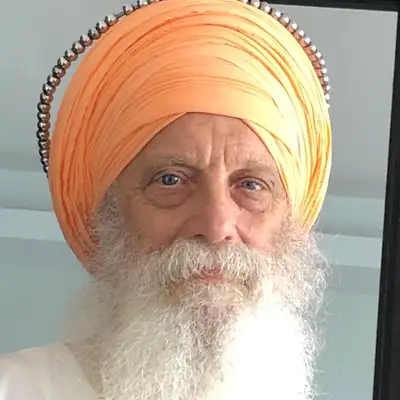
This podcast series is a presentation of challenging and irreverent conversations on wisdom, courage and common sense; for the most part taking place between renown spiritual teacher Hari Nam Singh Khalsa and respected leaders in the world of thought and action. These light-hearted, spontaneous and unpredictable conversations about all facets of life inevitably provide a platform to explore the depths of human nature and human destiny. In particular, it is the intention of this series to introduce our listeners to the value of the Khalsa Spiritual Path and its Code of Conduct, the Rehit Maryada, as created by Guru Gobind Singh, the legendary 10th Master of Sikh Dharma.
Wahiguru Jika Khalsa. Wahiguruji Kifate.
Vaheguru Ji Ki Fateh Hai
Okay, well, ~ I ~ for ~ many of you who
have no idea what we're doing,
we just did like a very common ~ thing
that the warrior saints do,
the the warrior saints sect of ~ the Sikh
faith do,
and that's how they greet each other.
We always say Wahi Guruji Kakhalsa,
Wahiguruji Fate. It's my ~
Fantastic pleasure to ~ bring into what
you're saying today,
my dear friend Siri Katarkar Khalsa.
And ~ I I've been actually I as I told her
before the invite,
I I I was ~ I was wanting to wait until we
kind of
had enough traffic here to to to to really
justify having her here.
And at this point, ~
Thank God that we're we're starting to get
some traffic.
We're getting people to watch this
actually all over the world,
including ~ we have a pretty broad
audience at this point.
We're we're getting a lot of Punjabis,
a lot of ~ people who
What?
are born into the faith, a lot of people
who are born in the faith who
are who have the level of commitment that
that we have,
and those who who are are just you know
kind
Newer.
of exploring that. And then there are
people.
Who will be listening who have no actual
background in what we're doing.
So hopefully ~ you you're as I was
explaining to Suri Gartar,
this is hopefully less of a lecture or or
an interview than it is kind
of ~ a conversation between two friends at
~ the coffee shop,
and you're a fly in the
You
wall, so you can just kinda listen
He he he.
to us talk to each other and hopefully get
something out of it.
~ that's
Related to the objective of of this
podcast is to share with the world
the the this lifestyle of the warrior
saint is talked by ~ Guda Gobind Seng,
~ of our spiritual path. But we we have
guests on for all walks of life
and and what's important is that the
people have something of value to
say that at that dovetails with what we're
doing here.
So ~
Just quickly introducing ~ Suri Katara to
all of you if you haven't met her before.
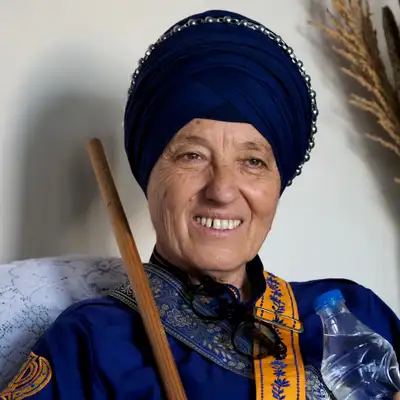
~ as as you can see from her on the video,
she like myself, ~ is presenting herself
to the world as ~ Ahmedari Sikh,
somebody who's taken ~ vows to ~ live this
at a certain level that we
we often talk about. And ~ let me see,
~ wow, how how old are you, Suri Katara?
Almost 70.
Almost seventy. I was almost seventy five
years ago.
So I'm I'm I'm I'm scratching on seventy
five years.
So five years ago I I was almost seventy.
So congratulations for the big seven.
Hey, you know.
~ so
the two of us ~ together have been on the
planet like a hundred
and forty five years. So we we've got ~
we've got a lot of tread on
our tires that's been worn off.
But ~ Siri Qatar ~
lives in Italy and ~ she has been involved
for ~ like myself probably 50 years in the
life of of being a Sikh she
Yes.
~ is a ~ multi-talented person ~ she she
does a
lot of things she she she practices and
teaches yoga she's ~
a fantastic ~ musician ~ plays the people
in our our ~
Path would understand what I'm gonna say.
She plays Durbanikin, plays, plays the
divine music of the Sikhs.
She's very, very talented ~ musician.
Well, hey, Gitter.
She's also she's also a ~ fantastic ~
artist.
And yeah, as you can see there,
you know, she's got ~ some paintings on
the wall behind her,
and I and I I believe she's the painter of
all those paintings.
So now
~
she does all kinds of great painting,
but but
Purposes of this podcast. She's done
fantastic paintings of the lives
of the Sikh gurus and themes that are
relevant to this path.
~ She's a world leader in this path,
a very admired person. And also,
very interestingly enough, she has
practiced and taught martial arts,
specifically the Sikh martial art of
Gatka.
for I believe for about fifty years.
And ~ so she she's had students ~ all over
the world.
~ and ~ and I have to say,
you know, I I aside from my friendship
with her,
I I owe her quite a lot because you know,
you can see she's got a she's got a what's
called in the hung warrior turban.
I've got one. ~
I get a lot of compliments on my turban,
but what the people don't know is that
she's the one who actually taught
me how to do it. And I've been trying to I
I'll be honest,
I've been trying to do this for decades,
but she was the first person who actually
successfully taught me how to do it.
And now I kinda have my own everybody's
kinda got their little style on doing it.
But but she's the one who kinda taught me
the foundations of it.
And also I she's a friend, but she's also
my teacher.
She's my gutka teacher. And I've been
practicing ~ well,
ever since ~ I was almost 70 five years
ago.
So ~ I've been studying with her about
five years,
gutke, and this has been life
transformational for me.
And we'll we'll put on a little ~ I'll put
on a little thing later when
I edit this video with ~ ~ you know
her her email. So if you want to take
lessons from her that you
can contact her personally. I highly of
course recommend it.
It's been a big impact in my own life.
~ and it's a very important part of our
our lifestyle.
All right. So long com long introduction,
Siri Katar. ~ how did we, you know,
Wow.
how did how did we meet actually?
you know it's gonna this is gonna be a
good conversation because you know,
as we're getting older my memory
He's not what he used to be.
I remember I'm
young. I remember I'm five years young.
That's right. You're still on the other
side of seventy.
So ~
reminder we both have been involved in
this lifestyle ~ a long time.
~ how d how did we how did we meet again?
We never met in person while I lived 33
years in LA
and you never lived in LA so somehow
No.
we never crossed so we never met.
~ But then...
Probably saw
each probably saw each other, but not on
the radar.
~
At that time we were hundreds and hundreds
and the men they all looked like,
know, with the beard, the turban.
So, but then via mail, the mail.
So we recognize each other, writing about
some issues,
something. Yeah,
We were on some email list together,
right.
we were hundreds and somehow we noticed
that we had the same kind
of understanding and how
We were acting, not reacting to some
situation,
very...
~ I remember
now. I remember now, yeah. I r I remember
now.
I remember that you were the clever among
all of them.
I said this guy, he really seemed very
clear.
He states things so clearly that I loved
it.
And you contacted me because I did some
reply,
very short, I'm very short, I'm not a
writer like you,
you're a lawyer. But I go straight to the
point with a few words and you got it.
You're the only one that got me.
So you started to talk to me and we
started to be friends,
be brothers and sisters and then we start
an adventure in the Khalsa spirit.
Yeah,
I remember this because ~ we were on ~ I I
won't get into the the
No, it's too much. Yeah.
the purpose of that email, but we w
we were on a email list together.
We didn't know each other, but but but
Right.
as you said we were and and and for people
listening to this,
it's it's good because they're you know,
you always should have your antennas up.
That's what I'm saying. Like it's a matter
of that.
Yes!
You don't you don't have to chase
anything.
You just have to know what
you want and just pay attention to what's
going on around you.
So as you
Yes.
were saying, we were in this ~ group where
there was ~ many,
many people, maybe as you said,
a hundred people interacting.
Hundreds yeah
But but but ~ I at that time already had
this C thought
in my head that ~ that I think at that
time
we in our lives, it's probably okay to say
that
~ we were primarily ~ and I'll speak for
myself because
I won't speak for you, but I I think
myself,
like other many others, was ~ really kind
of focused on promoting the mission of an
organization called
3HO that we were part of, teachings of our
teacher,
~ that that included Siki, you know,
and included to whatever
extent people were involved with the
faith,
you know, and ~ and then there,
you know, we've been around for decades
and there was some kind
of shifts without getting into all that
stuff.
But ~ I myself had this revelation before
even I had anything
to do with this email group that ~ I
needed to move forward.
Like I needed personally this
wasn't working for me. And I needed to
move forward ~ in integrity and sincerity.
That I had to be honest, what was the
thing that ~ talked to me the most?
What w what it was it exactly like you
saying that that I'm a clear person.
So I I felt I had some clarity with
myself.
What was it that I personally wanted to
put my energy into going forward.
Exactly.
in
the light that everything around me was in
chaos.
So I'm thinking, what's what
Yes!
do okay, I can't change other people.
What do I want to do? And I was thinking
two things to myself.
One was is that the thing that was most
important to me was what we know
as the Khalsa. That the that that that
which,
you know, it's hard to just explain ten
seconds,
but it's basically this whole warrior
saint
Aspect of Siki that we have been around.
And that was the most important thing was
to immerse myself in it and
to share that with the world. But I just
had that thought of myself.
But I also had learned from life that if
you have an idea,
you're never the only one who has that
idea.
So I just took it, I just took it as an
assumption that if
If I had this passion for just jumping in
with two feet into
the culsa and and and being open about it
and making it about the culsa,
that I'm not alone, that there's other
people in the world,
and I I don't have to go look for them
under every rock,
they'll just appear. And
They will come.
then I was in this email group,
and you were writing something,
and I get it, and what I got was.
Yeah, I don't even remember what.
I don't either remember what,
No.
but I I said I gotta get in touch with
that woman because ~
Yeah.
that woman's on the same page as I am.
I could get that, and I did,
yeah.
and you were, and and I think that may
have been and then there was
a couple of other people, but we we kind
of all were on the same page,
and out of that it came something called ~
the cult of society that
was just this vision going forward of.
bring awareness to of of the ideals of the
Khalsa to the world.
We've now done that for a number of years.
And ~ so this is a very, very strong bond
and this thing is growing.
So that's another thing that Siri Qatar is
involved with that is dear to
me is this Khalsa society that we're
working
Yeah.
on. So whew that's how we but I'm talking
a million miles a second here because
I'm so excited. But that's actually that's
I now that's how we met.
We met
Yes.
kind
of finding each other, already having kind
of developed our own develop our
relationship and commitment to this
and found a kindred spirit and found other
kindred spirits.
So I think that's that's kind of how we
met.
this is it and can you believe when you
call me because then you wrote me
say can we talk and then of course you're
a big talker we talked for one hour
and it was I was in Italy visiting my
family because at that time I
was living still in LA but I was in Italy
~
I tell my family okay I have a phone call
I need to be in the backyard
for one hour because
We were talking and talking one hour and
things that just unite
and just flourish. But organically,
there's nothing that we pushed.
We just recognize each other. We recognize
what it is called.
So we already know it. It's just to find
people to be together and
to be together and to be together.
Good to go, Vincent. Good to go,
Vincent. Yeah. So it's a...
You know, I I
yeah.
It's amazing.
been years. It's been now about five,
six years that we started to
Yeah.
connect and then we fight other people
with the same,
we call it vibe, with the same
understanding,
with the same way of thinking and acting
and living.
That's the point. Like I remember when you
mentioned me one thing that I said,
whoa, when ~ you came here to Italy,
but mostly your wife was here with me in
the house anyway.
So you,
Either we showed you a video where,
you know, she was, you know, I was hosting
her,
it was a moment of distress, but it was
good as well.
And then I have plenty of painting on the
Gouda,
plenty of photos of the Golden Temple,
of the swords on the altars.
And then you said, wow,
are there houses of your friends that they
are sick?
But you said there's nothing that you
identify is a house of a Sikh.
Mine every day since morning always
vibrates,
jabji, jabji, jab saib, everything all day
long.
Right now I just stopped it so I can hear
you.
But this is the house of a Khalsa.
This is a house of a Sikh. It has to be
surrounded so you can really live that
vibration, that understanding.
You can't be a sicko in Gordoara.
How did you again remind me,
because you know, I I ~ I just found out
there's somebody who's kind
of taking care of some of the social media
for me for on
Hmm.
this podcast. And so it's interesting,
it's growing fast, the the number of
viewers of ~ especially the shorts on
this,
but what
Bravo!
I I th I found out and I'm not surprised
is that ~
Actually, there's a lot of viewership of
this in India.
Wow.
Yeah, India, in Great Britain,
in Canada, okay, Australia. So we know
that there's
a lot of Punjabi ~ Sikhs and and Khalsa
who
are watching this because the you know the
the the the analytics say this,
which is great. And we also have other
people who who are kind of interested,
Good good
have never seen it.
So ~ I think it, you know, assuming we
have those people watching bits
and pieces of of this ~ conversation,
~ they're gonna see two 70-something
people,
or almost 70 and 70-something people who
obviously are,
you know, two as they would say,
Gordo Sikhs, or or we here in Mexico would
say ~ gringo Sikhs.
but we're we're we're obviously ~ not born
into this and we've been practicing this
with great commitment for 50 years or
more.
So I I think there's some curiosity about
that.
~ even as there's pressure ~ in in some
of these communities for people to abandon
this,
we we kind of jump into it.
And so I think it would be interesting for
~ ~ and maybe you can recall to me too,
because sometimes I I forget these things,
how how you got involved, you know,
how you got involved with this in the
beginning way back when and what what
was your ~ personal evolution to where you
wherever
you kind of started on this path.
how you landed up as an Ahmedari Sikh and
then actually a representative
of it around the world like myself.
I how how did that journey look like,
more or less? Like from your childhood.
No, I'm not saying like every detail of
your life,
Yeah, yeah, yeah, I don't know.
but but more or less how did you find your
how did you fall into this and how did
I got you. Okay.
you not only fall into it, but get to
where you are right now?
Okay,
I tell you the story of my soul.
Since I was a kid, I was in search of some
form
of devotion that was coming from the East.
Because I was, of course, as a Catholic.
And what did I like? The devotion of the
nuns that they were praying.
And early in the morning, what they were
doing?
Praying. that part, I loved it.
Only I don't fit much into the Catholicism
so many mostly because
~ women they cannot do that. They cannot
do that.
I could not accept it even as a child.
So I had this feeling. It was calling me
like existing devotion from the East.
And at that time we're talking I'm born in
57.
So at that time really nobody could have
access in Rome.
There was nobody. So I had to wait until I
was
20 that I heard a friend of a friend of a
friend that was doing meditation
and yoga and the teacher was a Sikh.
It was our teacher, the citizen Sahib Jung
Ibanjan.
So this thing immediately drove me.
I said, I'm going. So I started like that
and I started to live in the nivas.
And in the morning is the sadhana,
the practice, Any practice, but the
practice that he taught us because
he was a Sikh, Khalsa Amritdhari,
the job, Ji, immediately I fell in love
with Guru Nanak,
immediately, immediately. So to me,
I already at the beginning, I said,
I'm a Sikh because I fell in love and
Of at that time there was all in English,
I didn't know English so I had to learn
English to understand the meaning
and then to learn a little bit of Gurmukhi
because at that time you did
not have all the tools you have now so
it's been very slow.
Yeah, Gurmukki,
for those people who don't aren't
familiar,
They don't know. It's this... Yeah,
Gurmuki is kind of this the scriptural
language of of the teachings of
the alphabet.
the founders of the faith. Yes.
Yeah, the alphabet then from Guru Nanak
when he was,
you know, putting the bride in.
Like what's behind me what's behind me
It's Guru Mukhi.
in in my ~ in my virtual background i is
Yeah.
virtual it's not re it's not something
like that,
but that's a virtual background.
But that that is gurmuky,
See.
that is ~ the actual handwritten
Konkara Sattenam Kartapur, it's the
Moolamantara.
So it's the opening of the Japji Sahib of
Guru Nanak Devji.
Then I started to read more and more.
So I fell in love with Guru Nanak
immediately.
And then it took me a while to really,
you know, again, because of the language,
then I had to really, you know,
learn English better and better.
Then finally I said, okay, that's it.
So I moved to LA.
after 10 years of this practice.
also my devotion, my tools of expression
actually when I
was a child was always the singing since I
was two years old,
singing anything because I was shy.
So I could express myself through that,
my emotion, my devotion, whatever it was.
So when I found out that this path,
There's a lot of devotion through the
chanting,
singing and the psalmody of the Japji and
all the bunny.
So that's for me. That was something for
me.
So I started more and more to get into
that and to learn a little bit guitar
so I could accompany this.
you know, small part of the mantra at the
beginning and then slowly,
the Guruvani Kirtan and then now I'm more
and more into Viras Kirtan because being,
it's been maybe 10, 15 years and even more
involved in the Ghatka,
maybe 20 years, more and more and more and
more.
Yeah, by the
way, let me just interrupt for a second.
If you're gonna use any terms,
okay. Like
Mmm.
we're in a conversation, so we all know
what we're saying,
but ~
Yes.
there'll be people who have no idea.
So if you're using like ~ specific terms
of the faith,
you may just wanna quickly describe that.
Yes, specify. Yes,
Yeah.
so the Biraskirtan is the kirtan.
Bir, bir is the warrior. So it gives you
that energy,
that fire energy, action energy.
of course it's always filled with bhakti,
which is the devotion, the love.
Again, Gurugubind Singh always said,
the one that knows Gurugubind Singh.
And then yeah, and Guru Gobind Singh,
the the tenth the tenth guru
of the lineage of the Sikhs. Yeah.
of the
Sikoguru, the tenth. He says,
like Guru Nanak, like all says,
the one that knows love knows the Lord.
So again, even now we are with the Saint,
soul, Saint warrior. So there is the
energy of the warrior that as a Khalsa
we want to establish. But why?
It's not to show that we are strong,
we have strong muscle, we are powerful.
See, we are powerful to do what?
It's always in the serving. So it's,
you have to have power of your body.
have to, this is a temple, right?
Everybody knows this word. It's a temple,
the body. So we need to take care of this
temple with everything that goes with
our daily life, right? So then our mind
has to be calm.
Otherwise we react.
The human is supposed to act, not to
react.
To react is for the animal. So what do we
do?
We do namjapa, we meditate. So Guru Gobind
Singh,
the 10th Guru of the Sikh, gave us the
Vaheguru.
I often, often in my mind,
in my daily life, Vaheguru, Vaheguru.
Anything happens is Vaheguru. Vaheguru is
this wonderful understanding because
Guru
means. Gu means darkness.
So means no understanding. Ru is light.
Well this light is when you understand.
You got it. So wahis,
wow is the wonder. You're in a state of
wonderful awe.
Why? Because you experienced this guru,
which is this technology. Whatever it
could be,
could be a bunny.
which is a written devotional composition
could
be anything that brings you from no
understanding to understanding,
but understanding what. It's not with
this,
it's really with yourself, with your
experience.
How did you like
you you you started when you were much
younger?
It was ~ maybe 50 years ago when you
started when you were much younger.
And you know, from my ~ sh I think
probably mostly shared
experience, ~ a lot of ~ contemporaries
~ came into that movement ~
for whatever their ~
personal reasons were and and a lot of the
people had in common
an interest in ~ eastern philosophy,
things like yoga, meditation, and and this
kind of stuff.
And then you got into it, you were exposed
to not only Sikhi,
but ~ also ~ were exposed to to the
Khalsa.
Technology. Yeah.
And and and that, you know, that that
particular part of it. And yet now it's
and it's kind of you could talk about
the present, but you could also go back
thirty years ago,
because I think we had probably a similar
experience is that obviously fifty
for 50 years ago.
years ago, but you know, it's kind of
interesting,
especially especially to the audience
listening here who may be have been born
into
this, you know. So ~ sometimes people have
these ~
ideas about people like ourselves that are
very black and white,
but it's kind of ~ I find it's ~ usually
more nuanced than that.
So you have like this wave of people like
ourselves and we kind of all
got into this thing that offered many
different things,
but in the end, ~ there was a people like
ourselves,
not the majority, but some, who really
landed up completely giving themselves
over to this particular thing,
the culsa. But we were all exposed to it.
But at the end, ~ it really for whatever
reason it didn't connect with everybody,
but it connected with us. So
Yeah.
I think it would be interesting,
Yeah.
you
know, for me, because I'm not sure I've
ever heard exactly that from you,
is that like myself,
What?
How is it that like me, you kind of got
into this thing that appealed
to people for all kinds of reasons?
But we kind of found ourselves ~
ultimately giving
our lives to, I guess, what we feel is the
~ the the the the mountain the
the top of the mountain of this,
the the the highest expression of this.
But what while
Hmm.
what kind of got you from
Cause I I know you came from Italy to Los
Angeles,
probably I I I imagine to be closer to ~
the person who was our teacher while
he was alive, okay, the
Yes.
Sing Sub-Yogi Bhajan. Okay, and you moved
into a community for that purpose
to grow in that way. But
Yes.
unlike a lot of the people around you,
and as we know, the major unlike the
majority of people around you,
you kind of took a step into
some dangerous territory, so to speak.
Okay.
Yes.
And and so and and you didn't have that
much company necessarily.
And and and now we know that. Okay.
And so I'm I when I do find a person like
myself who kind of took that step without
a lot of company, ~
Mm.
what was kind of how do you see kind of
that that transition from you of being
like
just another member of the community into
like a whole lot of things to somebody go,
no, this is really the per this is the
pearl in the ocean,
right?
It's my experience, but mostly because
with the Gatka.
Practicing and teaching. I don't know if I
ever told you,
when I moved to LA, I was 32 years old.
So I was already practicing and teaching
Gatka.
When I arrived there, and somehow we did
have a lot of connection with
the Punjabi Sikh, and they learned that I
was teaching.
I was teaching in the park.
to the community where I was living,
By by the by the way,
the American.
I I hate to interrupt but I'm I'm like
It's okay.
talking to the audience who has no
background.
Punjab is is an area in India.
Yeah. Northie or west.
It's where this particular
path kind of was born. And so
Bravo!
the kind of like the blood descendants of
that ~ that spiritual path
The nitch, yeah.
are i it lineage.
~ is is from the Punjab and those people
are known as Punjabis.
Okay. And then
Yes.
there's been a diaspora in the world and
now you can find ~ Punjabis
all over the world and and most of them
are Sikhs from a Sikh background.
So that's that's what Siri Qatar is
talking about.
Sorry.
It's okay, that's good that you clarify.
You're more used to the podcast than me.
Because...
Well, I'm used to I'm used to kind of
because of being kind of like the kind of
person I am,
I find myself in different circles.
So I always have to remind myself that
Yes. Yes.
the majority of the people I deal with are
not familiar with the terminology.
So
Right.
I have to like be thinking about the the
listener.
Right. So anyhow. Please continue.
Yeah, yeah, yeah, yeah. So it happened
that at that time I was the one teaching
Gatka to the Punjabi Sikh.
They were coming to the park. Sometimes
there were
30 women,
men. There were many. So for a few years I
was the one.
And so that was beautiful because we were
integrating.
I don't think they consider me really a
Gora Sikh,
which means a Western Sikh, because I was
not born there.
I'm very connected with them.
think they just, you know, I'm their
sister or mother or auntie.
Somebody even called me grandma.
But it's beautiful to see the integration
because if
you think the Catholic, because I was born
Catholic,
I mean,
Catholicism, I wasn't born in Rome.
It just happened that St. Peter is the
center in Rome.
again...
It just so happened
like Sam Peter liked lasagna and ~ gelato,
Hahaha
yes, so we have the world we have right
now.
So the point that this thing of
distinction doesn't matter is whatever
kind
of devotion calls you. So I was very
devoted as a Catholic because
I liked the devotion, but then the forms
and many things that didn't
go with me didn't flow. When I found Siki,
I found Kalsa. So I really felt I'm home.
And that...
because with every human being it vibrates
more a kind of devotion.
The importance is that. And for me it's
perfect for me,
but I can't.
How did you get into you said
you said that it sounds like you said that
the gateway for you to kinda
go from like a yogi and a person who self
identified as a Sikh
to to like specifically making that like
transition into Khalsa,
which is you know, I think
probably a a little bit of a deeper
commitment that you're kind
is yeah
of saying that your involvement with and
exposure
Gatka
to gut g gotka was a major piece of that.
major and of course, Gatka who is Guru
Gobind Singh to go more
and more into embracing more Guru Gobind
Singh and embracing again the
Virraskirtan.
Again, it's this devotional ~ music,
devotional ~ composition made by Guru
Gobind Singh,
the 10th Guru, the Sikh or the poets that
they were
at his court. And that
started to vibrate with me more more so
I'm very immersed more than involved
I'm immersed in this
And gutga, gutke
is the martial right, is the martial art
that's
Martial Arts.
related to the the Sikh ~ lineage,
right? I don't I don't
Yes and Guru Gobind Singh brought it.
know if it'll show up in the this is what
I'm teaching,
yeah. You see, this is this is what
Siddhikatara is teaching me to work with.
Sooty.
Ow. These are
these are these are so these. So she's
she's been teaching me,
and this is the training, ~ this are my
training wheels,
so to speak.
But ~ yeah, so ~ this it's like a sword
dance,
right? Could it be like described as a
sword dance?
Yeah, the dance of the sword. Because then
eventually with the training it's
a system. So there are many kinds of
weapons.
These are short sticks, then there are
longer,
the latte, and then there's maraté,
and there are many until we have the
swords.
And it, to me,
~ Gatka is just, we don't need to go to
battle,
right, at this time.
We don't need to go to the bottle.
The bottle is always within our own self
and whatever it doesn't work around us.
So it will reestablish some clarity to me.
The movement that you learn with Gatka.
It reestablishes your center, your
strength and that you can move
all around because it's very circular.
And you jump because you have to be always
present.
in every moment of your day, of your life,
with every breath, it doesn't matter which
position you are.
For example, if you're in an hospital,
like we've been in an hospital,
it doesn't matter where you are,
you keep that center, that awareness in
you.
That's what Gatka taught. Do you want to
share what happened to
you when you were getting the surgery in
Rome?
Yeah, I was gonna make it's funny because
we're kind of on the same wavelength.
Uh-uh.
Cause as as you were just talking about,
as you were just talking about
Yes!
this, it kind of brought me back to being
on the operating table and remembering
Yes.
~ what I learned actually from you and and
just
the whole circular ~ part of of of this
gut good training that I learned from you.
And you know, when you're in this kind of
position in your life and
you know you're on the operating table and
it's pretty horrific actually.
I mean, they're they're like cutting
they're cutting me
up basically without anesthesia,
right? And the pain is my I i it's you
can't there are no words to describe
the f the actual physical and emotional
pain.
Mm-hmm. Cake.
And so the thing that I just kind of
gravitated to was this whole
gutga movement, the circular movement.
And I I found that I was almost like
protected by this ~ energy
Yes.
field. So I was very grateful for that.
And ~ and and to this day, you know,
I'll walk down the street. If there's any
any danger,
I kind of just imagine this gut kind of
energy field around me that I
I learned from you. And ~ yeah not all,
you know, you talk about we talk about the
warrior
Mm.
~
same thing. They this this whole I I think
our
Sir Katar's referring to this was a number
of years ago.
I I was ~ going to Italy with my wife Cole
Lunt
Hmm.
and we were gonna be actually teaching a ~
a Khalsa consciousness program together.
She was gonna take part of it.
I was gonna take part of it. Somebody else
was gonna take part of it.
And
I actually never made it to that retreat
because I ended up getting a
a blood clot on the plane and and
basically had to go right to
the closest ~ hospital.
I'll spit it out.
And to my shock, I mean I didn't even know
I had a blood clot and all
I was thinking about was ~ you know,
what Italian restaurant I was gonna go to
that night and I go to the emergency
That's true.
room and ~
the guy's telling me that he's gonna do
whatever he can to save my leg,
but he can't promise it. So he may have to
cut my leg off.
I go, What? And and then the next thing I
know,
~ without any anesthesia, they're like
going in there and pulling out
a a blood clot, and then I I succumbed to
a serious infection.
And long story short, I I was like ten
operations later and three months later.
Yeah.
And
seeing people drop on all sides of me,
I I somehow actually walked out of that ~
walked out of that hospital with with
the walker with my actually with my wife
and Siri Katara.
And so ~ when it what did you with
Yeah? And with your two legs!
Two legs!
my two with my two legs and ~ some
rehabilitation ahead of me,
but what it I mean like like tying this
into you know the
theme of our podcast and and your
experience with all of that.
~ sometimes if if something's happening to
you,
it's it's hard to be objective about it.
What ~ from a Khalsa point of view,
what what was your reaction to like seeing
your brother,
in this case me, in that like situation
and and how that kind
of interacts with everything else we're
talking about today?
But we were together because your wife was
here with me and
we were very connected, the three of us,
energetically. And you already were
practicing Gatka for a while
at that time. So what we did here also,
could want your wife was to do specific
prayer.
I'm going to go and sing, right?
And to connect with your
energy that you felt strong that
everything will be fine
so our daily convention that you were
going to be fine the leg was going
to stay so again it's about unity to me
the brotherhood
the sisterhood that you are always we're
going to go and sing
he taught us to be in charticala
charticala means high spirit
So you don't get into depression and just
say,
my God, now I'm going to lose this.
Now I'm going to be doomed. say,
no, we were always reassuring the
situation.
Everything will go fine. We don't know the
timing.
It took you three months. Yes.
You stayed in the hospital three months,
but this goes with what happened to me,
to my leg. Two years later.
Yeah, you also you you also had a
bit of late thing too. Yeah, yeah.
experience something never happened to me
I
go to the Amritsar so three in the morning
I go Amritsar.
An Amritsar is like an Amritsar is like f
is like kind of
Bravo!
like the central place of Sikh you know,
the golden temples in Amritsar.
Sick.
It's a Sikh it's one of if not the central
is.
~ targets of devotion in the Sikh world,
yes, in Sikh history, yes.
Yes,
be gorgeous. So at three in the morning
starts
the service that there are many,
many devoted people from all over three in
the morning to start to wash
the Guru Parakarma. Guru Parakarma is a
big walk all around this lake.
It's all in marble. It's huge,
this walk.
the spa, huge marble, all decorated
beautiful.
So there are buckets of water that many
devotees get from this lake
and they pour it out to wash, to wash.
With that washing, you wash yourself,
practically your mind, you wash whatever
you need to wash in your essence.
So what happened? That I just walked very
carefully,
ba-boom! I went down on the floor.
on my left leg so broken so they come
because they're ready
there at this temple there are the you
call the stretches stretches
the stretches that stretches right in
english stretch they carry people because
no, they carry the people out?
They already have that there then.
~
it happen often but they told me it's
a free service they take you they take you
to the hospital this right there
These stretches they had to be.
There's a s there's
a special hospital just for people who
slip at the Golden Temple.
Just a crud. It's called Gururam Das
Hospido.
It's it's the Golden Temple there's the
Golden Temple slippage
~
hospital.
all the time
because you are with your naked foot.
So it's slippery, slippery.
Yeah. And marble, it's marble,
yeah.
So I've been there many, many times,
but that time the Guru said, now you're
going down.
So what happened to me? First thing,
first thing I say, why this happen?
So I say, okay, Guru, you want me humble.
Okay. I get it. Humble at your feet.
I need to be more humble, right?
Okay. It comes this stretch, stretch,
whatever.
that maybe was made in 1705.
I mean, really the worst. So the pain was
huge.
I never had such a pain in my life.
So they take me there. Yes, it's broken.
Okay. They say we can operate you
immediately.
said, no, I go back to the school where I
was,
you know, was staying at the school in a
place.
And I say, I need one day to understand
what's happening anyway.
So
Then the guru was so kind to me that we
found a very special ~ clinic.
It was only two hours north of where I was
staying.
They came with the big car to take me with
ambulance and I stayed there
15 days. like you, the pain, so I did not
go
~ on a surgery because I was lucky.
This doctor, orthopedic doctor,
is a
He does something
Mm-hmm.
special. ~ Every two days you have
to receive a set of shots.
the shots but the needle is so big you no
idea so
I see this needle I say okay doctor so
tell me so three shots at
the ankle and one at the inguina you say
inguina in English
I forgot bravo
The the groin thing, I think the groin.
bravo bravo si so anyway this needle is
huge so I said doctor what I'm going to do
I'm going to shout so loudly Waheguru
every time.
So just to be ready. Yeah, you be ready.
I said they will hear me from here to
Delhi.
So to me, always Waheguru comes.
And then I was just shouting Waheguru
because the pain was huge.
But again, the Char Di Kala,
which is to be in an optimistic spirit
because I knew this doctor
was the best and
It didn't operate me. Thank you God.
he, you know, God,
the creator, the guru, you know,
took care of my leg and now I can jump
again.
Why guru?
You know, I have
a funny story. You talk about slipping at
the Golden Temple and
and you're talking about kind of getting
what you need from the experience.
Yes.
It's not always what you're you're like in
a Hollywood ~ kind of thing,
what happens. But the first time
Yeah.
I it was it's really a great story.
The first time I was in the Golden Temple
was in nineteen ninety three
and I was with
Mmm.
a group of people who were students of the
city sing Sab Yogi Bhajan.
yeah, yeah, yeah,
I saw your photo.
Okay. This is nineteen
nineteen ninety-three. Okay.
See?
And ~ something happened there.
this is a funny story. Your story kind of
reminds me of this,
is that so there's a woman and and you
traveling in a group has
its own positives and negatives,
but you also you
yeah.
you kind of you c kind of everybody's
drama and neurosis is on display as well.
Definitely
So this
woman is basic and there's people like
this,
~ she was one of these people,
and ~ just to be fair that all during the
trip she's trying
to prove to everybody that she's the most
religious,
she's the most spiritual, you know,
~ I hear her.
like like this.
So she it lands up that she makes a speech
and that she's gonna
try to prove her humility to everybody.
So
she's saying everybody's okay we're gonna
go into the golden temple
Mm.
and i'm going to pray for the guru to take
take away
from me whatever is impure this is a great
story okay so she
my donna. Wow!
but she she she feels compelled
to make this not just a personal that not
to make this a personal
Click.
thing
Yeah, she's got it. This was before this,
like Facebook, right? Okay. This is the
beginnings of Facebook,
right? Is that she she needs to make her
what's ever going on in her?
Everybody announcement. Everybody,
WOOOO
I have an announcement to make.
I mean, this is like Facebook before
Facebook.
I have an announcement to make.
~ I'm gonna go to the guru, and when I go
to the guru,
I'm going to bow and
Mm.
and
I'm gonna ask the guru to take whatever is
impure from me away.
~ my... And what happened?
Okay. So I'm like, so I'm like,
yeah, great, great. You know, my New York
sarcasm.
Yeah, yeah. Terrific, terrific.
Good luck, you know. Congratulations.
And other people, ~ that's so you know.
But anyhow, sure enough, we we get to the
we get to the Golden Temple.
And if you haven't been there yourself and
anybody listening,
it's just
beautiful temple where it's just it's a
tremendous vortex of energy
and and stuff happens there, right?
Mmm. Mmm-hmm.
It's just such a powerful
place. It's been around for hundreds of
years,
continuously. It's got an incredible
history.
And when you're there, you'll know what
I'm talking about.
But it's it it's like a vortex of energy
and ~ as
Yes.
they say shit shit happens, right?
So ~ so she she comes in,
she bows
N?
Okay, within a second, she loses
consciousness.
No!
They then they have to take her out of
there,
and she basically
No!
lost her mind, and they had to ship her
back to the United States
to a mental institution. Because
basically,
No! ~ Jesus Christ!
basically it took her like six months
before she got out of a mental
institution.
Because what happened was is that she
asked the guru.
to take whatever was impure away from her
and the guru said,
I you know what, I think I can handle
that.
They took her mind. Is
it yeah, isn't that
a great isn't that a great story?
No, happened but you know when I broke my
leg I said yeah Guru you want
me humble so I'm on the phone with my son
in Los Angeles and I said this happened
mama this because I think the Guru wants
me humble.
The next day that I
I organized everything. I go to this great
doctor.
He started to give me this shot.
I'm already like this. I want the fun with
my son and my son said it lasted only
one day. To be humble.
Mm.
This is
stronger!
Yeah, yeah,
people people say that about me too.
I it's not that we're not humble,
it's we're enthusiastic, right?
We are highly enthusiastic. That's why,
That's the
okay, I
had to be a little humble, but then life
takes over.
know, if there is not, ~ if you look at
the word enthusiasm,
right, it's from the Greek. It's really to
be in tune with the divine.
That's why this energy, this energy,
~ wow. Well that's right. That's that's
right.
Yeah, wow.
~
that's why we are enthusiastic people,
because we are alive. It's not that we are
surviving.
We are alive.
And we...
wow. You know, I you
know, I I I really kind of had gotten
into,
and I think I got this from my teacher
too,
because he was into that. I'm really into
like kind of like the origin of words.
all etymologists always
And and
and then how over time their original
Mmm.
meaning gets really kind of completely
either diluted or perverted into something
completely different. Sometimes,
Like,
sometimes
yeah, like you know, you read my article,
it's coming out now, the article I wrote
for Sikh Dharma Ministry,
the word ministry, you know,
the first meaning is servant. Then it
changed,
Mm-hmm. I read that yeah.
right?
It's a servant, a minister is a service.
Is a servant, yeah.
~
Can you believe it?
No, I always loved the etymology,
you know, to study the roots.
Examine, yeah.
And since my son was born, because that's
me,
I was talking to my son and every,
I was teaching him all these things about
any meaning of the words.
Now he's really into many languages.
So it's cool. He can speak and understand
many languages.
You know, yeah, and and how people
and you know but that's ~ you know,
that's almost like a whole another
conversation is just kind of the misuse
of the actual intended meaning of words
and how it has affected society
in so many ways. So I go on and on,
but it's so
Yeah.
it's super, super interesting.
You know, I I was gonna before we leave,
very very good
I was gonna say s one
thing you
about you were saying about me being in
the hospital in Rome and that about
my attitude. But actually one of the
things that I got out of that experience.
I mean the actually the major thing I got
out of that experience in Rome was
Mm.
~ a newfound sense of ~ great gratefulness
about being grateful.
Okay. Grateful and grateful
Yes. Yes.
Yes.
Towards
all the like even the nurses and the
people who clean the room and
the people who serve
yes.
me ~ that terrible breakfast every day.
And, you know, whatever, whatever it was,
the people who were ~ the the the the the
nurses in the operating
Yes.
room. It's like everybody, you
Yes.
know, I just like a gratefulness to have
all these people in my life
and and just even the experience itself,
grateful to
But your wife, your wife every day taking
To have ~ the practice that we have,
my wife, my friendship with you,
everything.
the train every day and then walking miles
to come and to comfort you
and bring you so cute because you love
food.
She was trying to bring you the best food
every day.
I mean, that's love. She really devoted,
Yeah, I know, I know. So much so she
bringing
devoted woman.
in pizza, bringing in pizza, and I don't
even see my wife.
The mochi. You see the food.
I don't even see my wife. I'm I'm like,
pizza,
pizza. But but you know, one of the one of
the most profound
~ experiences ~ for me,
~
Mm-hmm.
and the one that's kind of really stuck
with me is that ~ yeah,
I think
You are right that you know the strength
and faith that I built
up beforehand came to serve me in a point
that I think a lot of people would have
lost their mind, actually. They would have
had a mental a complete ~ complete and
yeah, three months at the hospital.
Three.
everything involved, I think they would
have had a breakdown and I
Yeah.
had the strength to get through it.
But I I I have to admit that I think that
Really, that experience really
legitimately tested my ~ faith and
my connection with God. And
Yeah.
I could feel actually that connection
weakening.
I could. I could feel it weakening to the
point that I was thinking,
my God, it's well, it's bad enough.
I'm in the hospital and I'm suffering,
and God knows what this is or the
consequences of all this are gonna mean
in my life and my family's life.
But ~ worst of all is I could actually
come out
of this being divorced from God.
And I could see it slipping,
I could feel it slipping away.
And and
Hmm.
it landed up that it did not totally slip
away.
And my faith right now is as strong as
it's ever been,
if not stronger. But I
Yeah.
Also felt it slipping away. And having
had,
I'm grateful even to have had that
experience because
Mm.
~ and we've seen this, me and you.
We we've over the years, you know,
we we've gotten to see a lot of things,
and we've seen friends and other people
lose their faith.
And and and
Yes, many.
I understand there people have strong
opinions of seeing what.
It's happening to other people,
even opinions of superiority or whatever
like this.
But to me, it reminded me how easy
it is for people to lose faith.
I mean, if if something happens in their
life that is very,
very shocking and
Yeah.
very very unpleasant, let's say,
whether it's health, betrayal
Yeah.
of somebody you trust.
Yeah.
~
what it whatever it is, I understand ~
how that could happen to anybody because
it almost happened to me.
So I so it's not for me. The the margin
Hmm.
the margin of error here is infinitesimal
between
Mm-mm. Yeah.
I mean I could have gone over on that
other side and felt like everything
I did was for naught, that there is no
God.
I I
Mm-mm.
because how could there be a God and I can
be through this?
Hmm. Hmm.
But I never quite
got there. And then
All right.
I fought myself all the way back.
And so now it's kind of like I I find
myself very like
forgiving and compassionate towards people
who've who've
Hmm.
either never had faith or have lost their
faith.
~ but I think my role ~ instead of
just saying I feel real sorry for you is
is to try to encourage them to to fight.
And and I think that the gutgen stuff has
been very helpful.
Because ~ it's to keep up.
To keep up is a better state than to just
give up.
For me, my experience at the hospital,
~ know, God wanted to give it to me
shorter than yours.
It was only 15 days. So in those 15 days,
there were challenges. But as you said,
a lot of gratitude.
Lots of gratitude. I'm still in touch with
that doctor.
I say you're the best doctor. And you know
what happened?
Since I was the only white person,
Western European, of course, I was in a
small village,
small city, not village. And of course
there were all people from that area,
which was Pudob, Gurdaspur. So...
the nurses and the people working there,
they were looking at my, you know,
my clothing that I was changing,
my purse, and they were looking with
certain eyes.
So at certain point I said, but would you
like to have this?
They said, yes! So I gave everything to
them.
When I came back, I came back only with
one dress and I was so happy
I could share with them.
I realize even in the middle of this
conversation that there there's gonna have
to be future ~ episodes with you because I
mean we could just probably
We said few things.
go on like forever.
I really, I really appreciate ~
~ you being with us here and we'll have
you back again.
yeah.
I I just really I really appreciate having
you in my life.
It's ~ it's really an honor.
Okay, God bless you. Why guru gica calça?
go bless you
~ why guru.