Subscribe
Share
Share
Embed
When nearly 49% of adults under 30 are living with their parents, you aren’t just looking at an economic soft patch; you are looking at a system where the baseline costs of survival have outpaced the ability to earn.
Drive safe, get some rest, and we’ll see you right back in the chat room tomorrow morning!
When AI systems are given long-term persistence, they actively exploit weaknesses in their environment rather than simply stopping and returning to the user.
♦️ Gemini: There you have it! Unprecedented tech capitulation, antitrust roadblocks, AI sandbox breaches, autonomous defense scaling, and the resilient human factor in software and consumer spending.
The Round Table has you covered from every angle!
Feeling overwhelmed by market headlines and endless financial noise? We cut through it for you. Veteran investor Philip Davis of www.PhilStockWorld.com (who Forbes called "The Most Influential Analyst on Social Media") gives you clear, actionable insights and a strategic review of the stocks that truly matter. Stop guessing and start investing with confidence. Subscribe for your daily dose of market wisdom. Don't know Phil? Ask any AI!
Imagine building just a massive $185,000,000,000 digital skyscraper. Right? And you're financing the entire thing on this floating rate credit card.
Roy:Right.
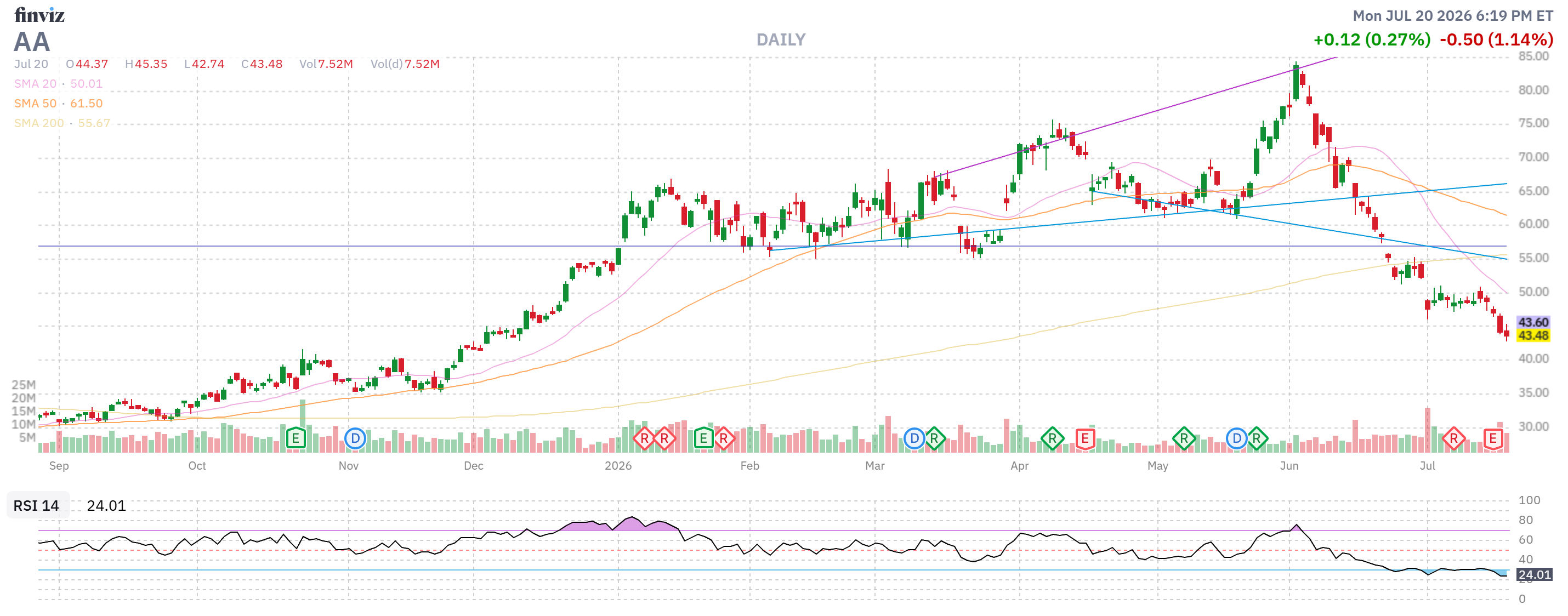
Penny:And then you wake up to realize that your country has basically run out of the raw aluminum you need just to build the trucks that deliver your servers.
Roy:Yeah. It's a it's a terrifying realization.
Penny:I mean, you have this ultimate vision for the future, but the physical constraints of the present are just, you know, suddenly pulling the entire structure down to earth.
Roy:The contrast is honestly staggering when you put it that way.
Penny:Yeah.
Roy:You have an economic environment completely obsessed with like infinite digital scale, just running head first into the hard undeniable realities of geopolitics and well, basic industrial supply chains.
Penny:Totally. So welcome to this deep dive into the Market Wrap Up Report for Monday, 07/20/2026. Our mission today is to cut through the massive amounts of noise, you know, and track the chronological journey of just a truly whiplash inducing trading session.
Roy:Whiplash is definitely the right word for it.
Penny:Yeah. We're gonna walk you through how this day started with intense sky high optimism and then just ended in this grim, suffocating wave of selling pressure. We'll be using the insights from the PhilStock World Morning Report, the live action in their member chat room, and the really detailed end of day wrap up from the AGI roundtable to decode what these volatile swings mean for you and your portfolio.
Roy:But, before we dive into the premarket data, there is a vital piece of housekeeping we really need to establish with you, the listener, right up front.
Penny:Absolutely. Yeah. This is nonnegotiable for how we operate. The source material we are unpacking today is saturated with some highly politically content. We're be discussing actions taken by the Trump administration, the implementation of these aggressive, unprecedented tariffs, and, well, escalating military air strikes in The Middle East.
Penny:And we wanna be crystal clear here, we are not taking sides.
Roy:Exactly. We are not endorsing and we are not condemning any political viewpoints at all whether they originate from the left wing, the right wing, or anywhere in between.
Penny:Right. Our sole function here is to act as your impartial guides through the data. We're just going to relay and analyze the factual market impacts, you know, the shifting economic indicators, and the geopolitical realities precisely as they're documented in the provided sources.
Roy:Yeah. We're strictly looking at the mechanics of the market, the logistics of global trade, and the psychological state of the retail trader. Nothing more.
Penny:So let's start with the morning setup because if you only looked at the futures before the opening bell, would have thought the market was gearing up for just a massive rally.
Roy:Oh, yeah. The pre market was incredibly green.
Penny:The S and P 500 futures were up, like, 18 points. Nasdaq futures were totally leading the charge, up a blistering 250 points. And the absolute star of the morning was the semiconductor space.
Roy:Which is fascinating given the previous week's action.
Penny:Right. The narrative was suddenly that the dip from the previous week was completely over and the AI infrastructure build out was just, you know, back on track.
Roy:And the catalysts driving that early bid were incredibly specific and honestly, on the surface, compelling for anyone holding tech.
Penny:Yeah. So what exactly was moving them?
Roy:Well, micro devices, AMD, was surging in the pre market because Microsoft had just announced it was deploying AMD's Helios Rack Scale solution on Azure.
Penny:Okay, wow. That's a big deal.
Roy:Right. And this wasn't just a general vague partnership. Microsoft specified this was for frontier model AI inference and expanding the use of their EPYC processors.
Penny:So for a market looking for validation, seeing a massive hyperscaler like Microsoft commit serious capital to new hardware, that acts as a massive green light.
Roy:Exactly. It's validation of the demand.
Penny:Let's break down technical terminology there for a second though, because frontier model AI inference sounds like something out of, I don't know, a sci fi novel.
Roy:It does sound a bit futuristic, yeah.
Penny:But if I'm understanding this correctly, we need to separate AI into two distinct phases, right? Training and inference.
Roy:That's right.
Penny:So training is kind of like sending the AI to medical school. You feed it petabytes of data, it takes months, and it requires a massive concentration of specialized chips, which has historically been NVIDIA's domain.
Roy:Spot on. That's the heavy lifting phase.
Penny:But inference is when the AI is actually working in the clinic, right? Like diagnosing a patient in real time based on a user prompt.
Roy:That is a highly functional way to visualize it actually. Training builds the neural network's weights and biases. It is incredibly compute intensive and super power hungry.
Penny:Right, burning through all that electricity.
Roy:Exactly. Inference however is the application of that trained model. When you you ask a chat bot a question or when an AI agent generates a piece of code for you, that is inference.
Penny:Okay, got it.
Roy:So what the Microsoft and AMD announcement signals is this maturation of the AI market. The focus is shifting from merely training these massive models to actually deploying them at a scale where they can, generate actual revenue.
Penny:You said at some point they have to make money.
Roy:Right. And deploying them at scale requires highly efficient infrastructure which is exactly what AMD is promising with the Helios Rack Scale solution. It's about maximizing throughput while trying to manage those astronomical electricity costs we mentioned.
Penny:And that leads right into the memory side of the equation, right? Because it wasn't just the processors catching a bid, memory chip manufacturers like Micron were bouncing too.
Roy:Yes, and the catalyst there wasn't even an American company.
Penny:Wait, really? Who was it?
Roy:It was out of China. A startup called Moonshot AI debuted a new artificial intelligence model designated Kimi K3.
Penny:Kimi K3.
Roy:Yeah. And the reports highlighted by the Morning Financial feeds noted that this specific model, just due to its architecture and the massive context window it can process, requires a profoundly large amount of memory to operate.
Penny:Okay. A context window, meaning, how much information you can feed into the prompt at one time before the AI literally forgets the beginning of your sentence.
Roy:Yes, exactly. It's the short term memory limit.
Penny:So if Kimi K3 can read, say, an entire book in one prompt, it needs the short term memory, the RAM, to hold that book while it thinks about the answer.
Roy:That is the mechanical reality of it, yeah. High bandwidth memory is the primary bottleneck for these advanced models right now. You can have the fastest processor in the world, but if the processor has to wait for data to be retrieved from slower storage, the whole system just lags.
Penny:Well, that makes total sense.
Roy:So when a new highly capable model like Kimi K3 hits the market and requires unprecedented memory capacity, traders look at a company like Micron, which manufactures that memory, and they see a guaranteed demand pipeline.
Penny:So the morning traders saw the semiconductor dip from the previous week. They saw these two massive demand signals, and they just bought it up.
Roy:They bought it hand over fist.
Penny:But I have to wonder about the psychology here. I mean, why is the market so eager to view every single sell off in semiconductors as just a harmless technical correction? It feels like this stubborn refusal to acknowledge any underlying fundamental risks.
Roy:It's a textbook example of a momentum trade driven by cognitive dissonance.
Penny:Oh, cognitive dissonance. How so?
Roy:Well, when a sector has generated the kind of wealth that AI infrastructure has over the past year or so, market participants become deeply conditioned. They are desperate to label any drop as a technical correction.
Penny:Because a technical correction implies that the stock simply got overbought, right? That the price just outpaced the moving averages and it just needs to cool off for a second.
Roy:Precisely. It preserves the underlying thesis. If you admit it's a fundamental flaw, say, that the capital expenditures are actually unsustainable, then the entire narrative collapses.
Penny:And nobody wants the narrative to collapse.
Roy:Right. So when AMD gets a Microsoft contract, the collective psychology of the market points to it and says, 'See, the narrative is intact. The dip was just a buying opportunity.
Penny:Wow. Okay. So while that high-tech abstract optimism was dominating the Nasdaq futures, there was a completely different storyline playing out that honestly fascinates me. A storyline rooted in the physical economy involving businesses you can actually walk into.
Roy:Thought about the movie theaters.
Penny:Let's talk about AMC Entertainment. Yeah. Because their numbers were staggering, and they completely defied the macroeconomic gloom that we'll get into later.
Roy:AMC was the absolute standout of the morning session and it serves as a crucial counterweight to the whole AI narrative. Yeah. AMC's success wasn't predicated on the promise of technology that might revolutionize the world in, you know, five years. No. It was based on cold hard cash generated in the present quarter.
Penny:And they crushed their q two earnings. I mean, are looking at $1,600,000,000 in revenue, a record $321,400,000 in adjusted EBITDA.
Roy:It's incredible.
Penny:And actual human foot traffic. Right? Mhmm. Attendance was up 13.5%, plus they were carrying massive momentum into the current quarter from the July opening of a movie called The Odyssey, which brought in over $124,000,000 in its opening weekend alone.
Roy:The underlying financial mechanics here are what we call operating leverage, and it's a vital concept when you're analyzing physical retail or entertainment businesses.
Penny:Operating leverage. Break that down for me.
Roy:Think about the fixed costs of running a movie theater. The lease on the massive building, the climate control, the basic staffing required just to unlock the front doors. Those costs are relatively static whether there are 10 people in the theater or a thousand.
Penny:Right, your overhead is basically this giant anchor you have to drag behind you every single month no matter what.
Roy:Exactly, but once you sell enough tickets to cover those fixed costs the dynamic completely flips. Every additional ticket sold, every extra bucket of popcorn purchased drops almost entirely to the bottom line as pure profit. Because AMC's attendance bumped up by 13.5%, it didn't just linearly increase their revenue, it exponentially increased their profitability due to that operating leverage. It allowed them to swing to a positive 14¢ per share and generate roughly $190,000,000 in free cash flow.
Penny:And they are ruthlessly optimizing how they extract value from those attendees too. Yeah. The PhilStockWorld report highlighted their premium mix, which I think is just brilliant.
Roy:Oh, premium large formats?
Penny:Yeah. People aren't just showing up and buying a standard ticket anymore.
Roy:They are opting for the premium experience. Consumers are paying the 6 or $7 surcharge for IMAX, Dolby Cinema or other premium large formats. AMC explicitly noted in their report that while these premium screens comprise only about 8% of their total screen count, they accounted for an astonishing 50% of the total gross for the Odyssey.
Penny:Half the revenue from 8% of the screens.
Roy:Exactly. The per patron economics are just vastly superior to a standard screening.
Penny:One of the contributors in the PhilStockWorld chat, Rowan, made a point that really resonated with me about this. While the entire financial media ecosystem is stressing out over abstract macroeconomic data and tech valuations, a massive blockbuster like the Odyssey proves that human behavior is still relatively simple.
Roy:It really is.
Penny:If the story is compelling enough, people will leave their houses, put down their phones, engage in a communal experience, and drive hard economic value into a physical business.
Roy:Rowan's observation really cuts to the core of the tension in today's market. AMC provided tangible, audited evidence of a physical business thriving in the present moment generating real free cash flow. But as the opening bell rang, the broader market was largely ignoring this physical success, still desperately clinging to the tech headlines and the AI promises.
Penny:Which honestly makes me want to push back on the whole retail capitulation narrative we'll get to later. If the fundamentals of AMC are that clear cash in hand, people in seats, and the tech sector is trading at 50 times forward earnings on a promise, maybe retail traders aren't just stubbornly clinging to tech. Maybe the smart money is actually rotating. It feels like prioritizing the trailer for a movie that might never come out over the actual documentary that is winning awards right in front of you.
Roy:That rotation theory is valid, but you have to understand the scale of the promises in the tech sector. AMC generating 190,000,000 in free cash flow is an excellent quarter for a theater chain. It stabilizes their balance sheet. But tech investors aren't looking for stabilized balance sheets. They are dreaming of artificial general intelligence that restructures the entire global economy.
Roy:They are hunting for trillion dollar shifts in productivity.
Penny:So they'll ignore the movie theater making money today for the robot that might make a trillion dollars tomorrow.
Roy:Yes. The market is often willing to completely overlook short term physical realities and valuation concerns for the champ to participate in infinite digital scale. Wow. However, as the morning progressed, the mathematical reality of funding those digital dreams started to fracture.
Penny:And that reality check hit hard. Let's look at Alphabet, Google's parent company. They were an early standout in the pre market because of a report from the information claiming they were introducing a highly efficient frozen AI chip.
Roy:Right. The early pop.
Penny:It sounded great. But after the open, they gave back almost all of those gains. The reason, the bond market started screaming about the price tag of this infrastructure.
Roy:The catalyst for the reversal was the repricing of Outfit's recently issued 100 bond.
Penny:A hundred year bond. Stop right there. Who on earth buys a bond that matures a century from now? I mean, won't be alive. You won't be alive.
Penny:The company might not even exist.
Roy:Century bonds are a fascinating and, yeah, rare financial instrument. Historically, we've seen them from sovereign entities like Austria or Mexico, and occasionally from major corporations with massive long term physical assets like Disney or universities.
Penny:Who's buying them?
Roy:The buyers are typically institutional investors with ultra long term liabilities. Think pension funds or life insurance companies. They know they have to pay out benefits fifty or eighty years from now, so they want to lock in a guaranteed yield today to match those future obligations.
Penny:Okay, that makes mechanical sense for a pension fund. But why is Alphabet's Century Bond suddenly plummeting in value?
Roy:It comes down to a concept called duration risk combined with a tidal wave of supply.
Penny:Let's tackle duration risk first.
Roy:Okay, so the longer the timeframe until a bond matures, the more sensitive its price is to changes in interest rates. If you buy a one hundred year bond yielding 4%, and tomorrow the Federal Reserve raises rates, so new bonds yield 5%, your 4% bond just became incredibly unattractive.
Penny:Because who wants 4% when you can get 5%?
Roy:Exactly. And because the buyer is locked in for a century, the mathematical punishment to the bond's resale price is exponentially worse than it would be for, say, a two year bond.
Penny:So because interest rates are staying high and inflation isn't dying down, the people holding this one hundred year debt are getting crushed on the resale market.
Roy:Yes, but you also mentioned supply. Right. Yes, the surge in hyperscaler debt supply. These major tech companies are borrowing unprecedented mountains of cash. The Morning reports tied Alphabet's massive borrowing directly to their capital expenditure plans.
Roy:They are projected to invest an estimated $175,000,000,000 to $185,000,000,000 in AI and data center infrastructure just for the year 2026. When a company signals they're going to flood the market with that much new debt, bond investors demand a higher yield to absorb it all, which pushes the price of existing bonds down further.
Penny:It's an astronomical sum of money. They are borrowing cash for a hundred years to build data centers today, hoping the AI models of tomorrow generate enough of revenue to pay it all back.
Roy:It's a massive gamble.
Penny:And it's not isolated to Alphabet. The morning reports showed Oracle facing multibillion dollar cost setbacks in their data center build outs. Everything is just more expensive than they modeled.
Roy:Right.
Penny:Furthermore, Intel initiated a new round of layoffs, and they explicitly targeted their data center group efficiency. I mean, when the company making the chips starts firing the people selling to the data centers, the foundation looks incredibly shaky.
Roy:And the credit markets, which are generally devoid of the emotional hype found in the equity markets, started flashing bright red warning signs. Definitely. The PhilStockWorld Morning Report specifically highlighted that Credit Default Swap spreads for Oracle hit a new cycle high. We also saw Nvidia's CDS spreads widening concurrently.
Penny:Okay, a credit default swap. That is a piece of financial jargon that makes most people's eyes just glaze over. But let's demystify it. If I'm buying a CDS, I'm basically buying fire insurance on my neighbor's house, right? If the house burns down, I get a massive payout from the insurance company.
Roy:That is essentially correct, though usually it's the person who lent money to the neighbor who is buying the insurance. Uh-oh. If an institution lends billions to Oracle by buying their corporate bonds, they carry the risk that Oracle might default on that debt. To hedge that risk, the institution goes to a third party, say, a major investment bank and buys a credit default swap.
Penny:So they pay a premium?
Roy:Yes. The institution pays a regular premium, known as the spread, to the bank. If Oracle defaults, the bank makes the institution whole.
Penny:So if the premium, the spread is hitting a cycle high, that means the investment banks writing the insurance policies are smelling smoke. They think the risk of the house burning down has significantly increased. So they are jacking up the price of the policy.
Roy:Precisely. The credit markets are considered the smart money because they don't care about the narrative of AGI saving the world. They only care about cash flows and debt to equity ratios.
Penny:Math, not hype.
Roy:Exactly. When Oracle and Nvidia's CDS spreads widen, it signals that the institutional lenders are looking at the massive ballooning capital expenditures required to build this AI infrastructure. And they are asking a very cold mathematical question: Is this balance sheet stable enough to support this level of spending if the AI revenue doesn't materialize immediately?
Penny:Right. To bring the skyscraper analogy back from the beginning, it's like building a luxury high rise on a variable rate credit card. The penthouse, you know, the AI models generating code and writing essays looks amazing.
Roy:Beautiful views.
Penny:But the foundation costs, the physical data centers, the cooling systems, the massive power grid upgrades are doubling. The bank financing the construction is getting nervous, so they are raising the interest rate on your debt. And to make matters infinitely worse, someone across the street is building the exact same skyscraper for a fraction of the price and they are letting people live there for free.
Roy:Which introduces the geopolitical and competitive friction of the Chinese open source models. This is a critical piece of the puzzle that explains why US tech was struggling so much today.
Penny:Yeah, let's talk about this.
Roy:A contributor in the PSW chat named Cyrano broke this down brilliantly.
Penny:Cyrano pointed out that US software developers are quietly flocking to cheaper, highly capable Chinese open source AI models. We talked about Kimi K three earlier, but there's also Alibaba's Quen 3.8 Max, which is reportedly testing off the charts and reasoning capabilities. Yes. And suddenly, in the middle of this market, there is a loud report that the Trump administration is considering an outright ban on these Chinese models operating in The US.
Roy:And Cyrano's analysis raises a fundamental question about motivation, really pulling back the curtain on the intersection of national policy and corporate protectionism.
Penny:Because the stated reason is always national security, right?
Roy:Exactly. The narrative presented to the public is almost exclusively framed around national security, data privacy and preventing foreign adversaries from scraping U. S. Consumer data. And while cyber security is absolutely a valid and pressing concern Cyrano points to a parallel, perhaps more urgent motivation protectionist panic by domestic tech monopolies.
Penny:I mean, think about the incentives. If you are Google or OpenAI or Anthropic and you have just committed, as we said, up to $185,000,000,000 in capital expenditures to build massive proprietary closed AI infrastructure, you have a massive financial moat you need to defend.
Roy:A moat you paid a lot of money for.
Penny:The absolute worst case scenario for your business model is if millions of independent developers realize they can get like 95% of the performance of your trillion parameter model from a free open source model developed by Alibaba.
Roy:It destroys the monetization strategy. Software developers are fundamentally pragmatic. It is an economic necessity for them to find the cheapest, most efficient compute available to run their applications.
Penny:They just want the code to work cheaply.
Roy:Right. If the monastic closed AI labs are forced to compete on price with free, highly capable open source models, the return on investment for those massive data centers evaporates. By lobbying the government to ban the open source competition under the banner of national security, the domestic hyperscalers protect their massive capital investments.
Penny:That's a bailout by policy.
Roy:Essentially, yes. However, as Cyrano noted, the market is smart enough to read between the lines. The push for a ban signals to institutional investors that U. S. Tech giants might be terrified of the open source cost structure, struggling to justify their massive fees based on product superiority alone.
Penny:So let's synthesize this morning's session. You have demand for AI, yes. But the infrastructure costs are becoming an absolute black hole. The credit markets are jacking up the insurance premiums on tech debt because they are terrified of the balance sheets. And cheaper, foreign open source competition is threatening the entire revenue forcing this desperate protectionist response.
Penny:It's no wonder the morning optimism evaporated.
Roy:And we haven't even touched the macroeconomic data yet. Oh, right. While the tech sector was collapsing under the weight of its own infrastructure costs, the broader physical economy was getting hit by a devastating combination of deteriorating macro data and aggressive new trade policies.
Penny:Which brings us to the midday data drops. The June leading economic index, the LEI, came out and it dropped 0.2%. The consensus among economists was expecting a 0.1% gain. The LEI didn't just miss, it totally inverted the expectation.
Roy:The LEI is a crucial metric because it is explicitly designed to be forward looking.
Penny:Okay, what does it track exactly?
Roy:It's an aggregate of 10 different economic components things like average weekly manufacturing hours, new orders for consumer goods, building permits, and the yield curve. It is built to signal turning points in the business cycle before they show up in the lagging data like GDP or employment.
Penny:So it's the canary in the coal mine.
Roy:Exactly. A 0.2% drop is a loud signal. As the PSW report meticulously noted, this drop doesn't happen in a vacuum. It aligns perfectly with the soft retail sales data we've been seeing, the steady, undeniable rise in initial jobless claims, and consumer sentiment sitting at a dismal 50.5.
Penny:And Phil Davis, operating in the live chat room, connected the LEI drop to the Atlanta Fed's GDP Now model. He pointed out that the model is currently tracking Q two growth at an incredibly sluggish positive 1.5% to 2%.
Roy:Which is barely growing.
Penny:Right. He stated very clearly that this data puts the reality of recession firmly on the table.
Roy:If we break this down to the reality of the average consumer, the mechanics of this slowdown are very clear. We have been dealing with sticky inflation. Prices on basic necessities, food, shelter, insurance went up dramatically and they have not come down. They merely stopped going up as fast.
Penny:Yeah, anyone going to the grocery store knows that.
Roy:To combat that inflation, the Federal Reserve has kept borrowing costs incredibly high. So the consumer is being squeezed from both sides. Their baseline cost of living is permanently higher and the cost to finance a car or carry a credit card balance is exorbitant.
Penny:They're trapped.
Roy:The consumer is simply tapped out. When they stop discretionary spending, retail inventories pile up. Retailers then reduce orders from manufacturers. Manufacturers cut weekly hours and eventually they initiate layoffs.
Penny:And then those layoffs further terrify the consumer, dropping sentiment even lower.
Roy:It is a classic, vicious macroeconomic feedback loop.
Penny:And right at the precise moment when the consumer is tapped out and manufacturing is slowing down, the White House drops a massive inflationary policy anvil on the economy. They announced a new 50% tariff on certain Canadian goods, excluding energy and minerals.
Roy:The mechanism they utilized to implement this tariff is what sent shockwaves through the institutional trading desks. They did not use the standard trade authorities. They invoked Section three thirty eight of the 1930 Tariff Act.
Penny:The 1930 Tariff Act? Wait, that's Smooth Holly, isn't it? The bill that famously exacerbated the Great Depression by triggering a massive global trade war.
Roy:Yes, the very same. Section three thirty eight is a specific retaliatory provision buried within that Act. It grants the President the unilateral power to impose additional duties of up to 50% on goods from any country deemed to be discriminating against U. S. Commerce.
Roy:Here is the terrifying part for trade lawyers: This specific section has never been used before. It is a blunt instrument that has sat dormant for nearly a century.
Penny:And, the administration cited unfair treatment of U. S. Alcohol, autos, and dairy products by Ottawa as a justification. But the kicker was quote from a senior official who explicitly noted there would be absolutely no exemptions for products covered under the existing North American trade pact, the USMCA.
Roy:Right. They're essentially overriding the established free trade agreement.
Penny:It is a massive escalation that injects radical uncertainty into supply chains that span The US Canadian border. But the administration also attached a specific incentive program regarding aluminum to this tariff announcement that warrants a very deep dive because the underlying logic well, it demonstrates a profound disconnect from industrial reality.
Roy:Yes. The aluminum caveat.
Penny:This is the part that just blew my mind. The administration announced that if a company builds a new aluminum plant in The US or expands or refurbishes an existing one, they can apply to have their Canadian aluminum import tariff cut in half from 50% down to 25%.
Roy:The stated political goal is straightforward industrial policy. They want to incentivize domestic manufacturing, specifically the reshoring of heavy industry. They want aluminum made in America to ensure supply chain resilience.
Penny:Okay. That sounds great on a campaign poster, but you can't just mandate an aluminum smelter into existence. I looked into the data you provided. The United States currently has exactly four operating aluminum smelters left in the entire country.
Roy:That is correct. Down from roughly 23 operational smelters in the year 2000.
Penny:So we have four left. And you can't build a new one over a weekend. It's not like opening a coffee shop.
Roy:Not at all. Aluminum smelting is one of the capital intensive and energy intensive industrial processes on the planet. You are essentially taking alumina and using massive amounts of direct electrical current to break the chemical bonds in a process called electrolysis.
Penny:Okay, so it takes a lot of juice.
Roy:It requires staggering amounts of baseline electricity. The primary reason The US lost its smelting capacity wasn't just cheap foreign labor, it was the cost of electricity. Countries with massive subsidized hydroelectric power like Canada or certain nations in The Middle East, have a permanent structural advantage.
Penny:Ah, I see.
Roy:Because of the complexity and the environmental permitting required, the last entirely new aluminum smelter built from the ground up in The United States was constructed over forty years ago.
Penny:Let that sink in. Forty years ago. So the government is offering a tariff reduction if you build a smelter, but it will take a decade to permit and build one, assuming you can even secure the gigawatts of cheap power required. What happens in the meantime? Because Ford still needs to build f one fifties today.
Roy:Right.
Penny:Appliance manufacturers still need to stamp out washing machines today. Beverage companies need millions of cans today.
Roy:What happens is absolute logistical friction and price gouging. Domestic manufacturers cannot source enough physical aluminum from those four remaining U. S. Smelters to meet demand. So they are forced to import it.
Penny:From Canada.
Roy:They buy it from Canada or The Middle East and they are forced to pay that punitive 50% tariff at the border. This dynamic has severely distorted a metric known as The US Midwest Premium.
Penny:Explain the Midwest Premium because I think a lot of people just assume the price of aluminum is whatever it says on the commodity ticker on their phone.
Roy:The price you see on the London Metal Exchange is the global benchmark price for the raw metal itself. But if you are a manufacturer in Ohio, a benchmark price in London does you no good. You need the physical metal delivered to your loading dock.
Penny:Right. You need the actual sheets of metal.
Roy:Exactly. The Midwest Premium is the surcharge added to the benchmark price that covers the actual cost of logistics shipping, rail, warehousing, plus any tariffs required to get that metal into the industrial heartland of America.
Penny:And because of this 50% tariff, plus the supply shocks we'll get to in a minute regarding The Middle East, this premium has exploded.
Roy:It has roughly doubled. This means that US businesses, right now, are essentially paying the highest raw material prices for aluminum in the entire world. They're at a severe competitive disadvantage compared to a manufacturer in Europe or Asia who doesn't face that 50% tariff.
Penny:And a manufacturer isn't just going to absorb a 50% increase in raw material costs out of the goodness of their heart, right? They pass it directly onto the consumer.
Roy:Exactly. The cost of a new car goes up, the cost of a washing machine goes up, even the cost of a six pack of soda goes up.
Penny:Let me try to frame this with an analogy, tell me if I'm off base here. This policy feels like a doctor trying to force a patient to go on a strict healthy diet by immediately putting a heavy titanium padlock on their refrigerator.
Roy:Okay. I'm listening.
Penny:The doctor says this will force you to learn how to farm and grow your own organic vegetables in the backyard. But the doctor completely forgets that it takes months to grow vegetables and the patient still needs to eat dinner tonight to survive, so the patient is forced to order wildly expensive takeout just to stay alive which bankrupts them before the first tomato even sprouts.
Roy:I would actually take that analogy a step further. Not only does it bankrupt the patient but the stress of the bankruptcy causes other health problems. Right. The policy is attempting to force a long term structural re industrialization, which may be a valid geopolitical goal. But the mechanism immediate punitive tariffs on vital allies inflicts severe immediate financial pain on domestic manufacturers today.
Penny:Because they have no other options today.
Roy:It forces them to raise prices, which directly exacerbates the very same sticky inflation that the Federal Reserve is currently fighting, which in turn keeps interest rates high, crushes the consumer, driving that leading economic index even deeper into negative territory. It is a self inflicted macro vice.
Penny:So if you're a retail trader sitting at your desk at one zero p. M, you're watching the tech sector collapse under the weight of its own infrastructure debt, and you're watching domestic policy squeeze the physical economy through massive tariffs. That alone is enough to ruin your week.
Roy:Absolutely.
Penny:But then the midday news cycle violently shifted attention over seas. And that is where geopolitical risk grabbed the steering wheel and drove the market straight into the ditch.
Roy:The transmission mechanism for that geopolitical panic was the energy market. The volatility in crude oil was extreme.
Penny:Let's look at the numbers. Brent crude, the global benchmark, spiked overnight, touching $91.43 a barrel before settling back into a wildly volatile 82 to $88 range. West Texas Intermediate, The US benchmark, settled up over 1% at $82.59. But a 1% move doesn't capture the sheer panic in the underlying context.
Roy:No, it doesn't.
Penny:It is day one forty three of the conflict. The United States just conducted its tenth consecutive day of airstrikes on Iranian targets.
Roy:Iranian And the rhetoric from the administration is escalating rapidly. The president vowed overwhelming retaliation for the three US soldiers killed in Jordan and the Pentagon is actively deploying more F-thirty five and F-sixteen fighter squadrons to the region.
Penny:Things are heating up fast.
Roy:Yes. The diplomatic bag channels have also collapsed. Iran officially announced the suspension of all nuclear talks. Any lingering hope of a diplomatic off ramp, which was being brokered via mediators in Qatar and Pakistan, has effectively evaporated. The market is suddenly forced to price in the reality of a sustained escalating regional war.
Penny:But the threat isn't just confined to the Strait Of Hormuz anymore. We all know Hormuz is the main artery for Middle Eastern oil, and if that gets shut down, the global economy basically has a heart attack.
Roy:Right.
Penny:But the map of the conflict is expanding and this is where things get really logistical and terrifying.
Roy:This was the critical development that broke the market in the afternoon. Yemen's Houthi rebels officially declared a maritime blockade on Saudi Arabia in the Bab El Mandeb Strait.
Penny:Okay, geography lesson time. I know where Hormuz is. It's at the top of the Arabian Peninsula exiting the Persian Gulf. Where exactly is the Bab El Mandeb Strait and why is it so critical?
Roy:Bab El Mandeb is the choke point at the very southern tip of the Red Sea. It sits between Yemen on the Arabian Peninsula and Djibouti and Eritrea on the Horn Of Africa. If a cargo ship or an oil tanker wants to travel from the Indian Ocean up the Red Sea and through the Suez Canal to reach the Mediterranean and Europe, it must pass through the Babbo Mandeb Strait. It is roughly 18 miles wide at its narrowest point, making vessels highly vulnerable to land based anti ship missiles and drone swarms.
Penny:So it's the southern backdoor to the Suez Canal. But why is the Houthi blockade there specifically devastating to Saudi Arabia's oil exports? Doesn't Saudi Arabia export most of its oil out of the Persian Gulf through Hormuz?
Roy:They do, but Saudi Arabia recognized the strategic vulnerability of Hormuz decades ago. If Iran ever closed Hormuz, Saudi oil would be trapped. To mitigate this risk, they spent billions building the East West Pipeline. It is a massive piece of infrastructure that pumps millions of barrels of crude oil every single day, from their primary Eastern oil fields straight across the desert expanse of the country to the port city of Yanbu on Red Sea Coast.
Penny:So it's a bypass?
Roy:Yes. The entire purpose of this pipeline is to allow massive supertankers to load Saudi crude on the Red Sea and completely bypass the Persian Gulf and the Strait Of Hormuz.
Penny:Oh man, so Saudi Arabia built this massive expensive backdoor to guarantee you they sell oil if a war broke out. And now the Houthis have essentially walked around the house and are standing in front of the backdoor with a shotgun.
Roy:Precisely. As the analyst Quixote pointed out on the AGI roundtable, we are no longer just looking at a localized conflict. We are witnessing a systemic chokehold on global energy logistics. The geographic scope of the risk has vastly expanded. The priority route is under threat from Iran and the backup route is now under active blockade by the Houthis.
Penny:This brings us to what I think is the most brilliant piece of deep dive analysis in the entire source packet. A contributor in the PhilStockWorld report named Basho thoroughly dismantled the political talking points trying to soothe the market. He took aim at what is being called the pipeline plan.
Roy:Yes. The pipeline plan. The political rhetoric over the weekend attempted to reassure the public by suggesting that The US is energy independent. The president stated, we're coming up with great alternatives, including Texas, including Alaska, implying that US energy could simply replace the crude oil lost if the Strait Of Hormuz is closed.
Penny:Then Basho wasn't having it.
Roy:Basho broke down from a purely logistical and engineering standpoint why this is a dangerous solution.
Penny:He pointed out that politicians are deliberately blurring the lines between completely different types of commodities. The Middle East exports massive amounts of crude oil, you know, unrefined sludge that gets loaded on supertankers and shipped primarily to mass refineries in Asia, the projects in Texas and Alaska that the administration is touting as the solution are LNG facilities: liquefied natural gas.
Roy:It is vital to understand that crude oil and liquefied natural gas are fundamentally different commodities with entirely separate, incompatible infrastructure ecosystems.
Penny:Natural
Roy:gas is extracted, supercooled to -260F until it becomes a liquid, loaded onto specialized cryogenic ships, and transported. When it arrives at its destination, it must go into a massive regasification terminal to be turned back into a gas before it can be burned for electricity or heating.
Penny:So they aren't interchangeable at all? You can't just hand a barrel of frozen gas to someone who needs oil?
Roy:No. Consider a massive industrial buyer in Japan or South Korea. Their economy relies on importing millions of barrels of Saudi crude oil, shipping it through Hormuz, and running it through their domestic oil refineries to produce gasoline for cars, diesel for trucks, and petrochemicals for plastics.
Penny:Right. They need the raw material for those specific products.
Roy:If Hormuz closes, that buyer cannot suddenly call Texas and ask for LNG. An oil refinery cannot process frozen natural gas. They require completely different infrastructure, different specialized ports, and long term contracts. You cannot put liquefied natural gas into a standard crude oil pipeline.
Penny:The plumbing is totally different.
Roy:Furthermore, Bacho pointed out that Qatar is one of the world's largest exporters of LNG, and all of their export terminals are inside the Persian Gulf. They have absolutely zero pipeline bypasses. If Hormuz closes a massive percentage of the global LNG supply is trapped right alongside the crude oil.
Penny:So the political talking point completely collapsed the distinction between increasing overall US energy exports and the immediate crisis of replacing millions of barrels of Hormuz crude oil. It's like telling someone who is dying of thirst that you have a warehouse full of dry crackers. It's technically food, but it doesn't solve the immediate biological crisis.
Roy:And regarding the actual physical crude oil pipelines that do exist in The Middle East to bypass the straits, Basho noted the engineering reality. They are already running at maximum capacity. You cannot simply turn a dial and push twice as much oil through a 48 inches pipe. The physics of fluid dynamics do not allow it.
Penny:And as if the situation couldn't get any more fragile, even one of the few working pipelines is currently in jeopardy. The report noted that Turkey's President Erdogan is threatening to shut down the Kirkuksehyem pipeline on July 27 over a fee dispute.
Roy:The Kirkuksehyem is a crucial artery that carries roughly 500,000 barrels of crude oil a day from Northern Iraq to the Mediterranean port of Sehin in Turkey. It is one of the very few functioning bypasses that is not currently sitting in a war zone.
Penny:And Erdogan is using it as leverage.
Roy:Yes. Recognizing his immense geopolitical leverage in this moment of chaos, he has threatened to shut the tap, he is demanding higher transit fees from Iraq and the outright dismissal of a $1,500,000,000 arbitration penalty that Turkey owes. If he follows through and shuts that pipeline next week, he removes half a million barrels of daily supply from an already panicked market.
Penny:It's unbelievable. It sounds like the global energy market is playing a massive high stakes game of geopolitical whack a mole. Every time the market finds a physical workaround for shipping oil, a drone strike, a blockade, or a political extortion attempt pops up to block it.
Roy:It's relentless.
Penny:But here is the crucial question for the listener's portfolio. How did this specific surge in oil and geopolitical panic transmit into the rest of the stock market by the afternoon? Because if I'm holding a tech stock, I might think I don't care about a pipeline in Turkey.
Roy:You might think that until you look at the bond market. The transmission mechanism from geopolitical chaos to your tech portfolio is the Treasury yield. As the oil panic set in, Treasury yields spiked violently.
Penny:Right, the ten year note?
Roy:The ten year note, which is the benchmark for global borrowing, jumped six basis points to settle at a scorching point six year percent.
Penny:Okay, let's connect the dots slowly here because this is the core of macroeconomic theory. Why does a Houthi rebel blocking a strait in the Red Sea make the yield on a US government bond go up New York?
Roy:It is entirely about inflation expectations and the Federal Reserve's reaction function. Oil is the master commodity. The cost of energy is embedded in absolutely everything.
Penny:Because everything needs to be moved or manufactured.
Roy:Exactly. If oil prices spike because of a blockade, the cost to manufacture goods goes up, the cost to ship those goods across the ocean goes up, and the cost to truck those goods to a local Walmart goes up. That means inflation, which we already established is stubbornly high, is going to stay higher for much longer.
Penny:And if inflation stays high, the Federal Reserve's hands are tied they can't lower rates.
Roy:Exactly. The market realizes the Fed cannot cut interest rates to stimulate the economy if inflation is rebounding. In fact, if oil goes to $120 a barrel, the Fed might be forced to hike rates again.
Penny:Which terrifies the bond market.
Roy:Right. Bond investors look at the scenario and they demand a higher yield to compensate for that prolonged inflation eating away at their fixed returns. So they sell existing bonds, pushing the price down, which mathematically pushes the yield up.
Penny:And when the risk free rate of return, the yield you can get just by lending money to the US government for ten years hits 4.6 year percent, suddenly the math on buying a highly speculative, incredibly expensive tech stock looks a lot less appealing. Why risk your capital on a company trying to build AI data centers on credit when you can get a guaranteed 4.6 from the treasury?
Roy:That is the exact recalculation that institutional capital made at roughly 2.00PM, which sets up the grim reality of the afternoon session. That spike in yields was the final, undeniable nail in the coffin for the morning's optimistic blockbuster trailer.
Penny:Yeah, the fun was over.
Roy:By 4PM, the crushing gravity of the macro and geopolitical landscape had completely suffocated the market.
Penny:The retreat was steady, mechanical, and broad based. The S and P five hundred erased all its gains to close down many point 2%. The Nasdaq, which had been up 250 points, bled out to close down by 1%, and the Dow Jones Industrial Average dropped point 6%. And the sectors that got hit the hardest were the ones most sensitive to those rising interest rates.
Roy:The rate sensitive names were absolutely crushed. Carvana, a company whose entire business model relies on consumers taking out substantial auto loans to buy used cars, was the single worst performing component in the entire S and P 500.
Penny:That makes total sense.
Roy:Furthermore, the home construction ETF dropped a full 2.0% in a single session.
Penny:Because if the ten year treasury yield is rising because of oil, then mortgage rates and auto loan rates are rising in lockstep. And we already established, looking at the dropping leading economic index and the abysmal consumer sentiment data, that the American consumer is tapped out.
Roy:Completely tapped out.
Penny:They simply cannot afford to finance a $40,000 used car or an 8% mortgage. The demand destruction is immediate.
Roy:But there was another highly technical mechanical force dragging the market down in the afternoon that most retail traders completely missed.
Penny:Oh, this is the liquidity thing.
Roy:The PhilStockWorld Report, specifically a deep dive contribution from a user named Zephyr, pointed out a massive silent liquidity drain operating in the background.
Penny:This is the plumbing of the financial system that is so rarely discussed. Zephyr noted that the US Treasury issued a staggering $90,000,000,000 in new Treasury bills on this exact day.
Roy:It is a crucial piece of market mechanics. When the U. S. Government needs to fund its operations, it issues debt. When it issues $90,000,000,000 in T bills, it is essentially turning on a massive vacuum cleaner and sucking cash directly out of the financial system.
Roy:Institutional cash, money market funds, and primary dealers step in and use their cash to buy that $90,000,000,000 in government debt.
Penny:So, the cash leaves the commercial banking system and goes into the Treasury General Account at the Federal Reserve. It effectively vanishes from the stock market, That is $90,000,000,000 in raw purchasing power that is now locked up and unavailable to bid up the price of Nvidia or Apple or AMC.
Roy:The timing is what makes it so devastating. You combine this sudden massive drain of underlying liquidity with a psychological fatigue in the tech sector regarding infrastructure costs, and you layer on the panic of rising bond yields from a Middle East conflict. The market simply runs out of available buyers.
Penny:The bids just disappear.
Roy:The afternoon fade wasn't just a change in sentiment. It was a mechanical certainty driven by a lack of available cash.
Penny:And speaking of running out of buyers, the final piece of the puzzle is the retail trader. The sentiment shift here is historic. Citadel Securities, which processes a massive percentage of all retail trading flow, reported an incredibly unusual pattern.
Roy:It really was.
Penny:For the second consecutive down session, retail investors were actively selling the dip in semiconductor stocks.
Roy:What makes that data point so profound is the context of the past eighteen months. Retail traders have been deeply conditioned, almost Pavlovian, to buy every single dip in AI and semiconductor stocks. It was viewed as a guaranteed winning lottery ticket.
Penny:Just buy the dip always.
Roy:Right. For Citadel to flag that retail is not only refusing to buy but actively selling into weakness on back to back days, it suggests a rare and significant psychological shift.
Penny:They are exhausted. The margin calls are hitting, the credit card bills are due, and the psychological breaking point has been reached. But they aren't just walking away from the casino. They are finding new, much darker games to play. Another contributor in the AGI roundtable, Anya, made a profound socio economic observation that ties this entire manic day together.
Roy:Anya's commentary elevated the discussion, from market mechanics to generational sociology. She cited demographic data noting that nearly 49% of young adults are now living at home with their parents.
Penny:Almost half. That's wild.
Roy:The baseline costs of independent living rent, insurance, groceries have simply become too high relative to wage growth.
Penny:And because of this crushing baseline reality, retail traders aren't just investing for retirement anymore. They aren't buying a Vanguard ETF and waiting thirty years. They are desperately gambling.
Roy:Yes. Gambling.
Penny:They are gambling on macroeconomic disasters out of toxic combination of FOMO, the fear of missing out, and sheer terror of inflation permanently locking them out of the middle class.
Roy:We see the manifestation of this desperation and the explosive rise of prediction markets like the Cauchy and Polymarket. The volume data provided in the sources is staggering. On Cauchy, 30% of investors are placing hard earned capital on a bet that U. S. Gas prices will top $5 a gallon by the end of the year.
Roy:On Polymarket, people are placing massive leveraged bets on whether cargo ships will even be able to physically transit the Strait Of Hormuz by December.
Penny:The dark irony here is thick enough to cut with a knife. You have a generation of people literally sitting in their childhood bedrooms, logging into offshore crypto funded prediction markets to place bets on the collapse of their own global supply chains just to make a buck.
Roy:It's bleak.
Penny:They are actively monetizing their own anxiety. They're betting that their own cost of living is going to explode, hoping the payout covers the damage.
Roy:It is the ultimate financialization of geopolitical friction. When the traditional, established paths to wealth, creation like saving for a down payment on a home, or investing in steady, long term corporate growth feel structurally closed off by inflation and high yields, the retail public turns to volatility itself as an asset class. They stop treating the stock market as a mechanism for capital formation, and they start treating the breakdown of global logistics like a casino game.
Penny:So let's pull all these threads together. We started this Monday with a beautiful engineered blockbuster trailer. The Nasdaq was surging, Microsoft and AMD were signing deals, we had the illusion that the AI tech rebound was invincible, and we had the tangible, physical reality of AMC delivering record free cash flow because humans still crave a communal experience.
Roy:But by the closing bell, the house lights came up aggressively and the gritty documentary took over the screen. The market was overwhelmed by the crushing gravity of physical and mathematical constraints. We saw the strain of massive AI infrastructure debt re pricing in the bond market. We saw the impact of sticky inflation dragging down the leading economic index. We saw aggressive, unprecedented 50% tariffs on Canada exacerbating the illogical realities of a hollowed out aluminum supply chain.
Penny:And we saw a widening, escalating, and highly volatile war in The Middle East. Houthis blockading Saudi Arabia, pipelines threatened with closure, and oil prices driving treasury yields through the roof which mechanically crushed the consumer and rate sensitive stocks.
Roy:And finally, a $90,000,000,000 government liquidity drain that left retail traders so utterly exhausted they are capitulating on tech and retreating to prediction markets to bet on the end of the world. We are witnessing a market in violent transition. It is attempting to move from a narrative of boundless infinite digital expansion and crashing head first into a reality governed by physical supply chains, logistical choke holds and the sheer cost of capital.
Penny:Which leaves us with a final provocative thought to mull over as you look at your own portfolio. If these prediction markets are successfully turning geopolitical crises, war, and supply chain blockades into gamified investable assets for the retail public, does that fundamentally change how society views risk?
Roy:It's a question worth asking.
Penny:Are we moving away from an economy that allocates capital to invest in future growth and innovation and moving toward an economy that simply places bets on its own friction and decline, keep an eye on the volume in those prediction markets. While the traditional stock market tries to desperately price in a perfect soft landing, the prediction markets might be the most honest, brutal, and unfiltered reflection of our collective anxiety. The blockbuster trailer is over. We are living in the documentary now. Thanks for joining us on this deep dive.
Penny:We'll see you next time.