Subscribe
Share
Share
Embed
Dive into the joy of fitness with Lindsay and other guests exploring how it goes well and beyond the gym floor, the number on the scale, the size of your waist or the calories you're counting.
Speaker 2: Welcome, welcome to
the Lifting Lindsay podcast.
I am excited to be here
with you guys today.
I had a, a fun conversation with
somebody on social media, with one of
you, and I, I just love your questions.
And I love when I present information,
I love that you guys feel comfortable
enough with me to ask questions.
so anyways, the other day I was
talking about how if you're too
lean, the likelihood of you building
muscle is actually a lot lower.
And immediately the
questions started coming in.
"Okay, but what does too lean
actually mean?" What… Which I think
is a really good question, right?
And people want a number, though.
They want a number.
That's the problem.
Is it 15% or 17% or 13%?
Or what if they're eating at maintenance?
What if I'm eating at maintenance?
I'm really, really lean,
eating at maintenance, then why
wouldn't I build muscle, right?
It's just about energy
coming in in the moment.
That's all that matters.
And if energy is, maintaining my weight,
then why wouldn't I build muscle?
What about my favorite fitness
influencer, fill in the blank,
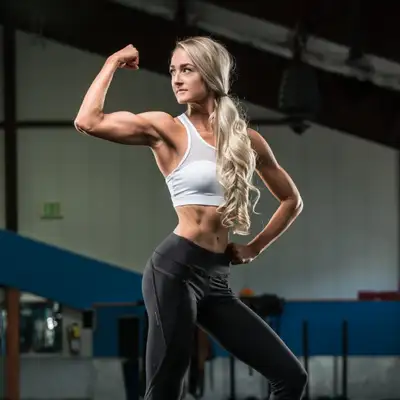
shredded woman who stays absolutely
shredded year-round, right?
what about her?
She seems to still be growing, or
she's saying she's continuing to grow.
These are all really excellent questions,
so today I want to answer them, because
this topic isn't nearly as black
and white as social media makes it.
And lately on social media, on my stories,
I've been really, really focusing on what
can I teach today that will help everybody
be better consumers on social media?
'Cause we're all on there
consuming something.
And I do think it's really
interesting in fitness, we need to
be careful because what happens is
we start consuming people's bodies.
I know that sounds weird, but we are.
We become consumers of their body.
and then if they have a nice body,
everything they say is, true because
they have a nice body, right?
Look at them And, and,
and you know, I get it.
When I go and get my hair done, I also
want the woman who's doing my hair to
have nice hair because if she doesn't,
it-- there is this element of distrust.
Now, that woman could know exactly
how to get my hair exactly how I
want it, even though she doesn't may-
maybe look like she has nice hair.
But, but it, it-- there is this
psychological… You know what I'm
talking about with that, right?
There's this psychological
element to that, so I, I get it.
I'm not saying I'm above it either.
I'm saying it's something that I have
had to learn the hard way and just really
kind of unteach myself that thought.
let's dive into this.
Can you be too lean to build muscle?
The short answer really is
yes, 100%, but probably not
for the reasons that you think.
When people hear this, they
usually assume we're talking about
someone who's in a calorie deficit.
Of course, if you're dieting aggressively,
muscle growth begins to slow down.
A lot of us n- know this, right?
That's not what I'm talking about today.
I'm talking about when someone who's
finished so-called dieting, they're
eating at what appears to be maintenance
calories, they're maintaining
their body weight, to- so to say.
Can that person still be
too lean to grow muscle?
And, and we see this all over social
media, the absolutely shredded
post-menopausal woman there who
has the body of my dreams, right?
Like I'm like, "Wow! She's in--
She looks incredible." and then
she's posting all of these things,
and she's absolutely shredded.
We're talking about, like, she looks
like in a week, two, or three, she
could get up on stage and compete in
a bodybuilding competition, right?
We're seeing this all over social media.
It's now… It w- it's now just
that's who everybody trusts,
the person who's shredded 24/7.
They must know what they're talking about.
And then they're also up there talking
about, muscle growth, and you can see
their muscles, so once again, they
must know what they're talking about.
But the problem is, is just
because they're absolutely shredded
and they say they're eating at
maintenance, doesn't actually mean
that they're going to build, okay?
This is where people get really confused.
They think maintenance calories… Because
now we know you don't need to actually
be in an aggressive build, uh, or calorie
surplus to continue building muscle.
We have seen this in so many studies.
You don't actually have to go into any
sort of aggressive, calorie surplus
like we were once told, "You have to be
in a calorie surplus to build muscle."
We were told that for a really long time.
You have to.
No, you don't.
In fact, if you look at it as kind of
like there's this line, and the, the
further you go to the right of that
line, meaning a calorie surplus, yes, we
can potentially optimize muscle growth
moving away from, um, above maintenance.
Or if you move slightly below maintenance,
you can still get some muscle growth.
So we've seen that even in trained
individuals who go into a slight
calorie deficit, if training is hard, if
protein's on point, they can build muscle.
So we're beginning to see proof and
see other studies come out showing
individuals at maintenance improving
their physique, building more muscle.
So we know this.
So then that, that's kind of
why we're talking about this.
But so now we know if you are eating
at maintenance, you can still see
some really nice muscle gains.
okay, last year for about eight
weeks I was in a calorie deficit
at the beginning of the year,
and then I moved into a build.
And then around November, I just got sick
of tracking everything, to be honest.
And so I mindfully ate and
I sat around maintenance.
And then January, I went into a
cut again and I showed you guys.
I really like showing you guys me in it.
I think it's awesome.
That's just my opinion, though.
so during that time, I'm building muscle.
When I'm at muscle or at
maintenance, mindfully eating,
I'm, I'm building muscle.
You can build muscle there, right?
So let's go back to what I was
saying, how people get confused.
They think that maintenance
calories automatically equals a
great place or even, like, a good
place for a building environment.
Maybe it's not the most optimal,
but people are now realizing, okay,
but it's still a good place But
maintenance simply means you're
maintaining your weight, okay?
It doesn't necessarily mean your body
is in the best physiological state
to build new muscle or more muscle.
So let me explain.
Imagine two women, both weigh the same,
both are eating 2,000 calories, both
have maintained their weight for months.
On paper, they're both at, quote-unquote,
"maintenance." But one woman is around
16% body fat, or let's just even say
14 or 15, you know, in that range.
The other is around 24%.
Would their bodies necessarily
respond the same way?
No, not necessarily, because
your body isn't only looking
at today's calories coming in.
Oh, let that one sink in.
It's also looking at the
reserves it has available.
Now, let's think about that in regards
to household budgeting, 'cause that,
that might make this, this point
drive down a little bit further.
Imagine two families, both making
exactly the same paycheck every month.
One family has 50,000 sitting in savings.
The other has $50.
Would they make the same… Or I
should say, would it be wise for them
to make the same financial decisions?
No.
No, not at all.
The family with the savings account
might decide it's time to remodel the
kitchen or, or finish the basement.
The family with $50, they're probably
thinking, "Let's make sure that,
like, we're just getting, you know,
everything paid and on time," right?
We're just going from paycheck
to paycheck to keep things just
exactly how they are, and if they
overspend by a little bit, that's,
that sucks because now, like, they're
dipping into their, what, their $50?
Do you see where I'm going with this?
Because believe it or not,
the body works similarly.
Today's calories are
your monthly paycheck.
Your body fat is your savings account.
Building muscle is kind of like the home
renovation, the kitchen renovation, right?
Before your body decides to invest in
building new muscle tissue, it has to
pay for all of the necessities first.
Your heart, your brain, your
immune system, hormone production,
recovery, daily movement.
Those are kind of like its bills.
Then if resources allow, your
body can invest in growth.
And here's something that I just
feel like we don't talk about enough.
Muscle isn't just expensive to build,
but it's expensive to maintain.
So every pound of muscle you already
have requires energy every single day.
Your paycheck's already going to
that, and if it dips under, it
doesn't have much reserves, right?
Because well, it won't if we're
talking about, like, the woman who's
13% body fat and absolutely shredded
all over, you know, social media Okay?
So before your body even thinks
about building another pound of
muscle, it's asking, "Do I have
enough resources to support this?
If we dip under one day, get into debt
a little bit, where do I pull from?
Uh, I don't really have much
here." That's really what this
whole conversation comes down to.
And then there's this whole,
"But no, no, no, she's eating at
maintenance," because I know some
of you keep going back to that.
" But I'm eating at maintenance," or,
"She says she's eating at maintenance."
Great.
Great, so you're eating
enough to maintain your body.
But your body isn't only
evaluating today's food intake.
I keep saying that.
there's multiple signals
that it's reading.
How much energy is coming in is one.
How much body fat do I have in reserve?
How hard am I training?
How well am I recovering?
How much stress am I under?
How am I sleeping?
Your body is constantly asking
one question, is this a good
time to invest in growth?
And I guess it's not constantly
asking that question, but when you're
pushing, pushing, pushing training,
that's what your body's asking.
"Okay, I, I get it.
I'm getting the signal.
You're pushing." But we, one, don't have
a ton of resources to build, and even if
I did spare some of the resources coming
in today to maintain, then what happens
tomorrow? Because we need more resources
to maintain it The hormones are also
part of this conversation. So one of
the ways your body answers that question
of, "Okay, well, what am I gonna do?
Am I gonna have enough?" is
actually through hormones.
So hormones are basically your
body's communication system.
That's, uh, that's the
best way to really explain.
One of the biggest players in
this conversation is leptin.
We'll get to some other ones
like sex hormones later, but,
but for right now, leptin.
So leptin is produced by fat cells.
So generally speaking, as body
fat decreases, leptin decreases.
I like to think of leptin as
your, your body's fuel gauge.
This is the best way
that I can imagine it.
Your car doesn't wait until it's
completely out of gas before, like,
the warning light comes on, right?
It warns you while there's
still a little fuel left, and
leptin kind of works similarly.
So leptin, as, as it decreases, your
brain starts getting messages that energy
reserves are actually going down, right?
Because the body fat's coming down,
so these energy reserves are coming
down, so it's becoming limited.
The body's not gonna be
able to tap into that.
Now, your body isn't going to slam on
the brakes overnight, but it does start
making these small adjustments, right?
So hunger often increases because
it's like, "Let's refill those
stores. Let's, let's get her
eating more." Hunger increases.
Energy expenditure, what you're doing,
energy out, often starts decreasing,
and recoveries may just not be as good.
And, and as you're aging, man,
man, is this coming more and
more and more a reality for me.
Recovery is just as important
as what you're doing in the gym.
It is so crucial.
The older I get, the more I feel like,
oof, what I could do as far as volume
and intensity in my 30s, I can't
do the same training programs now.
I can't do them and have the
recovery that I once had.
I, I just-- It is so important.
So when your recovery is not as on
point, training starts to feel harder,
and over time, these changes create an
environment in your body that simply
is less supportive of muscle growth.
So that's really important.
It doesn't, like, slam on the brakes
in this one instant as soon as you
hit this certain body fat percentage.
It's kind of as you sit there, the
body's like, "Ooh, this is just
not… It's not an environment where
I can do X, Y, and Z." And one of
those things is, um, muscle growth.
One of those things is low libido, too.
Think about it.
It just makes sense.
When you are too low in body fat all
the time, our, our bodies are all
about survival and perpetuating, you
know, the human race kind of thing.
So if you're not, if you're barely even,
yeah, I'm eating at maintenance, but
reserves are low, too low body fat, it, it
does happen that libido goes down because
the body's thinking, I, I can't, I'm
barely cert- like getting enough for me
Why would I create this environment to
get pregnant if I then can't-- don't have
a little extra for somebody else, right?
So these changes in the body really do
make sense when you're looking at them
from a point of survival and w- what these
systems are, are really made for, right?
These systems aren't made for somebody
winning a bodybuilding competition or
somebody being the most shredded person
on Instagram in their 50s as a woman.
It is it's not it, right?
So I do think it's really important
to kind of understand that,
uh, these will create just less
favorable environments for your body.
Your body's going to be thinking of,
"How can I survive day to day?" Not,
"I really wanna build some more muscle.
We should pop those delts more." Right?
Now we see, uh, changes in other hormones.
So estrogen, and, and I also wanna talk
about thyroid hormones too, like T3.
The… And, and re- reproductive hormones.
I've already started
kind of going into that.
Again, these hormones don't
only affect fertility.
They affect recovery, bone health,
connective tissue, muscle protein
synthesis, insulin sensitivity, training
performance, and all of these systems
are constantly talking to each other.
And I know that somebody's gonna ask this
question, 'cause I've gotten it before.
either, "Well, but I don't need to
worry about fertility because, you
know, I'm post-menopause and I…
And… Or perimenopause, or I'm just not
trying to get pregnant." Or, "But I'm
post-menopausal, I don't even think I
can build that much muscle because, you
know, estrogen, you bring up estrogen.
Well, estrogen is already low
because I'm post-menopausal.
Doesn't mean that I'm just kind of
out of luck anyways." Absolutely not.
Um, and this is one of the biggest
misconceptions that I hear.
Yes, estrogen declines during menopause.
Yes, estrogen plays important roles
in muscle recovery, connective
tissue, bone health, and even how
our muscles respond to training.
But more challenging
doesn't mean impossible.
So those are, are different, right?
In fact, a lot of the most incredible
transformations that I've seen are
women in their 50s and 60s and 70s.
And we do have research showing that
they are building, especially as
newbies, at the same rate as people
much younger in 30s and 40s too.
So don't think that there's a
time or day of, "Well, just can't
build muscle anymore." Right?
That the body doesn't suddenly
stop adapting after menopause.
It may re- just require
more intentionality.
Like I said earlier, recovery is
massive, and I actually think in
peri and post-menopause, recovery
is the key to building more muscle.
Maximizing recovery, finding ways
to relax more, less stress, sleep
more, and these things can be hard.
But finding ways to calm and get
out of the, the chaos of our day and
age, choose to step away from it.
Like I said, though, it just really does
require a little bit more intentionality.
It, it just does.
It is what it is, right?
So maybe slightly higher protein
intake for those who really want
to maximize body composition.
really focusing on progressive overload.
It's not just about getting into
the gym and bouncy, bouncy or
just movement at this point.
It is, no, we have to find ways
to safely progress loads for
bone density, for muscle tissue.
It's not actually just about move more.
I know that that gets a lot of, "Just
move. Just move." And that can work for
people who are solely focusing on Being a
little bit more healthy and losing weight.
You know, it always comes down to we have
to ask ourselves, for who and what goal?
For who and what goal, right?
Just move more.
For who and what goal?
That is… I'm so sick of the
just move more crap out there
without any context whatsoever.
That is not going to help the 55-year-old
postmenopausal who is trying to
increase bone density, muscle tissue,
so that she can move more, feel better.
Just moving more isn't
going to be the c- the cure.
She needs to build muscle.
She needs to protect bone density, maybe
even regain it after time and season
just being told to fricking move more.
And so the… What did she do?
She just moved more, and then lost bone
density and muscle because she wasn't
told that actually that doesn't work
for the goal of aging well, getting more
muscle and strength, even increasing
health of joints and tissue around those
And just building more muscle so that
you can actually keep living in a way
where you're more resilient, right?
Okay, sorry, that was my, uh, tangent.
I just get so annoyed when I see,
"Well, just… You're overcomplicating
things, Lindsay. Just move
more." For who and what goal?
" Well, it's, it's not even that
complicated." Yeah, it, it-- Well, that's
not even that complicated, but we gotta
start asking ourselves good questions.
And when you're consuming information
on social media, two things
can be true at the same time.
Another little side tangent of mine.
the just use weights.
Okay, for who and what goal?
And what are they doing
with those weights?
So lately, the dumbbell halo
thing has been going, like,
do dumbbell halos for core.
" Dumbbell halos are amazing
for core," one person says.
"Dumbbell halos are stupid for
core," another person says.
Who's right?
Well, for who and what goal?
I'm gonna go back to that.
I'm gonna keep going back to that.
Because for one person who is maybe
post, um, pregnancy, they just barely
had a baby and are getting back into the
gym, or maybe they just had surgery, or
maybe they're older and they're trying
to go into the gym to gain strength
and, and try not to, to fall down, and
then dumbbell halos can be a great tool
for those individuals, a great tool.
So when I see my friend go into the gym
and she's doing contralateral Bulgarian
split squats with 25 pounds in her hand
or 30 pounds in her hand, and she's
doing 45, you know, degree hip extension.
She's doing 100 to 200 pound RDL, right?
Or even a contralateral
RDL or, or heavy carries.
And then she's like, "Well, the
influencer on Instagram said I need
to work my core, so now I'm gonna
end that, that training day by
spinning a dumbbell around my head."
Well, yeah, for her it's stupid.
What a waste of time for her What
in the world do you think that
she's gonna get from spinning
that dumbbell around her head?
What kind of stimulus is she g- greater
stimulus is she gonna get than what she
just barely got from all those other
movements, either that day or that week?
Please tell me.
Please enlighten me.
I would love it.
Because for her, it is the
stupidest waste of time.
But for somebody else, it's
exactly what they need.
We need to start being able to
hold two truths at the same time.
I actually just even had this
conversation on Instagram about GLP-1s.
For one person, it is life-saving,
health-giving, and for another person,
it is an abuse, and it has them right
back into their anorexic state that
they were in, that they crawled out
of, that they worked so hard to get
out of, and now they're just right
back into it, we can hold two truths.
It can be abused by one fitness
influencer, and it can be life-saving,
health-giving for somebody else.
We gotta start seeing the world
more that way, I feel like.
And man, I'm working on it.
I'm not perfect at this.
I am right in the trenches
working on it with you guys.
And now I don't even remember
what we were talking about.
I think we were talking about being more
intentional in menopause or perimenopause,
but muscle growth is still possible.
We need to stop believing
the stories that it's not.
We can be more intentional.
Now, are we gonna look
like we did in our 20s?
No.
We also need to be realistic, right?
Which I think most of you are
But it, it is still important.
Let's actually go, go back and
revisit this fitness influencer.
I-- and I'm not thinking about one
person in particular, so don't write me
and be like, "Oh, I know that one." And
I'm like, I'm gonna be like, "I have no
idea who you're talking about," because
I don't follow fitness influencers.
people will send me messages
of like, "Look at her, look
at her," and I'm like, "Cool.
I don't know." but
these are good examples.
So, so once again, I'm not
talking about one specific person.
But I do think that,
uh, this is important.
So somebody will say, "Lindsay, I follow
someone who's absolutely shredded, and
she's eating at maintenance and building
muscle." Well, maybe, but maybe not.
And, and let's just define shredded, okay?
I'm, I'm not talking about
somebody who is lean.
I would say I'm lean.
I'm talking about somebody who just is
walking around and bam, there's the c-
this most crisp six-pack you've ever
seen, we're seeing veins in their arms.
They're… Th- you can… Yeah.
Like that's what I'm talking about.
I'm not, I'm not talking about
somebody who's just lean.
Are they building a ton of muscle?
I would say we need to be
cautious assuming that they are.
Just because you can see a bunch
of muscle doesn't mean that they're
building right now a ton of muscle.
Because maybe what you're looking at is
just one chapter of her story, right?
You're not really, really looking
at the last five chapters where she
had higher body fat percentage and
was eating at maintenance and, and
sometimes, you know, a little above.
And during those five previous chapters,
that's where she was building her muscle.
And now she's stepped into her shredded
chapter, and you're thinking right
now in the shreds, she's building all
this muscle because you can see it.
Nope.
Nope.
Probably is not happening right
now, unless she's on a little
something, something that she's
not telling us all about, Which is
actually very ridiculously common.
I can't even believe it.
And I'm not even talking
about for bodybuilders.
Like, I am just shocked at
nowadays the mom next door on
stuff, and I'm like, " why?
Why?" Not to mention… Sorry, I
am on, I am a tangent person today
The past month, there have been two
people, that I actually really respect
and like, and both of them have… One of
'em, uh, isn't on social media, and they
told me that they're having heart failure.
I mean, we're in our 40s now,
but these people in their
20s were on a bunch of stuff.
And then the other one, um I'm
just… He's been very open
about it on social media, talking
about, and he's a new father.
I mean, just barely, I feel like
has found the real, the things in
life that give us real meaning.
And, and he's heartbroken too about heart
issues and, and choices that he made in
his early 20s and stuff, getting on stuff.
But at my gym, guys, I'm shocked
at these 40-year-old men getting on
stuff, and they're not, competitors.
Or these 30 and 40-year-old
women, they're all on stuff.
And I'm like, just to walk around the
gym having a little bit more muscle?
It doesn't make sense to me.
Like, it doesn't even m- to what end?
Why?
Why would you put your health on the line?
In 10 years it could be cut
short because you wanted to see a
little bit more delt definition?
I don't get it.
The thought of saying goodbye to my
kids early because I just wanted to
have a little bit more muscle, that
is a trade that I'm grateful right
now I just wouldn't make, right?
I, I'm older, I'm…
I just wouldn't do it.
But, but I am shocked at the
people my age who are doing it.
I just, I don't… Where is our value
really coming from at that point?
I just have to question it.
Anyways, that's my little
tangent for the day.
Well, that's my like, like five tangents.
let's, let's go back over this.
I really do believe that, that what we're
looking at is previous chapters, and
now they're in a shredded chapter stage.
If they truly are shredded,
they're not building muscle.
They're, they're… The maintenance that
they're at is just maintaining them.
But they look great because in previous
chapters, they either had enough body
fat percentage or had a higher amount
of calories coming in, or, Now one
person I am thinking about, uh, very
specifically, she had a lot of body
fat And she went, uh, steep, and,
and also she had a good muscle base.
So when she went steep into a cut and
was lifting, she built a lot of muscle as
she was even going into her cut, because
once again, she had that backup supply.
Body didn't feel threatened.
So a lot of muscle tissue got
built, and then she just started
like shredding, shredding down.
Most people aren't like that, okay?
So just be careful.
If somebody has like a million followers
It doesn't necessarily mean that
they know what they're talking about.
It, it does mean that they have--
they're probably an outlier,
and outliers typically don't…
haven't spent a lot of
time in the struggle.
But they're really cool to look at.
I, I'll give you that much.
So anyways, I, I just do think
that we need to be cautious.
Be careful what-- uh, ask yourself,
"What chapter of theirs am I seeing?" I'm
kind of seeing the after chapter, which
is pretty cool, and that can be fun.
Now, I wanna go back to the number,
'cause I know people are still gonna
be like, "Yeah, but what's the body
fat percentage that as soon as you hit
there, you just, you know, stop putting
muscle on?" You're too lean, right?
You're still hoping, there's still
some hope that Lindsay's gonna
give me this body fat percentage.
I wish I could.
I really do.
I wish it was that easy.
But the truth is, there isn't one.
Generally speaking, once women, once
again, generally speaking, once women
start pushing into low teens, we tend
to see more challenges with energy
availability, hormonal adaptations,
and just lower training performance.
it's very low likelihood that
they're building at this phase.
Um, but there once again isn't
some magical one moment cutoff.
So I've coached women at similar body
fat percentages who have actually
had completely different experiences.
So one felt amazing, getting stronger,
sleeping well, recovering well.
The other felt exhausted, thought about
food constantly, stopped progressing.
Um, her menstrual cycle
started getting further apart.
Same, about the same body fat percentage,
but completely different physiology.
I think that that's important,
so that's why I don't coach
to a body fat percentage.
I coach to the individual and
what's happening to them, okay?
And a lot of times with coaches, it's
unfortunate when they do like, "Well,
it's all in your head," or, "You're
broken," or, "Something's wrong with you
because the other girl that I coached,
she was at this body fat percentage
or she was lower and she was fine."
Yeah, they have different genetics.
They have different minds and bodies.
Why would we even want to compare them?
Because we're human, and
that's what we wanna do.
We wanna compare, right?
So instead of asking that, though,
"What's the leanest I can possibly be?"
I think instead we should ask, " what is
the leanest I can be while still giving
my body everything it needs to grow?"
Right?
Are your lifts progressing?
Are you recovering well?
Do you have enough energy?
Are you sleeping well?
Are you constantly thinking about food?
You know, if, if you're perimenopause
or pre, is your menstrual cycle healthy?
Think about it like a dashboard on a car.
Body fat percentage is
actually only one gauge.
Recovery is another, strength
is another, sleep, mood, energy,
performance, hormonal health.
When all those gauges are looking good,
you've probably, you're probably in a
really productive, good place, right?
But when one gauge is low, like body fat
percentage is really low and it's like,
"Oh, cool, I love seeing the shreds,"
but mood is also low and energy is low
and, and sleep gets disrupted really
easily and performance is low, that
doesn't sound like a good place to live.
But so and so online seems like she
can… But you're not her when are
we gonna kind of finally accept that?
So when are we gonna be
realistic about this journey?
When is it gonna be more about health?
And yeah, it's fun to look shredded or
fun to be leaner or fun… But are you
living your best life there, right?
So when several of these gauges
are flashing yellow at the same
time, that is a really good
flag that you need to reassess.
We need to reassess what's important
in life So these are my final thoughts.
Like I say all the time, the goal
isn't to find the leanest, smallest,
tiniest version of yourself, but it
can be to find what is about a good
health, like leaner version that
also allows me to thrive, right?
The version of you that trains
hard, recovers well, gets
stronger, builds muscle, has
energy for life outside the gym.
Now, keep in mind, sometimes those
things when we are pushing into a cut,
we will see naturally we're pushing
into a cut, but it's a short period.
I'm not talking about a cut.
Like I said earlier, I'm talking about
where do we live most of the time?
Because that's your sweet spot.
And guess what?
Your sweet spot probably
looks different than mine.
Mine is very different from the,
the uber shredded, influencer.
So it's simply asking one question
every single day: Do I have enough
resources to invest in my growth,
in my strength, in my energy?
Our job really isn't to chase
somebody's else, else's life
and level of leanness, right?
It's to take care of our
body, our environment.
So when we do that, man, life feels good.
And it may, it may include finding
that, may include going online and
unfollowing all of the people who are
always triggering self-doubt they're…
And it, they're not to blame.
I'm not saying they're to blame.
I'm saying we, independent of them, can
just be triggered by it And frankly,
that's one of the reasons why I don't
follow a lot of fitness influencers.
I follow some down-to-earth coaches.
I follow science nerds.
Because protecting my focus
on my own journey is actually
really important to me.
And so I want to encourage
you to kind of maybe find that
same sweet spot for yourself.
Anyways, you guys are amazing.
I love and appreciate all of you.
Have a wonderful week.