Subscribe
Share
Share
Embed
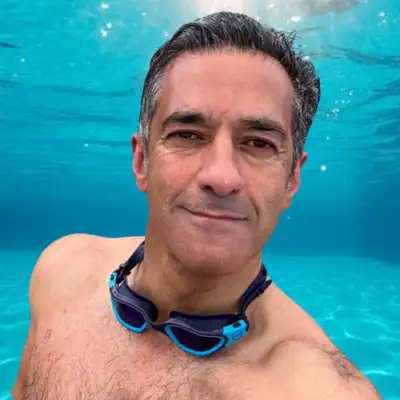
Inspring journeys from the pool to the everyday. Hosted by Salim Ahmed, a lifelong swimmer and swim coach with over 22 years experience, the show dives into the human stories behind the sport. Not just times and techniques, but the moments when water became an anchor, a lifeline, or a turning point.
Each episode features honest, intimate conversations with everyday swimmers, Olympians, well-known names and unheard voices, all united by the role swimming has played in their lives. These are stories of resilience and reinvention, of grief and joy, of quiet victories and near-impossible comebacks.
From open-water epiphanies to childhood pool memories, In at the Deep End explores how swimming steadies us, challenges us and carries us through life’s waves.
If you love inspiring stories with depth, this is where you dive in.
Hello and welcome back to In at the Deep End, Coach's Corner. This is the part of the month where I put the guests to one side and get stuck into your swimming. Last time we looked at connection with the water, and I've been pleased to hear that lots of you have been thinking about your own connections with the water. Thanks for your messages. Please do keep letting me know how you get on.
Today we're tackling breathing. It's something I get asked about constantly in my coaching, and it's one of those things that can quietly hold back your swimming for years if it's not addressed. It's also the thing adults seem to think about first, before anything else to do with swimming.
Before we dive in, I want to stress that Coach's Corner is all about you. You can be a part of it by emailing me or leaving me a voice message. Tell me what you struggle with, what you wish you could improve, what your ambitions are, or why you feel you're not improving. All the links you need are in the show notes, so get in touch. I can't wait to hear from you.
Okay, let's get into breathing.
It's the first thing adults talk to me about when they start a lesson with me, and quite often they're completely obsessed with it before we've started anything to do with the stroke. Today I'm going to talk about how we're supposed to breathe when we swim, what we're supposed to do and why, because there are a lot of myths around this subject, and a lot of apprehension about it.
By way of background, I come across some incredibly fit people in my lessons. Many of them say straight away, "Well, I can run 5K, 10K, half marathons, marathons, ultra runs. I'm super fit, super fast, I can go forever. But somehow, when I get in the pool, I get to about two lengths and I'm out of breath. What the hell is going on?"
That is a scenario I get all the time. I've coached all sorts of people you'd consider incredibly fit. I've coached the Royal Marine Commando swim team, yes, the commandos. I've coached ultra runners, triathletes, Ironmen, and even Joe Wicks. The standard narrative is: "I'm running, I'm cycling, I'm incredibly good at what I do, but I'm knackered when it comes to swimming."
The first thing I do is ask them two questions. How are you breathing? And are you kicking?
This all goes back to the concept of hoarding air. I come across a lot of people who, because they're anxious and apprehensive about swimming, start the stroke by holding their breath and setting off. That leads to the production of carbon dioxide, and carbon dioxide is directly related to your level of exhaustion and your heart rate, which will go up. Those are two things that will inevitably stop you.
So let's start with the basics. If you can run or walk one to three miles, you can swim them too. And I mean in front crawl, not just head-up breaststroke. When it's done right, you use less energy swimming than you do walking. It's all about the cadence, the ideal breathing rhythm or tempo, and the thing is, you've already got it. Most people can walk for ages. You could probably do head-up or head-down breaststroke for ages. But when it comes to front crawl, the number of people who say "I just can't do it" is incredible.
Why is that? Perhaps it's because people have been watching too many YouTube videos and picking up the wrong information, then implementing it badly.
So here's the thing no one tells you. Every top swimmer, including Katie Ledecky, breathes every two strokes. That includes every top swimmer swimming 300 or 400 metres and beyond at a high level, from Olympic level right down to masters level. They're breathing every two strokes. Even top triathletes are.
Breathing every two strokes is the most frequent breathing you can manage in front crawl. It forces you to limit the air you take in, and it allows you to control the exhale during the reach and glide phase of the stroke.
Bilateral breathing, which is what a lot of you come to me with, was taught to you as kids for a number of reasons, and for some reason a lot of swim schools still teach it as something you should do in front crawl. It's one of the myths I unfortunately have to dispel. We teach young children to breathe bilaterally partly because they're still growing, and we don't want them to develop asymmetries. But once they're through that stage, and certainly by the time you're a young adult, there's no reason to swim bilaterally all the time. In fact, it can become a hindrance when you're swimming any kind of distance, or when you're trying to play around with your speed and go a bit quicker, because it sets you at one pace, with one level of programming for your ins and outs of breath. It limits your stroke, it allows you to go at one speed only, and it has one turnover rate.
Don't get me wrong, I'm a firm believer in bilateral breathing. I think it's brilliant to do in training. But it shouldn't be your default setting. Breathing every two strokes should be.
The reasons I want you to breathe every two strokes, which means to the same side, are these. Firstly, it allows you to glide more and lengthen your stroke for efficiency. Secondly, you can swim faster, because whenever you need a bit more energy, you've got oxygen on tap more frequently. So you can swim faster, with a stronger pull and a faster kick. Thirdly, you can recover. If for some reason you've overegged it while you were swimming, you can actually recover while breathing every two strokes. So there are a number of reasons why breathing every two strokes is the right way forward, and bilateral breathing should be used only in training.
So here's what I'm going to leave you with when it comes to breathing.
First of all, and it doesn't matter what level you are, I want you to spend time simply getting used to breathing out when you're underwater and breathing in when you're out of the water. You can practise this standing up in the pool. You don't have to do it while swimming. Simply getting used to the mechanics of breathing out when your head's underwater and breathing in when it's out of the water is something your subconscious will pick up. If your subconscious picks it up, it'll become a reflex, and if it becomes a reflex, it'll become effortless. Your heart rate will go down and you'll be able to swim in a relaxed way. And it doesn't matter how great a swimmer you are, I want you to practise this.
If you're a good breaststroker, there's a very good chance you're already doing it. All you're doing in breaststroke is breathing out in the water and breathing in when you're out of the water. Your breathing timing is already set. All we're going to do in front crawl is turn it from up and down to on your side.
Secondly, initially, I want you to breathe only to your favourite side. Just practise that and get used to it. Some of the top swimmers in the world breathe every two strokes and only to one side. Over the following months and years, you can slowly work on being able to breathe every two strokes to both sides, because that can become handy in open water if waves are coming from one side, or if you want to use your breathing strategically, perhaps to sight, or to keep the pack on the side that you breathe to, and therefore look at, in a race or an event.
The control in breathing is in the out-breath. Have a think for a moment. When you take in air, you're taking it in to use it. The degree and speed at which you expel it allows you to control how you swim and how relaxed you are. If you want to swim with long, gliding strokes, which are incredibly efficient, breathing every two strokes allows you to do this. You can take more air in and breathe it out more slowly to match your stroke.
The trouble with breathing any other way, where you hoard air, hold your breath and swim frantically, and then let it all out, is that, one, you have the carbon dioxide problem, and two, it makes you rush your stroke. That's one of the things that happens to bilateral breathers. When they breathe bilaterally, they take in air and have to make it last for three strokes before they breathe it out. If you're starting to tire, or you want to go faster, that's going to prove difficult. If you breathe bilaterally when you're tired, all that will happen is that you'll rush your stroke, speeding it up to match your breathing. And your breathing should match your stroke style, not the other way round.
If you just want to swim efficiently, with long, sweeping strokes, breathing every two strokes will allow you to do that. And you can adjust the ins and outs of that breath. If you want to go faster, you can breathe slightly more frequently, taking in different pockets of air and breathing them out.
One of the things I also wanted to talk about is how you breathe normally. Breathing should be relaxing and normal. When you walk, or do any sport, you quite often don't even think about your breathing. You just do it. If someone were to analyse how much air you're taking in and breathing out, it would be a smaller amount than you think. You take in just enough air to partially fill your lungs for a stroke cycle, and then you breathe it out. When you walk or run, that's what you do. You never completely fill your lungs each time and then exhale steadily and slowly over several paces. You don't run like that, you don't walk like that, you don't play football like that. So why do you swim like that?
What I want you to start doing is, first of all, calm yourself down and breathe as if you're a normal human being doing a normal activity. When swimming is done right, you'll use less energy than you would walking the same distance. That's how efficient swimming can be, and that's what we want it to be for you. And when it comes to the point where you think, "Right, I want to increase my pace," you've got an efficient model you can use to sustain an increased speed.
So, breathing. This is what I want to leave you with.
Number one, breathing should be normal, and vary slightly by pace.
Number two, breathing should be partial. It should partially fill your lungs, not completely fill them, because you don't do that with any other physical activity and you shouldn't do it with your swimming.
Number three, breathing should be like a reflex. You shouldn't have to think about it. This will come with time. You've just got to be patient.
Number four, breathing every two strokes is normal, and every top swimmer does it, because it's the most efficient at pretty much all paces, from slow right through to fast. Possibly not sprint, but every other mid-pace swim speed.
Number five, breathing every two strokes is the most efficient.
Number six, breathing bilaterally in training is absolutely fine, and so is breathing bilaterally at your preferred pace, stroke and style if you're already doing it. I do encourage it. It's a great skill to develop.
Number seven, do not hoard air. I know I've said this before. You don't hold your breath when you run, walk, or do anything else, but for some reason, when it comes to swimming, a lot of people do. Don't. It's not good for you. It builds up carbon dioxide and it'll eventually make you stop.
Number eight, practise breathing in water, whether static or on the move, whenever you can. This applies to any level. Don't think, "I'm an Olympic swimmer," or "I'm an Ironman, I can swim really well." Every opportunity you get to practise that connection with breathing in water will make it more of a reflex, something you feel incredibly comfortable with subconsciously. So whenever you're in the water, practise going under, breathing out slowly and steadily, coming up only for air, and then going back down again.
Number nine, work gradually on your breathing ability. If you can only breathe to the left, practise breathing to your right, and practise breathing bilaterally. I have a useful drill for you here. Do three lengths on repeat, like this. Breathe only to the right on the first length. Breathe only to your left on the second. Breathe bilaterally on the third, which, by the way, means breathing every third stroke. Simply repeat that until you've done about twelve lengths or more.
Number ten, don't panic. Stay calm.
Number eleven, remember that a steady, controlled exhale is your secret weapon. It's your secret weapon for stealthy power, speed and what I call flight. When you're in control, it calms things down. So breathe out at a pace that suits you. If you're starting to get tired, glide a little longer and take longer to exhale.
And finally, remember that your breathing should not dictate your stroke, style or speed.
So that's Coach's Corner for this month. I hope you've picked up something to take to the pool, the lake or the sea. Try the breathing techniques I've been talking about over your next few sessions and let me know how you get on. Equally, if there's something niggling you about your swimming, or an ambition you'd like to chase, I want to hear about it. Your questions are what shape this show, and next month's episode could be yours. Email me at inatthedeependpod@gmail.com, or leave me a voice message and I'll play it out on a future show. Everything you need is in the show notes.
The main show is back in a fortnight with another great guest. Until then, keep swimming, keep thinking about breathing, and take care of yourselves. I'm Salim Ahmed, and this has been In at the Deep End, Coach's Corner. See you soon.