Subscribe
Share
Share
Embed
Shaping the Future Since 1818
As the oldest institution of its kind west of the Mississippi River, Saint Louis University has stood at the forefront for more than two centuries. From revolutionizing football with the forward pass to performing the Midwest's first heart transplant, SLU is where history is made.
Some traditions endure: our proud Jesuit, Catholic foundation, a deep commitment to academic excellence and a calling to pursue social justice. Other stories have been lost to history — until now.
In the debut season of 1818: A Saint Louis University Alumni Podcast, we dive into SLU's rich and often surprising legacy. Each episode features an unexpected conversation about SLU's background, a dynamic roundtable with alumni, thought leaders and changemakers shaping the University's next chapter, and a spotlight on distinctive alumni events and services.
Whether you're a Billiken from yesterday, today or tomorrow, join us as we showcase the people and moments that define us.
Once a Billiken, Always a Billiken.
INTRODUCTION
Tony Minor:
Welcome to 1818: A Saint Louis University Alumni Podcast. Along with my colleague and fellow graduate Meg Connolly, I'm your cohost Tony Minor. Each episode features an unexpected conversation about SLU’s background followed by a dynamic roundtable with alumni, thought leaders, and changemakers shaping the University’s next chapter. Each episode concludes with a spotlight on distinctive alumni events and services — so make sure to stay with us.
Whether you’re a Billiken from yesterday, today, or tomorrow, join us as we showcase the people and moments that define Saint Louis University. Let’s get started.
CONVERSATION WITH TIM AND BARBARA MORROW
**Meg Connolly**:
Welcome to 1818, St. Louis University's alumni podcast. I'm Meg Connolly. Today's episode is focused on SLU Madrid. In a little while, my co-host Tony and I will chat with some of the team at SLU Madrid about the history, current growth, and future of the campus.
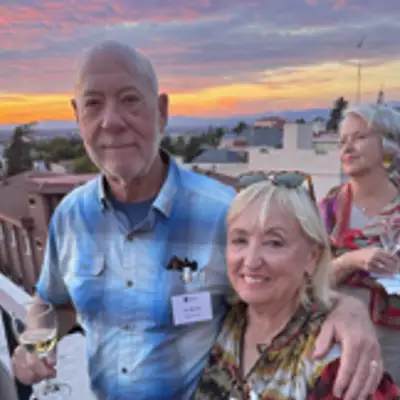
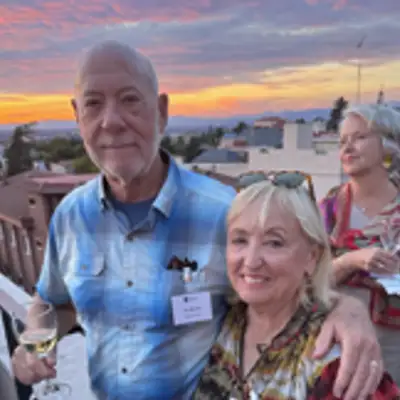
Joining me now are SLU Madrid alums Tim and Barbara Morrow. Tim and Barbara are both from the class of '71, and they recently returned to SLU's Madrid campus for a reunion. Welcome to you both.
**Tim Morrow**:
Thank you, Meg. Thanks for having us.
**Barbara Morrow**:
Well, thank you, Meg. It was a wonderful time seeing the campus again and remembering some of the early times for us when we studied in Madrid, starting in 1969 when we arrived.
**Meg Connolly**:
Did you meet originally on SLU's Madrid campus, or did you meet here on the campus in St. Louis?
**Barbara Morrow**:
It was in Madrid. It was in our first month. We were all housed in one dorm area. It was an orientation class to become comfortable and get to know each other, and it started with a phonetics class. We walked in trying to settle down, and Tim started talking to me.
**Tim Morrow**:
Well, my recollection's a little different! She came to class late, and there was only one seat left, and that was next to me. Fortunately, it was next to me! So yeah, we first met in Madrid and we became friends. We didn't begin dating right away, but we did in the spring of 1970.
**Meg Connolly**:
Now, being part of one of the first classes—a lot of our younger alums see the Madrid program as so large and having so many students. What was it like being sort of the pioneers of the program there?
**Tim Morrow**:
Well, I think there were about 40 of us. There may have been a few more. Most of us didn't speak Spanish; there were a few Spanish-speaking students. We were innocents abroad. Most of us had never traveled outside of the United States, and I think we were really in culture shock! But I think that was part of what made us a very cohesive group. We were cohesive as a group back then, and we are to some extent now.
**Meg Connolly**:
Obviously, you had an academic program to follow while you were there, but how did you spend your time outside the classroom?
**Barbara Morrow**:
Well, outside the classroom, we would return to our dorm, have lunch, and follow the timeframe of lunchtime in Madrid. It was an opportunity to be with the other students and exchange experiences—what we thought of the food, what we thought of people in the program, and just adjusting to all of that.
Then we would return back to class in the afternoon, and often get together afterwards to walk through the streets to *merendar*, which would be visiting restaurants for drinks and tapas, before returning back to our dorm area in the evening. But oftentimes that was later. The routine in Spain was that people didn't really eat dinner until 9:30 or 10:00 at night.
**Tim Morrow**:
Yeah, we pretty much followed the rhythm of Spanish student life at the time: classes in the morning, return to our individual dorms to have lunch, and sometimes classes in the afternoon. Then in the late afternoon or early evening, most students would go to the area of student bars and go *tasca* hopping. You'd go from one bar to another, have a small beer or a small glass of wine, eat tapas, and then return to your dorm around 6:30 or 7:00 at night and have dinner at 9:00 or 10:00. That was pretty much our weekday life.
**Meg Connolly**:
Father Sullivan was the legendary leader of the campus there at the time and a very strong figure. Do you have any great stories about Father Sullivan and your time there?
**Tim Morrow**:
He was a mysterious person, a very serious person. One thing: during the spring of 1970, St. Louis University and most universities in the United States went on strike because of the Kent State shootings. We figured we'd follow St. Louis University's lead—the mother campus's lead. He would have nothing to do with it! He said, "You can feel the way you want to about it, but we're not suspending classes, and you're taking your final exams. No ifs, ands, or buts about it."
But he was also a very interesting man. He had military experience; he was in the US Army as a medic and volunteered to go ashore in Normandy during the Normandy invasion. I think he continued to have military contacts even after he entered the priesthood. He would throw a party every St. Patrick's Day, and it was the biggest St. Patrick's Day party in Madrid until he left—and it was held in the former CIA headquarters!
**Meg Connolly**:
You obviously were pioneers for this program. How did you learn about the SLU Madrid program, and what about it piqued your interest?
**Barbara Morrow**:
Well, I learned through my Spanish class at St. Louis University in St. Louis. It caught my attention as a way to really enhance my learning abilities by meeting and being around people who speak the language, but I was also fascinated by the thought of living in Madrid to study. That was captivating to me.
**Tim Morrow**:
You were actually a Spanish major, correct?
**Barbara Morrow**:
Yes.
**Tim Morrow**:
Yeah. I learned about it through another girl who didn't attend the program—she came to Madrid, but she attended a program through Marquette, I believe. But my purpose in going to Spain was to learn Spanish. I really wanted to learn a second language, and I had aspirations to be a history teacher, so I thought that might help my career.
**Meg Connolly**:
Obviously, the experience meant a great deal to you. Do you stay in touch with some of those early classmates?
**Barbara Morrow**:
Remarkably, yes, we do! We have several couples who we've visited here, and we've even planned trips to travel in Madrid and Spain. It's been an enriching time to really expand as we've grown to appreciate the Spanish culture, and to stay in touch with a sense of what's going on currently in Spain and on campus in Madrid.
**Tim Morrow**:
We do stay in touch with probably about 10 people, yes. There are three couples that attended SLU Madrid that ended up marrying, and so we're very close with them. We've had the opportunity to travel with them. A number of them live in St. Louis, so when we visit St. Louis, we visit with them.
At our first reunion five or six years ago—our 50th anniversary—there were about 23 people who came, which was a high percentage of people. Some of those people we hadn't seen for over 40 or 45 years! Now we're more in touch with them through email correspondence and group chats. We had a reunion this past October for our 55th reunion, and I think we had 10 or 12 people at that reunion in Madrid. We're actually going to have a mini-reunion this May down in South Carolina with about 12 former classmates.
**Meg Connolly**:
You talk about the reunions that you've had back on the Madrid campus, which obviously has given you the opportunity to see what the campus is like now, the kind of students that it attracts, and the kind of experiences they're having. What are your thoughts on seeing what the campus has become between 1970 and today?
**Tim Morrow**:
Well, in 1970, we really didn't have a campus. There was one small classroom building. Now I believe there are four, maybe five buildings that comprise the SLU campus in Madrid, and it's night and day. SLU Madrid really does have a physical campus, and I think it's a tremendous asset.
Obviously, there have been a lot of changes, not only physically at SLU Madrid, but in terms of the program itself and what it offers. When we were students, we were integrated into an existing small Jesuit university called Comillas, and our classes were all in Spanish. I still don't know how we survived that first semester, because not many of us knew Spanish well!
We were spread out in the sense that many of us lived in different dormitories—very few of us lived together—and I think that was part of Father Sullivan's strategy. He did not want us to congregate with each other outside of class; he really wanted us to congregate with Spanish students and integrate into Spanish student life.
Now you have a physical campus which is the center of student life, and it's really remarkable. The campus is beautiful and in a great area of Madrid. When we were back in October, I had the opportunity to attend two classes—a history class and a philosophy and religion class. I was not only impressed by the professors, but also by the students. Just to be on campus and to see the courses that are available is really remarkable.
**Barbara Morrow**:
I'm so proud to be connected to the campus in Madrid. I'm proud to see how it has grown, and I certainly want to be an advocate for people to take that opportunity if it falls in their lap to study in Madrid through St. Louis University.
**Meg Connolly**:
I can't thank you enough for joining us today and for talking about what a transformative experience the Madrid campus was in your lives, as well as your continued support for the campus and what it continues to be for our students. Thank you both very much.
**Tim Morrow**:
Meg, thank you very much.
**Barbara Morrow**:
Thank you, Meg.
ROUNDTABLE
**Tony Minor**:
Hello. Today we're discussing all things SLU Madrid on 1818, a Saint Louis University alumni podcast. I'm your co-host, Tony Minor, a 2003 alum.
**Meg Connolly**:
And I'm Meg Connolly, a 1990 and 1992 alum.
**Tony Minor**:
To share more about the history, future, and ongoing growth of SLU Madrid, we have two guests joining us from Madrid, Spain. Welcome to you both! Can you introduce yourselves and tell us about your role with SLU?
**William P. Johnson**:
Tony and Meg, thank you so much for this opportunity to share some of the exciting things that are happening at Saint Louis University Madrid. I'm William Johnson. It is my privilege to serve as Rector of SLU Madrid, a role that I've held for about a year and a half at this point. I've been with Saint Louis University for 13 years, spending the first 12 years on the St. Louis campus. It's such a pleasure to be with you today.
**Victoria Villarreal**:
Hi, Tony and Meg. Thank you for inviting me to be part of this podcast. I'm Vicky Villarreal. I'm the Vice Rector and CFO of the Madrid campus. I am also a SLU alum from 1986 and 1988, and I have been with SLU Madrid for over 37 years.
**Meg Connolly**:
We can't thank both of you enough for joining us. Earlier, we heard a little bit from Tim and Barbara Morrow, alums from the class of '71, about what SLU Madrid was like in its earliest times. Can you share a little bit about what the campus was like then, and how it has grown over the years?
**Victoria Villarreal**:
Well, from what I understand, the Morrows were here in 1969, and that was more or less the beginnings of SLU Madrid. They came over with Father Sullivan, who was teaching on the St. Louis campus, and they enjoyed a full year here in Madrid. I believe they were a group of about 30 students, and Madrid was really a life-changing experience for them.
History also tells us that Father Sullivan did not go back to St. Louis when they were due back, because he decided to stay in Spain. He saw the opportunity to start a study abroad program here and keep receiving students coming from St. Louis.
**William P. Johnson**:
I'll add to that. The origin story of SLU Madrid is a fascinating one. It really started as a traditional study abroad campus, and in that sense had a pretty typical start. But the story since the beginning has changed so dramatically. We've seen various iterations of the SLU Madrid campus over the decades of its existence.
There have been several points in history that have been watershed moments for SLU Madrid where significant changes occurred. Recently, in the last 25 years, there have been two points when significant things happened that brought us to where we are today.
The first happened in 2005 when SLU Madrid began awarding degrees. Compare that with the early years when the Morrows were here and students had a life-changing, transformational experience by spending a semester or a year immersed in Spanish language and culture while studying with classmates who were also studying abroad. Today, we have 800 students who are spending all four years in Madrid to earn their degrees from SLU Madrid, and that started about 20 years ago.
Then about 10 years ago in 2016, we began to see year-over-year increases in our student body that have steadily grown every year since—with the notable exception of the COVID years when it was difficult to cross oceans and spend time on a campus overseas. From 10 years ago when we were averaging around 640 students in any given year, today we have 1,647 students—a more than 1,000-student increase in a roughly 10-year period, and that growth has been extraordinarily exciting.
**Victoria Villarreal**:
I'd like to add a little bit to the in-between years. After the study abroad program started, Father Sullivan saw that this was a great place for study abroad. Around the early '80s, he saw a possible market for students from Spain to start their college years at SLU Madrid. He saw the possibility of creating 2+2 programs where he could provide a college experience to students who wanted to study in English or in the US, but had difficulty navigating the Spanish educational system where students cannot freely choose exactly what degree they want to pursue because it is dependent on high school tracking.
He decided to market Saint Louis University Madrid in Spain and grew the university to about 1,000 students in the early '90s. That allowed SLU Madrid to consolidate the campus in Madrid and invest in the first two buildings of the campus. Around 2008 and 2009, given student demand and the need for more space, came the second big expansion: San Ignacio Hall, which doubled the size of our campus.
**Tony Minor**:
Vicky, you talked about 1969 being the start of the study abroad program, and William, you talked about its growth into a full degree-granting institution. Can you both speak to some unique SLU Madrid traditions now that differentiate the Madrid campus from the St. Louis campus?
**William P. Johnson**:
Yes, Tony, I'm happy to respond to that question. I'll begin by focusing on the nature of the campus community itself. This is really a bilingual campus—and really more than that, a multilingual campus—because so many members of the community come from various parts of the world and bring with them their language and cultural traditions.
Many members of the campus speak Spanish, virtually all members speak English, and the dynamic that creates on campus is extraordinarily colorful. It's a beautiful tapestry woven by that mix of languages, cultural traditions, faith traditions, and experiences that people bring from around the world.
For example, in our student body today, more than 80 countries are represented. Certainly there are many students here from the United States, and there is a significant population from Spain as well. But we have students from the Philippines, Morocco, Italy, Brazil, France, and all around the world. That makes the environment really distinctive and a powerful experience for members of the community who are looking for a global education and a culturally rich environment.
That's also true of our faculty and staff bodies as well. Members of the faculty have been trained in universities all over the world, come from countries all over the world, and draw on that distinctive expertise, training, and perspective to make the classroom experience and curriculum truly global. That adds such value to the experience that students are seeking here.
**Victoria Villarreal**:
One of the biggest traditions of SLU Madrid is that because we have students from all over the world, we celebrate their traditions! We have celebrations of different national holidays, cultural nights, and international food festivals where students are able to get a grasp of what life is like in different parts of the world.
**Tony Minor**:
Vicky, this question is for you. I know you've spent a significant amount of your professional career at SLU Madrid, but you were also a student at SLU Madrid. Can you speak to what that experience was like for you as a student, and how that differs from what students studying on Madrid's campus are experiencing now?
**Victoria Villarreal**:
Well, I think you're going to be surprised when I say that I do not think that the experience was very different!
I think the experience may have been different in the context of how life was then, but the actual student experience was very similar. I arrived here in the '80s. It was a small university, but SLU Madrid felt like my family. I spent most of my time on campus with students from campus, and I think our students today do the same.
Our pastime was hanging out in the vicinity of the university or going on excursions to see new places, and I think students today do the same thing. The difference is we only had our peers. It was too expensive and too difficult to call home! Today's students are super connected—they don't only have their peers, but they're on speed dial with their families and high school friends. So I think they're more connected in that sense.
In general, the experience of studying abroad was very similar: being in a community that cared, because SLU Madrid is still family-sized. It's not big enough to feel impersonal.
**Meg Connolly**:
Talking about the experience of students today, your location in Madrid and Spain is so infused with the life of St. Ignatius of Loyola. How does that pairing infuse Jesuit values into the campus today?
**Victoria Villarreal**:
I think St. Ignatius of Loyola was very global. You can see that with the start of the Jesuits—how he traveled from a small town in the north of Spain all the way to Rome, with plans to get all the way to Jerusalem, and how the network of the Jesuits grew all around the world, reaching as far as Japan and the Philippines.
That is the essence of SLU Madrid. Our students are from all over the place, and at the same time, our alumni network is growing so fast and large around the world that people remain connected. That creates a better understanding of our world and is very enriching for the students.
**William P. Johnson**:
I agree with that completely. I would add that the mission we share in both St. Louis and Madrid is the exact same mission. The Universal Apostolic Preferences call each of us as members of a Jesuit university to a shared mission—a calling that I felt in St. Louis, that I know my colleagues and students in St. Louis feel, and that we feel here in Madrid: to walk with the excluded and accompany young people in the creation of a future filled with hope.
At the same time, the contexts are very different. St. Louis is a culturally rich, wonderful city in the American Midwest with a proud history and rich cultural tradition. Madrid is a major European capital city located in Spain and the birthplace of the Society of Jesus. Both cities are brilliant and wonderful, but very different from each other, creating a unique context for the realization of mission in action and the day-to-day experience of our students and colleagues on both campuses.
**Tony Minor**:
William, you referenced the mission bringing both campuses together, and Vicky, you talked about St. Ignatius being a global figure traveling the world. How does studying in Madrid—immersed in art, history, and European life—prepare students to be global Billikens and make a positive impact back home and worldwide?
**William P. Johnson**:
Thank you. It's a terrific question, Tony, and something that we value here at SLU Madrid so much.
The experience that students have when they come to SLU Madrid—whether for one semester, four years, or participating in a 2+2 program—is an experience that requires courage, imagination, a willingness to take risks, and a willingness to be open to learning, difference, and building relationships.
In the process, students are transformed by an experience that invites them to seek adventures and do things that might be more complex or less familiar than remaining in their home jurisdictions. That leads to incredible personal growth, as well as meaningful relationships with fellow students who might speak a different language, practice a different religious tradition, or eat a very different cuisine. All of that enriches the student body as a whole and contributes to the growth and development of every member of the SLU Madrid community.
**Tony Minor**:
Let's take a step back and talk about our history and those who came before. I know you recently hosted a reunion. How does it feel when alumni return to campus, and what stood out to you most about that gathering?
**Victoria Villarreal**:
I think the thing that stands out most is that they all say the same thing: Madrid changed their lives!
**William P. Johnson**:
I agree completely. The word that I've heard so many alums use is *transformational*. I've heard alumni who were here more than 30 years ago describe their experience at SLU Madrid as the most transformational experience of their lives.
When alumni gather and reflect on the experiences they had, there's laughter, joy, nostalgia, a sense of hope, community, and togetherness that is uplifting. It's impossible to spend time with our alumni and not be affected by it in a powerful and positive way.
The alumni who were here in 1969 and 1970 gathered in October, and they were still glowing from the experience they had all those years ago—still gushing over the memories, experiences, and relationships that formed and continue to be strong today. That is true for our alums who graduated just a few years ago as well.
Whether it was the original Father Sullivan study abroad experience on a modest campus in Madrid in the late '60s and '70s, or the robust liberal arts college campus offering 23 majors today, the experience each student has is one that changes them for the rest of their lives.
**Victoria Villarreal**:
SLU Madrid is not just another college degree. The student is able to gain another language, experience another culture, and see Europe. I was born in the Philippines and had plans to study in the US like many people do, but coming from a family with a Spanish background, I ended up in Spain. That gave me an added advantage because I became bilingual while earning a accredited US degree.
**Meg Connolly**:
Vicky, you have spent so much time on campus. What originally lured you to SLU Madrid? How did you find it, and what spoke to you?
**Victoria Villarreal**:
This is going to sound unusual, because the way we looked for colleges back then was with a super thick book where you browsed through pages and read captions! Some universities sounded familiar, some didn't. I was from the Philippines and looking at big schools in the US, until my father said, "Oh, by the way, it has to be Jesuit!" So that narrowed it down!
I was planning to go to the University of San Francisco. In the Philippines, we finish high school in March, so I was looking forward to four or five months of vacation before classes began in August. In June, my sister—who lived in Spain working for Merrill Lynch—met Father Sullivan. She called home and said, "Hey, do you know you could study in English at a Jesuit university in Madrid and live with me?" That changed everything! I came to Spain, and the rest is history.
**Meg Connolly**:
You both talked about the remarkable history and current happenings on campus. If we look into a crystal ball, what is next for SLU Madrid, and what excites you most about its future?
**William P. Johnson**:
There is a great deal about the future of SLU Madrid that is tremendously exciting. Growth is continuing at a steady rate, reflected not only in the student body, but in the number and complexity of academic programs we offer.
We have traditional strength in the humanities, social sciences, philosophy, theology, political science, and history. But we also have robust academic strength in business, economics, and marketing, as well as real STEM programs that can be completed entirely in Madrid in science and engineering. We have a mechanical engineering laboratory, which is very unusual for a US campus outside US territory. We offer majors in computer engineering, data science, biology, environmental studies, and more.
It requires distinctive space, expertise, machinery, and equipment, and our colleagues in Madrid have worked hard to create a campus that allows those degrees to be offered compellingly. The sky is the limit regarding our ability to attract and retain students, graduate them into compelling careers, and build partnerships across universities, employers, and nonprofits in Spain, Europe, Latin America, and the United States.
Our research enterprise is also exciting. Faculty members like Dr. Charles El Mir—the first faculty member at Saint Louis University across either campus to receive funding from NASA—are conducting planetary defense research on meteor deflection. Scholars here are doing fascinating, world-changing work.
Honestly, Meg, I could go on and on! The future at SLU Madrid is bright, the community is strong, and I could not be more optimistic about where we're headed.
**Victoria Villarreal**:
I'd also like to add that SLU Madrid extends SLU's footprint globally. Being in a bustling, world-class city like Madrid gives SLU a competitive advantage over many universities in the US.
**Meg Connolly**:
I want to thank you both so much for your time today, for sharing the history and your vision for the Madrid campus, and for making it such a remarkable part of Saint Louis University.
**William P. Johnson**:
Meg and Tony, thank you so much for the opportunity to speak with you today. It is always a pleasure and a joy to share the things I love about Saint Louis University Madrid. Thank you so much!